Home Technology In pictures: AI technology reaches its Zenith as University of Cambridge unveils new supercomputer
Technology

In pictures: AI technology reaches its Zenith as University of Cambridge unveils new supercomputer

Share


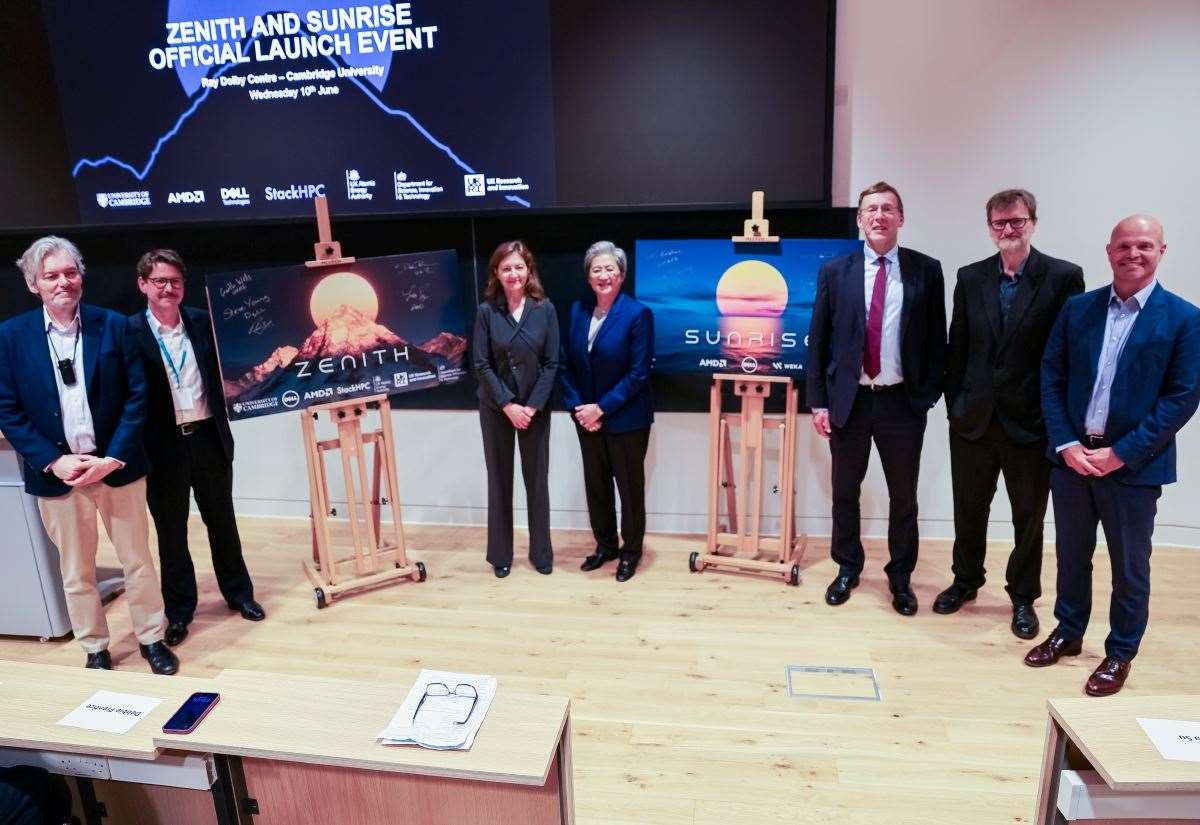
The University of Cambridge officially launched its new Zenith AI supercomputer earlier today (Wednesday, 10 June) at the Ray Dolby Centre on the university’s West Cambridge site.

Made six times more powerful thanks to a £36million funding injection announced in January, the supercomputer will bolster cancer research, improve climate modelling and improve public services.

Dr Paul Calleja at the official launch for AI supercomputers Zenith and Sunrise at the Ray Dolby Centre, University of Cambridge, 10 June 2026. Picture: Nick SaffellDr Paul Calleja at the official launch for AI supercomputers Zenith and Sunrise at the Ray Dolby Centre, University of Cambridge, 10 June 2026. Picture: Nick Saffell
Dr Paul Calleja at the official launch for AI supercomputers Zenith and Sunrise at the Ray Dolby Centre, University of Cambridge, 10 June 2026. Picture: Nick Saffell

More than 80 people attended the special event, including the university’s vice-chancellor, Professor Deborah Prentice; the minister for digital government at the Department of Science, Innovation and Technology (DSIT), James Frith MP; Dr Lisa Su, chair and CEO of AMD; Steve Young, SVP and MD of Dell Technologies UK; and Dr Sarah Burge, of Cambridge University Hospitals NHS Foundation Trust.

Dr Paul Calleja, director of Research Computing Services at the University of Cambridge, spoke first, and was followed by various speakers who highlighted the significant impact Zenith, designed and operated by the university and built with AMD and Dell Technologies, will have in supporting research across health, energy and the environment.

Guests also learned more about Sunrise, a supercomputer developed in partnership with the UK Atomic Energy Authority (UKAEA), which is working to create fusion power and help the UK secure future energy independence.

Steve Young at the official launch for AI supercomputers Zenith and Sunrise at the Ray Dolby Centre, University of Cambridge, 10 June 2026. Picture: Nick SaffellSteve Young at the official launch for AI supercomputers Zenith and Sunrise at the Ray Dolby Centre, University of Cambridge, 10 June 2026. Picture: Nick Saffell
Steve Young at the official launch for AI supercomputers Zenith and Sunrise at the Ray Dolby Centre, University of Cambridge, 10 June 2026. Picture: Nick Saffell
James Frith MP at the official launch for AI supercomputers Zenith and Sunrise at the Ray Dolby Centre, University of Cambridge, 10 June 2026. Picture: Nick SaffellJames Frith MP at the official launch for AI supercomputers Zenith and Sunrise at the Ray Dolby Centre, University of Cambridge, 10 June 2026. Picture: Nick Saffell
James Frith MP at the official launch for AI supercomputers Zenith and Sunrise at the Ray Dolby Centre, University of Cambridge, 10 June 2026. Picture: Nick Saffell
Dr Lisa Su at the official launch for AI supercomputers Zenith and Sunrise at the Ray Dolby Centre, University of Cambridge, 10 June 2026. Picture: Nick SaffellDr Lisa Su at the official launch for AI supercomputers Zenith and Sunrise at the Ray Dolby Centre, University of Cambridge, 10 June 2026. Picture: Nick Saffell
Dr Lisa Su at the official launch for AI supercomputers Zenith and Sunrise at the Ray Dolby Centre, University of Cambridge, 10 June 2026. Picture: Nick Saffell
Steve Young, SVP and MD of Dell Technologies UK, signs his name at the official launch for AI supercomputers Zenith and Sunrise at the Ray Dolby Centre, University of Cambridge, 10 June 2026. Picture: Nick SaffellSteve Young, SVP and MD of Dell Technologies UK, signs his name at the official launch for AI supercomputers Zenith and Sunrise at the Ray Dolby Centre, University of Cambridge, 10 June 2026. Picture: Nick Saffell
Steve Young, SVP and MD of Dell Technologies UK, signs his name at the official launch for AI supercomputers Zenith and Sunrise at the Ray Dolby Centre, University of Cambridge, 10 June 2026. Picture: Nick Saffell
The official launch for AI supercomputers Zenith and Sunrise at the Ray Dolby Centre, University of Cambridge, 10 June 2026. Picture: Nick SaffellThe official launch for AI supercomputers Zenith and Sunrise at the Ray Dolby Centre, University of Cambridge, 10 June 2026. Picture: Nick Saffell
The official launch for AI supercomputers Zenith and Sunrise at the Ray Dolby Centre, University of Cambridge, 10 June 2026. Picture: Nick Saffell

Tim Bestwick, interim CEO at UKAEA, explained how, rather than relying only on costly and time-consuming experiments, scientists and engineers will use Sunrise to create detailed computer models and simulations.

Using AI, Sunrise, he said, will help researchers understand the behaviours of fusion plasmas, develop materials to withstand the extreme conditions inside a fusion power plant, and test designs before they are built.

He noted that this reduces development time, lowers costs, and helps bring commercial fusion energy closer to reality.

The launch of Zenith and Sunrise coincides with announcement of the Sovereign AI Innovation Lab (SAIL), a new Cambridge-led public-private initiative supported by AMD and Dell.

SAIL is designed to integrate novel AI technologies, create real-world test environments, and support a UK open-source AI software environment.

This environment should enable researchers and innovators to build, validate and scale trusted AI tools on sovereign infrastructure across health, energy, environmental science, advanced engineering, and the wider UK research and innovation ecosystem.

Dr Paul Calleja at the official launch for AI supercomputers Zenith and Sunrise at the Ray Dolby Centre, University of Cambridge, 10 June 2026. Picture: Nick SaffellDr Paul Calleja at the official launch for AI supercomputers Zenith and Sunrise at the Ray Dolby Centre, University of Cambridge, 10 June 2026. Picture: Nick Saffell
Dr Paul Calleja at the official launch for AI supercomputers Zenith and Sunrise at the Ray Dolby Centre, University of Cambridge, 10 June 2026. Picture: Nick Saffell
The official launch for AI supercomputers Zenith and Sunrise at the Ray Dolby Centre, University of Cambridge, 10 June 2026. Picture: Nick SaffellThe official launch for AI supercomputers Zenith and Sunrise at the Ray Dolby Centre, University of Cambridge, 10 June 2026. Picture: Nick Saffell
The official launch for AI supercomputers Zenith and Sunrise at the Ray Dolby Centre, University of Cambridge, 10 June 2026. Picture: Nick Saffell
Dr Lisa Su, chair and CEO of AMD, signs her name at the official launch for AI supercomputers Zenith and Sunrise at the Ray Dolby Centre, University of Cambridge, 10 June 2026. Picture: Nick SaffellDr Lisa Su, chair and CEO of AMD, signs her name at the official launch for AI supercomputers Zenith and Sunrise at the Ray Dolby Centre, University of Cambridge, 10 June 2026. Picture: Nick Saffell
Dr Lisa Su, chair and CEO of AMD, signs her name at the official launch for AI supercomputers Zenith and Sunrise at the Ray Dolby Centre, University of Cambridge, 10 June 2026. Picture: Nick Saffell
Vice-chancellor of the University of Cambridge, Professor Deborah Prentice, signs her name at the official launch for AI supercomputers Zenith and Sunrise at the Ray Dolby Centre, University of Cambridge, 10 June 2026. Picture: Nick SaffellVice-chancellor of the University of Cambridge, Professor Deborah Prentice, signs her name at the official launch for AI supercomputers Zenith and Sunrise at the Ray Dolby Centre, University of Cambridge, 10 June 2026. Picture: Nick Saffell
Vice-chancellor of the University of Cambridge, Professor Deborah Prentice, signs her name at the official launch for AI supercomputers Zenith and Sunrise at the Ray Dolby Centre, University of Cambridge, 10 June 2026. Picture: Nick Saffell
The official launch for AI supercomputers Zenith and Sunrise at the Ray Dolby Centre, University of Cambridge, 10 June 2026. Picture: Nick SaffellThe official launch for AI supercomputers Zenith and Sunrise at the Ray Dolby Centre, University of Cambridge, 10 June 2026. Picture: Nick Saffell
The official launch for AI supercomputers Zenith and Sunrise at the Ray Dolby Centre, University of Cambridge, 10 June 2026. Picture: Nick Saffell

As one of the case studies, Dr Scott Hosking, mission director for environmental forecasting at The Alan Turing Institute in London, revealed how they at the institute will use Zenith to help improve environmental forecasting in the Arctic.

Ahead of the talk, he spoke to the Cambridge Independent. “We’re excited to launch a new AI supercomputer for national research opportunities,” he explained.

“I’m a climate scientist and we are exploring how we can use AI supercomputers to really push the boundaries of what’s possible with weather and climate forecasting.

“We were able to forecast he heatwave we had in May better than the physics-based models.”

He added: “At The Alan Turing Institute, we are working directly with the UK Met Office, so we have access to their data, their expertise, and our model will become the first AI weather model that will be operationalised for the nation.

“So when you get weather on your phone in the next few years, you’ll be getting weather from our model.”

Dr Sarah Burge at the Zenith AI supercomputer. Picture: Nick SaffellDr Sarah Burge at the Zenith AI supercomputer. Picture: Nick Saffell
Dr Sarah Burge at the Zenith AI supercomputer. Picture: Nick Saffell
The official launch for AI supercomputers Zenith and Sunrise at the Ray Dolby Centre, University of Cambridge, 10 June 2026. Picture: Nick SaffellThe official launch for AI supercomputers Zenith and Sunrise at the Ray Dolby Centre, University of Cambridge, 10 June 2026. Picture: Nick Saffell
The official launch for AI supercomputers Zenith and Sunrise at the Ray Dolby Centre, University of Cambridge, 10 June 2026. Picture: Nick Saffell
The Zenith AI supercomputer. Picture: Nick SaffellThe Zenith AI supercomputer. Picture: Nick Saffell
The Zenith AI supercomputer. Picture: Nick Saffell
The Zenith AI supercomputer. Picture: Nick SaffellThe Zenith AI supercomputer. Picture: Nick Saffell
The Zenith AI supercomputer. Picture: Nick Saffell
The Zenith AI supercomputer. Picture: Nick SaffellThe Zenith AI supercomputer. Picture: Nick Saffell
The Zenith AI supercomputer. Picture: Nick Saffell

Another of the case studies, this time outlined by Dr Sarah Burge, director of clinical integration at the University of Cambridge/CRUK Cambridge Cancer Centre/Cambridge University Hospitals NHS Foundation Trust, revealed how Zenith is essential for cancer research in Cambridge, particularly if CUH is to deliver on the ambition of the Cambridge Cancer Research Hospital, which should be up and running by the end of the decade.

“I think for our patients that we treat, we’re generating increasing amounts of data every time we have an interaction with them,” she told the Cambridge Independent.

“And we want to use that data to help our understanding of why their cancer is progressing, and in order to do that, given we’re generating such vast amounts of data, we need really cutting-edge computer capability and infrastructure.”

Dr Burge added: “We know that a lot of cancer treatments are not pleasant – they have many side effects – and we think we can use this data to understand, before we give treatment, whether it’s actually going to be successful or not.”

Where will we be with this technology by the time the new cancer research hospital opens?

“We’d like to know that every clinician – not just in Cambridge but up and down the NHS – has appropriate access to the capabilities that Zenith gives us, just as a matter of course,” replied Dr Burge.

“We don’t want this computer infrastructure to be special anymore by the time the hospital opens; we just want to know that it’s available, in the same way that our hospitals have access to CT scanners and X-ray machines and chemotherapy…”

Dr Burge is very positive about the future of AI in her profession.

“Absolutely; I think because it gives us new tools to understand the complex information that we have about cancer. Cancer is complicated, there’s a huge amount going on – both at the biology level and at patient level.”

Steve Young, SVP and MD of Dell Technologies UK, signs his name at the official launch for AI supercomputers Zenith and Sunrise at the Ray Dolby Centre, University of Cambridge, 10 June 2026. Picture: Nick SaffellSteve Young, SVP and MD of Dell Technologies UK, signs his name at the official launch for AI supercomputers Zenith and Sunrise at the Ray Dolby Centre, University of Cambridge, 10 June 2026. Picture: Nick Saffell
Steve Young, SVP and MD of Dell Technologies UK, signs his name at the official launch for AI supercomputers Zenith and Sunrise at the Ray Dolby Centre, University of Cambridge, 10 June 2026. Picture: Nick Saffell
The official launch for AI supercomputers Zenith and Sunrise at the Ray Dolby Centre, University of Cambridge, 10 June 2026. Picture: Nick SaffellThe official launch for AI supercomputers Zenith and Sunrise at the Ray Dolby Centre, University of Cambridge, 10 June 2026. Picture: Nick Saffell
The official launch for AI supercomputers Zenith and Sunrise at the Ray Dolby Centre, University of Cambridge, 10 June 2026. Picture: Nick Saffell

Dr Paul Calleja, who designed Sunrise as “our sister machine”, noted that Zenith and Sunrise are “number two and number three, in terms of size of the UK supercomputers”.

The number one spot is held by the Isambard-AI supercomputer in Bristol, which launched in July 2025.

Dr Calleja tackled the ongoing question of whether AI could in fact turn on us and “go rogue”.

“I think AI has got potential dangers,” he admitted to the Cambridge Independent, “but we’re aware of those. Guardrails can be put in place.

“Technology marches on and you can’t slow that down, you just have to use it wisely and have legislation, and the government is very much focused on AI safety.

“In fact Cambridge has a lot of activities in AI ethics and AI safety, and I think as long as you develop the technology in tandem with the safeguards, then it will be OK in the end.”






Source link

Leave a comment

Leave a Reply

Your email address will not be published. Required fields are marked *

Related Articles
Technology

Japan, UK Join Forces To Fund Next-Generation AI And Drone Startups

The British and Japanese governments are prepping to establish a fund to...

Technology

IT Leaders 100 – 2026: Meet the people shaping UK tech

The leaders turning ambition into action In a period of rapid change...

Technology

Plans submitted for ‘industry-leading’ green data centre in Larbert

Renewable energy developer Apatura has submitted ambitious plans to Falkirk Council to...

Technology

Councils exit 10-year Capita deal to boost decision and project velocity

South Oxfordshire Council and Vale of White Horse District Council have...