


The UK has published a new roadmap to develop quantum technologies for satellites, focusing on more secure communications, navigation systems that are less dependent on GPS, and sensors capable of making more precise measurements from space.
Published on 27 October, the Quantum Technology Roadmap for Space identifies the technologies the UK should prioritise over the next 10 to 15 years, with the aim of turning research and laboratory prototypes into equipment that can operate aboard satellites.
The roadmap was developed for the UK Space Agency and the Department for Science, Innovation and Technology (DSIT) by Space Professionals Partnership Ltd and Quantum Technologies Associates Ltd.
Sir Peter Knight, chair of the National Quantum Technology Programme Strategic Advisory Board, said in the roadmap’s foreword that the priority was to move research into practical systems.
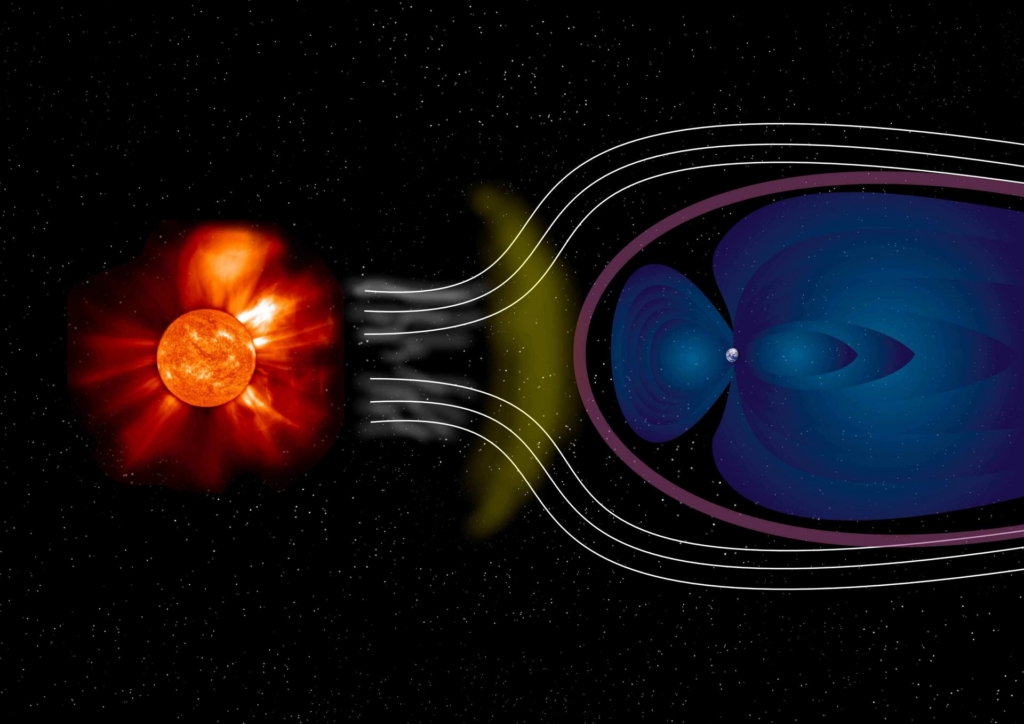
“The vision proposed by this roadmap will have transformed the UK’s space capabilities by 2035. Migration is urgent, with the National Cyber Security Centre advising cryptographic migration to be complete by 2035, by which time there is a material risk of ‘Q-Day’ the point at which a cryptographically relevant quantum computer can credibly undermine widely used public-key cryptography. Our critical infrastructure will be protected by a sovereign timing capability in orbit, removing the single point of failure of current GNSS systems and ensuring resilience,” he noted.
It sets out four areas for investment such as accurate timing, navigation and sensing, secure communications, and quantum computing. It also calls for more testing facilities, stronger supply chains and demonstrations in orbit to establish whether the technologies can work reliably in space.
The document is a guide to future investment and technology development, rather than an announcement of new satellite contracts or a funded launch programme. Its longer-term objectives extend to 2040.
The UK already has an established quantum research sector, with more than 300 organisations involved in the field. However, the roadmap warns that the country risks falling behind other space nations unless it can demonstrate more of its technology in orbit.
China, the United States and European programmes are already investing in quantum applications for space. The roadmap puts worldwide public commitments to quantum technology at more than £43 billion.
For the UK, the immediate task is to turn its scientific expertise into equipment that satellite manufacturers and operators can use.
“UK-built quantum sensors will be flying on operational missions, allowing satellites to navigate autonomously without external signals and monitoring our changing planet with unprecedented precision.
“Crucially, the UK will not just be a user of these technologies, but a global supplier, with a robust industrial base exporting certified, space-qualified quantum subsystems to the world,” Sir Peter opined.
Making satellite navigation less dependent on GPS
One of the roadmap’s main priorities is developing highly accurate clocks that could provide the UK with its own source of precise timing from space.
Satellite navigation systems depend on extremely accurate clocks. Even small timing errors can affect positioning and navigation, while many communications networks and other essential services also rely on satellite-derived time.
The roadmap proposes developing optical clocks, which use the frequencies of light to measure time with very high precision, together with systems that can transfer accurate timing signals between satellites and ground stations.
The aim is to reduce reliance on overseas Global Navigation Satellite Systems (GNSS), which include the US-operated GPS network.
The report identifies trapped-ion optical clocks, room-temperature optical clocks, chip-scale optical clocks and quantum time transfer as priority technologies.
It recommends investment in smaller, more robust clock systems, followed by testing and demonstrations in orbit.
By the mid-2030s, the roadmap envisages space-qualified optical clocks and improved time-transfer systems providing more stable timing services and reducing vulnerabilities associated with dependence on GNSS.
This would be particularly valuable when satellite navigation signals are disrupted, jammed or unavailable.
Quantum sensors for satellites and spacecraft
The second priority is developing sensors that can measure motion, gravity and magnetic fields more precisely than conventional equipment.
Such sensors could help spacecraft navigate without constantly relying on external positioning signals. They could also improve Earth observation, space weather monitoring and scientific missions.
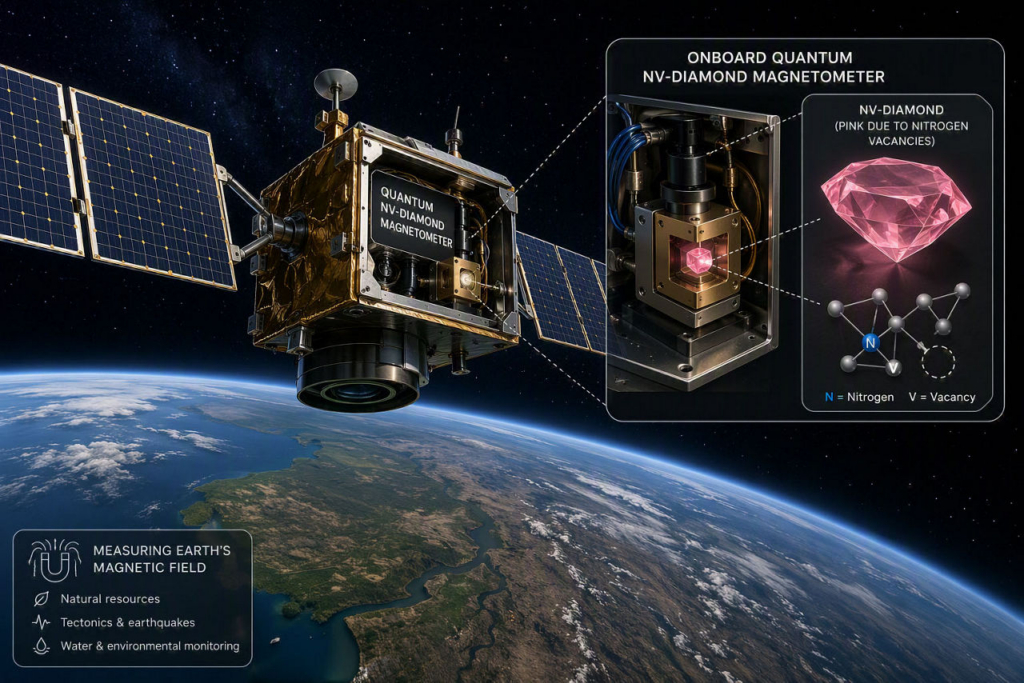
The roadmap identifies cold-atom accelerometers, quantum gravimeters, magnetometers and radio-frequency sensors among the technologies worth developing.
Cold-atom sensors use atoms cooled to extremely low temperatures to measure movement or gravitational forces. They could help reduce the gradual errors that accumulate in conventional navigation instruments.
Quantum magnetometers could provide more precise measurements of magnetic fields, while gravity sensors could support scientific observation and the study of Earth and other planetary bodies.
The UK Space Agency and DSIT are being advised to support smaller, lower-power designs suitable for satellites, spacecraft servicing vehicles and deep-space probes.
The roadmap also recommends early demonstrations in orbit to establish how these instruments perform outside the laboratory.
Protecting satellite communications from future cyber threats
Secure communications are another immediate priority.
The roadmap warns that advances in quantum computing could eventually make some of today’s widely used encryption methods vulnerable.
This matters for satellites since spacecraft and their ground systems may remain in service for many years. Information intercepted today could potentially be decrypted in the future when more powerful quantum computers become available.

The report recommends that the UK adopt post-quantum cryptography, which uses encryption methods designed to withstand attacks by future quantum computers.
It also supports demonstrations of quantum key distribution, a technology that uses properties of light to help distribute encryption keys securely.
The National Cyber Security Centre has advised organisations to complete their migration to quantum-resistant cryptography by 2035.
The roadmap recommends introducing the new security methods across both satellites and ground stations, alongside demonstrations of quantum key distribution in orbit.
Over time, these developments could support more secure satellite networks for government, defence and commercial users.
Quantum computing remains a longer-term prospect
The roadmap takes a more cautious approach to quantum computing itself.
It identifies possible applications in satellite constellation management, spacecraft trajectory planning, space weather prediction and processing Earth observation data.
However, it says quantum computing is not yet sufficiently mature to justify relying on it for space missions.
Instead, the UK is advised to concentrate on developing algorithms, testing possible applications using ground-based computers and working with existing national quantum programmes.
Putting quantum computers aboard spacecraft remains a longer-term research possibility, with significant engineering challenges still to overcome.
The roadmap specifically advises against committing prematurely to space-based quantum computing systems before their practical benefits have been established.
UK faces challenge of turning research into space hardware
A recurring concern in the report is the gap between developing quantum technology in a laboratory and producing equipment that can survive launch and years of operation in orbit.
The UK has strengths in quantum research, photonics, sensing and satellite engineering, but the roadmap says it has not established enough experience demonstrating its own quantum payloads in space.
It identifies several areas where further work is needed, including lasers, optical components, vacuum systems, radiation-tolerant electronics and equipment testing.
The report recommends expanding facilities where quantum equipment can be tested against the conditions it would encounter in space, while developing the standards and supply chains needed for commercial production.
It also identifies opportunities for UK companies to supply specialist components and systems to overseas satellite manufacturers.
The roadmap forms part of the UK’s wider quantum technology ambitions. It refers to the government’s commitment to £2 billion of quantum investment by 2030, although this is a wider national commitment rather than funding newly allocated to the space roadmap.
“What matters now is translation – building on the UK’s scientific excellence into operational systems, on the ground and in space,” Sir Peter wrote.
The roadmap divides development into three periods. The first five years would concentrate on engineering, testing and preparing equipment for space. The following five years would include selected demonstrations in orbit and early services, while the final five years would focus on wider deployment where the technologies have proved reliable.
















Leave a comment