
ASTANA — International agreements are often measured by the ceremony surrounding their signing. Their real value, however, is measured years later: by investments made, businesses launched and partnerships that would not have happened otherwise. The entry into force this July of the Strategic Partnership and Cooperation Agreement (SPCA) between the United Kingdom (UK) and Kazakhstan raises precisely that question. Beyond its diplomatic significance, could it become the framework that reshapes how the two countries work together?
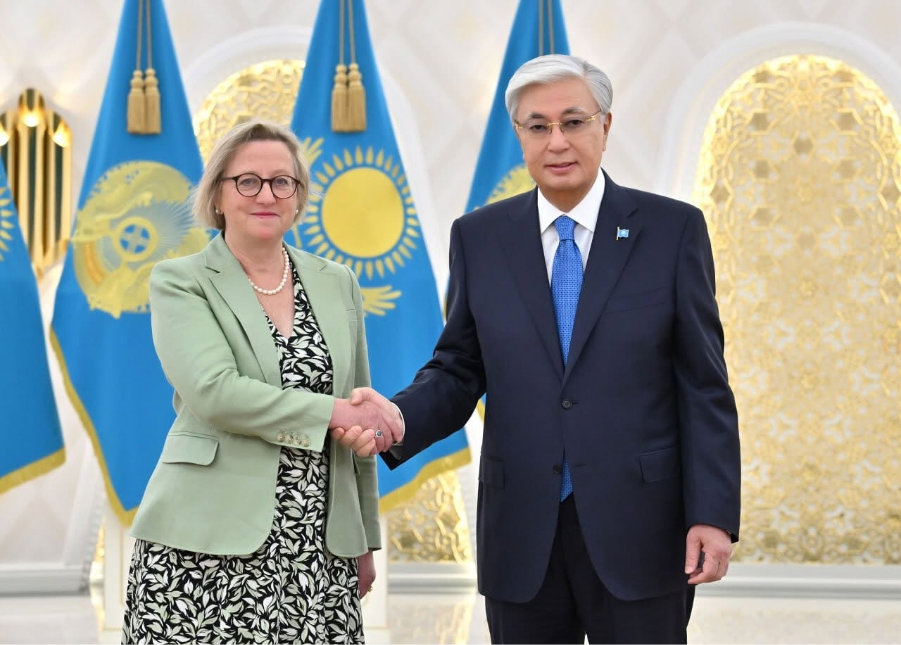
British Ambassador to Kazakhstan Sally Axworthy with President Kassym-Jomart Tokayev. Photo credit: Akorda
British Ambassador to Kazakhstan Sally Axworthy said exactly that: the agreement is more than a diplomatic milestone. Rather, “it is a signal of intent.”
“The UK is open for business. The SPCA gives our companies, universities and innovators a stronger platform to work together, invest and deliver practical results. From critical minerals and energy to education, technology and sustainable growth, this agreement sets the course for the next chapter of UK-Kazakhstan cooperation,” she said.
Her remarks reflect a broader shift in the bilateral relationship. Rather than focusing on a handful of traditional sectors, the agreement creates a framework for cooperation across industries that are becoming increasingly important in today’s economy.
From resources to value creation
The timing is notable. Global competition for critical minerals is intensifying. Countries are looking to build more resilient supply chains, diversify economic partnerships and secure access to strategic resources. Kazakhstan, with its mineral wealth and growing role in Eurasian connectivity, finds itself increasingly at the center of those conversations. In this context, the SPCA appears less like the beginning of a relationship than its natural evolution.
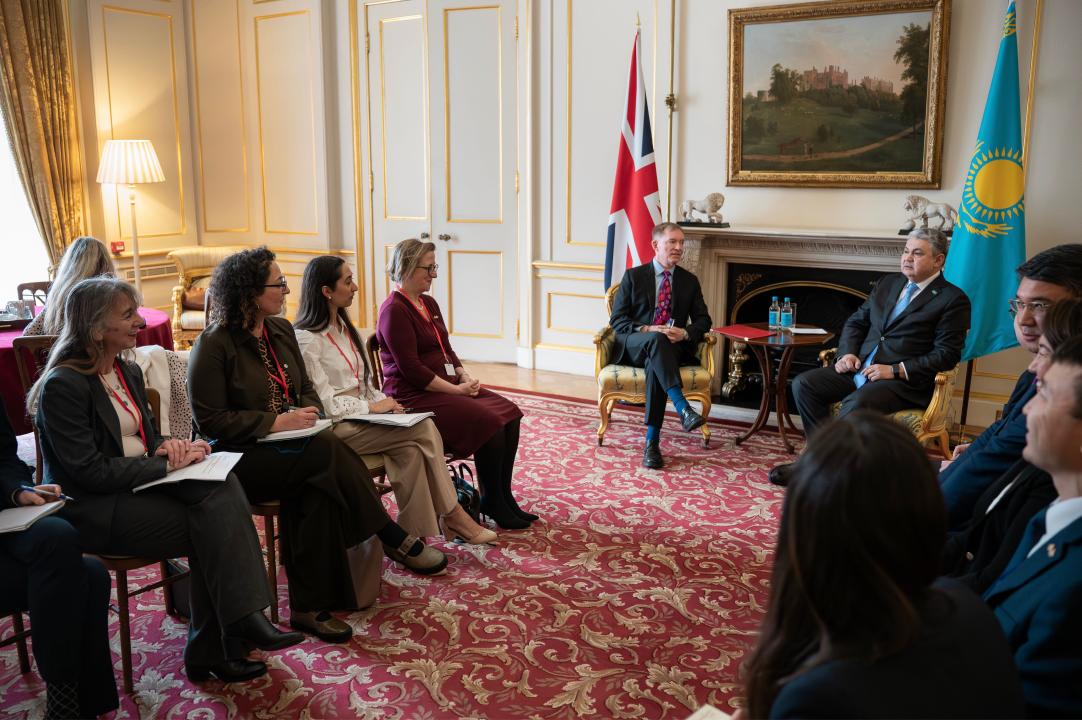
Yermek Kosherbayev held a series of high-level talks in London on Feb. 26 with UK officials. Photo credit: Kazakh Foreign Ministry.
The UK and Kazakhstan have been strategic partners since 2013. Over the years, cooperation has expanded across energy, financial services, aviation, education and environmental protection. British expertise contributed to establishing the Astana International Financial Centre and its English law-based court, while educational partnerships have steadily expanded. Yet the global economy has changed considerably over the past decade, and so have the priorities of bilateral cooperation.
That shift was already becoming visible in 2023. At the time, British Trade Commissioner Kenan Poleo described the growing bilateral agenda as “a wave of activities”: extending beyond a single visit to include critical minerals, agriculture and education. Three years later, the SPCA gives that trajectory a formal institutional framework.
For years, Kazakhstan attracted international interest largely because of its natural resources. Today, the conversation is increasingly shifting toward what happens after those resources are extracted. How can they be processed? Where can additional value be created? Which technologies and expertise are needed to move further up the industrial value chain? The SPCA provides a framework for exactly those conversations.
The first projects emerging under this new framework already offer a glimpse of where the partnership is heading. One of the clearest examples — the recently announced five-year, $107 million agreement between the UK’s Maritime House and Kazakhstan’s Zhezkazganredmet illustrates that shift. The project will expand cooperation in rhenium recycling and is expected to support an additional $30 million investment in Saran to produce metallic rhenium from secondary raw materials.
At first glance, it is simply another investment announcement. In reality, it reflects a broader trend. Rhenium is used in high-performance aerospace manufacturing and other advanced industries, making it a strategically important material. Rather than focusing solely on exporting raw materials, projects like this point toward industrial cooperation built around technology and higher-value production. In other words, the conversation is gradually shifting from extracting resources to creating more value from them.
That direction is hardly new. In an interview with The Astana Times last December, British Ambassador Sally Axworthy said the UK sees Kazakhstan’s ambitions extending beyond resource extraction.
“We understand that Kazakhstan wants not just to be a producer of raw materials, but also to process,” she said, referring to cooperation in critical minerals as an area where both countries could build long-term partnerships.
The agreement entering into force now provides a stronger institutional foundation for those ambitions. Critical minerals, however, are only one part of the story. Trade and connectivity are beginning to tell a similar one. Just days before the agreement entered into force, Kazakhstan launched its first multimodal shipment of mineral fertilizers from Ekibastuz to the UK via the Middle Corridor.
The new route, linking Kazakhstan with the UK through the Caspian Sea, Azerbaijan and Georgia before reaching the Port of Felixstowe, expands export opportunities for Kazakh producers while diversifying supply chains between the two countries. The shipment is significant not only because it opens another export route. It also demonstrates how the Trans-Caspian International Transport Route is becoming part of a broader economic relationship between Kazakhstan and its Western partners.
Taken separately, a shipment of fertilizers and a rhenium recycling project may seem unrelated. Together, they tell a different story. One reflects the movement of goods, the other the movement up the value chain. Both suggest that UK-Kazakhstan cooperation is becoming broader, more practical and increasingly tied to resilient supply chains.
Investing in people, not just projects
Education tells a similar story. While critical minerals and transport reflect the economic dimension of the partnership, education represents its long-term investment in human capital. The two are more closely connected than they may initially appear.
Education has long been one of the strongest pillars of UK-Kazakhstan relations. For more than three decades, the Bolashak Scholarship has helped shape a generation of Kazakh professionals, with the UK emerging as one of its principal destinations. More than half of all Bolashak scholars have studied at British universities over the lifetime of the program, while nearly 6,000 alumni have received their education in the UK. Today, many of those graduates work across government, business, academia and the private sector, creating long-standing professional and people-to-people ties between the two countries.
Yet the relationship is evolving once again. Instead of only sending students to Britain, British universities are increasingly coming to Kazakhstan. The UK has become one of Kazakhstan’s leading partners in higher education. Since De Montfort University opened the country’s first British university campus in 2021, the UK’s academic presence has expanded steadily. Coventry University and Cardiff University have since established campuses, with Cardiff becoming the first Russell Group university to open a branch in Central Asia. Further British institutions are expected to open this September.
The expansion reflects a broader agenda pursued by both governments. Education featured prominently during high-level bilateral talks held by Kazakh Foreign Minister Yermek Kosherbayev in London earlier this year, alongside critical minerals, trade, logistics and digital transformation, underscoring its role as a strategic pillar of the partnership.
Ambassador Axworthy believes education and industrial cooperation are closely linked.
“Education and standards play a critical supporting role,” she said, noting that Cardiff University’s Astana campus offers programs in geological exploration while the UK is also working with Kazakhstan through the Extractive Industries Transparency Initiative.
“These are the things that give businesses confidence to come and invest,” she added in her December interview with The Astana Times.
Sally Axworthy with AT correspondent Aida Haidar. Photo credit: The Astana Times
Viewed separately, critical minerals, new transport routes and university campuses may appear to belong to different stories. Taken together, however, they point in the same direction. Kazakhstan is seeking not only investment, but also knowledge, technology and skills that allow the country to move further up the value chain. In that sense, education becomes part of the same long-term economic strategy as industrial cooperation.
As British Ambassador Axworthy described the SPCA as “more than a diplomatic milestone” and “a signal of intent.” That may ultimately prove to be the agreement’s greatest significance. A single agreement rarely transforms strategic partnerships. They evolve through investment decisions, research collaboration, educational exchanges and new trade routes. In many ways, the SPCA recognizes a partnership that had already begun moving in this direction. What happens next will determine whether it becomes simply another bilateral agreement or the foundation for a more mature economic partnership between the United Kingdom and Kazakhstan.












Leave a comment