
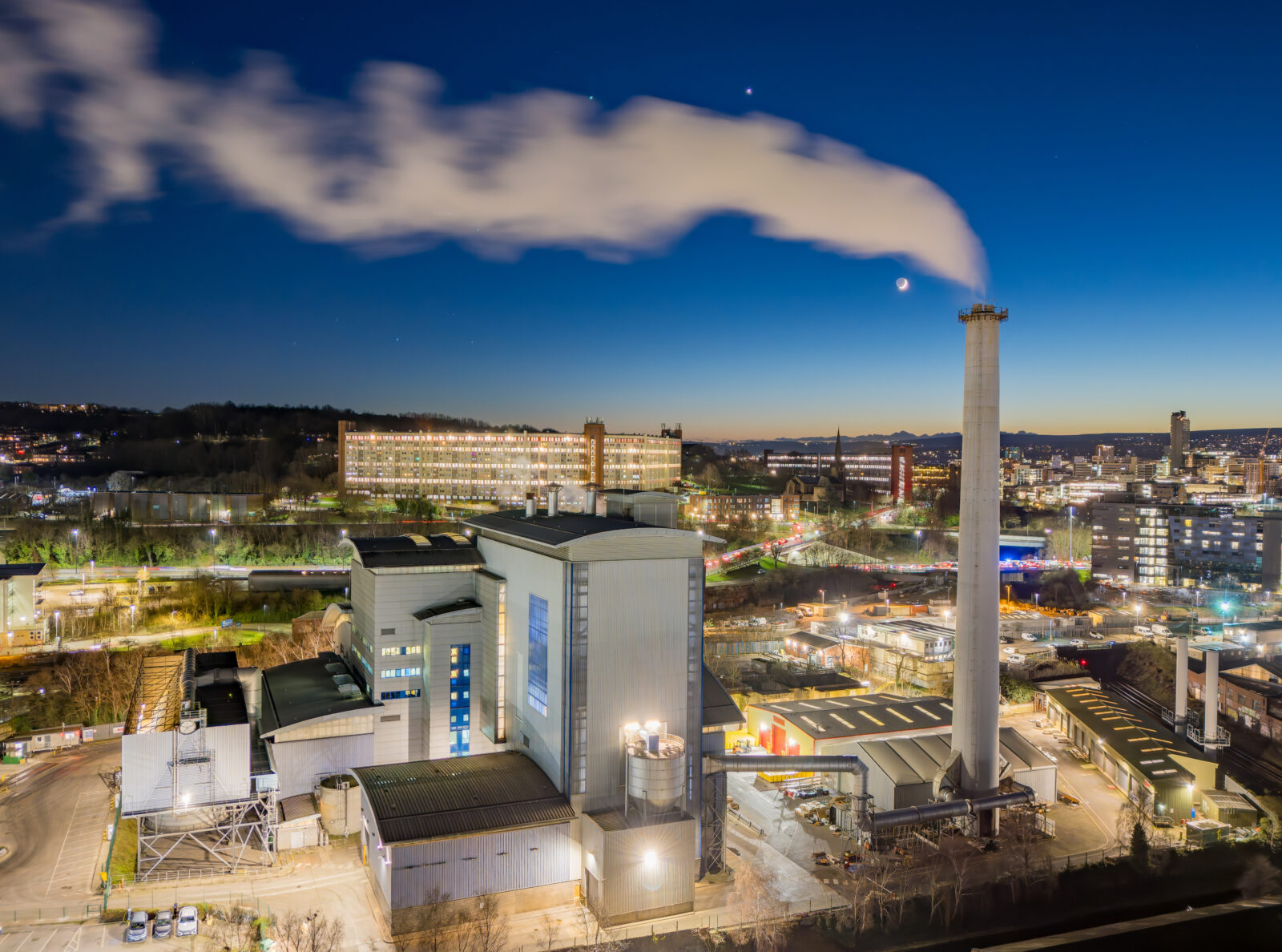

Image credit: Adobe Stock
Working with Sheffield City Council, Veolia has this week (3 August) announced that it has validated the potential of a next-generation, non-amine carbon capture solution at the Sheffield Energy Recovery Facility (ERF).
The site burns municipal waste, generating CO2 in the process, to generate electricity and supply heat to Sheffield’s District Energy Network.
The ongoing two-year pilot project is being delivered in partnership with cleantech company C-Capture, using a non-amine solvent that was originally discovered by scientists at the University of Leeds. To begin with, the CO2 will be released into the atmosphere so that engineers can verify the performance, safety and efficiency of the technology.
Greg Searle, commercial director at C‑Capture, commented: “Successfully operating our technology at the Sheffield site is a major milestone. It demonstrates not only the scalability of our non‑amine approach, but also its real‑world advantages in energy efficiency, cost and safety – particularly for challenging applications like energy-from-waste facilities.”
Related article: CCS Financing Challenges: Bridging the Investment Gap
Most industrial-scale carbon capture systems rely on amine solvents, which selectively react and combine with CO2 emissions in flue gas as it passes through.
This amine solution is then heated to high temperatures to break the chemical bonds so that the CO2 can be released for use or storage, enabling the solvent to then be cooled and returned for reuse. This process is highly energy intensive.
C-Capture’s solution, by contrast, uses a non-hazardous, biodegradable solvent, consuming much less energy and requiring less money to operate than traditional systems.
Councillor Mark Rusling, chair of the Environmental Services and Regulation Policy Committee at Sheffield City Council, added: “This carbon capture trial in Sheffield represents a big step forward in the development of decarbonisation opportunities in our city.
“This is the largest project of its kind in South Yorkshire, and we are proud to support innovation and new technology. Every project like this makes a difference to reducing our carbon emissions, and this important work supports our aim to reduce our carbon emissions to net-zero.
“Net-zero will help us move to cheaper renewable energy and protect households from global fossil-fuel price shocks, which should permanently lower household bills in the future.”
The potential of carbon capture
‘Netting’ residual emissions via carbon capture is a key part of the nation’s long-term climate strategy, as well as broader global net-zero goals.
Climate scientists have repeatedly stated that man-made carbon capture is essential to limiting the global temperature increase in line with the Paris Agreement. As such, the World Resources Institute (WRI) has estimated that man-made carbon capture capacity should be expanded more than ten times faster over the coming years, equivalent to building nine of the largest direct air capture facilities currently under construction each month.
The UK Government is aiming for at least 20 million tonnes of CO2e to be captured and stored annually by 2030, predominantly through large carbon capture (CCUS) projects at industrial clusters.
Under Keir Starmer, the Labour Government previously pledged up to £21.7bn of funding over a 25-year period for carbon capture, utilisation and storage (CCUS) and low-carbon hydrogen production.
If scaled, the solution deployed by Veolia could offer companies in hard-to-abate sectors a more viable and affordable way to prevent further emissions from entering the atmosphere, without large and disruptive changes needing to be made to their infrastructure.
The idea is that such solutions would be introduced alongside other sustainable interventions across the waste management sector, including through cutting waste, increasing recycling and designing out fossil carbon from products from the outset.
Donald Macphail, chief operating officer, treatment, at Veolia UK, commented: “Carbon capture is one of the tools available to help decarbonise residual emissions where they cannot yet be avoided.
“However, achieving net-zero also requires continued progress in waste prevention, recycling and circular economy solutions to reduce emissions at source. Technologies such as this are designed to complement – not replace – those priorities.”














Leave a comment