
Last time, I mentioned that machine learning is a method where humans don’t write the rules, but instead let the machine find them from data.
Today, we’ll cover the details. There are 18 terms, making this the section with the highest count in Chapter 1.
Hajime: “18 terms… That’s a sudden increase.”
Shiba-sensei: “But you know, there are only four main bones. There are just four ways to teach it.”
Hajime: “So if I learn those four, the rest just hang off them?”
Shiba-sensei: “Exactly. You’re a quick learner. I’d give you a treat, woof.”
Hajime: “No thanks.”
Today’s Goal
The learning objectives in the official syllabus are written as follows.
Understand the basic concepts of machine learning and the differences between each representative learning method.
Translated into Shiba Inu language, today’s goal is this:
Be able to categorize the four learning methods based on ‘whether you provide the correct answer, don’t provide it, or let it experiment.’
Once you settle this, the 18 terms will fall into place on their own.
1. What is Machine Learning: A state where training is finished is called a ‘trained model’
Hajime: “To begin with, what is ‘learning’ in machine learning?”
Shiba-sensei: “It’s a bit different from human study. Looking at data and extracting the regularity within it is what we call learning.”
Hajime: “So it’s not memorization?”
Shiba-sensei: “If it memorizes, it’s a failure, woof. …We’ll talk about that another time.”
Machine learning is a method of automatically finding regularities from a large amount of data. And when learning is finished, a product is created. A
trained model is something that has finished learning and is in a state where it can provide answers to new data. In Shiba Inu terms,
the dog itself in a trained state is the trained model. It refers not to the process of learning, but to the finished result
. Hajime
: “Which one do companies use?” Shiba-sensei
: “Most companies borrow and use trained models created by someone else. Chappy does that too.” Hajime
: “So you borrow it, not make it?” Shiba-sensei
: “Exactly. That’s why this exam is a qualification for the user side, not the creator side.”
2. Supervised Learning: Training with data that includes correct answers
Shiba-sensei “Now for the main topic. The first one is Supervised Learning.”
Hajime “Are you the one teaching it, Sensei?”
Shiba-sensei “Not a teacher, but the correct answer. It’s the same as training with treats.”
Shiba-sensei “If it sits on command, it gets a treat. If it gets it wrong, no treat. You do this hundreds of times.”
Hajime “So you’re providing the correct answer every time.”
Supervised learning is a method of learning by providing data paired with ‘correct answers’. The ‘set of problems and correct answers’ at this time is called
training data. Think of it as a state where a photo of a Shiba Inu has a label attached saying ‘This is a Shiba Inu’. There are two main things you can do with supervised learning.
-
Classification … Guessing ‘What is this?’. Answering by group, such as whether this puppy is a Shiba Inu or an Akita Inu.
-
Regression … Guessing ‘How much?’. Answering with a numerical value, such as how many kg this puppy will weigh.
Classification is further divided into two types based on the number of choices.
-
Binary classification … Choosing between two options (Is it a Shiba Inu, or is it not a Shiba Inu?)
-
Multi-class classification … Choosing from three or more options (Is it a Shiba Inu, an Akita Inu, or a Kai Ken?)
And a representative measure for gauging the quality of the results is accuracy. It refers to the ratio of how many were guessed correctly out of the total.
Hajime “If the accuracy is high, that means it’s excellent, right?”
Shiba-sensei “Oh, there’s a pitfall there. …Well, that’s a topic for a later chapter. For now, accuracy = ratio of correct guesses is fine.”
3. Three methods that don’t rely entirely on correct answers
Hajime “Can’t you learn without providing correct answers?”
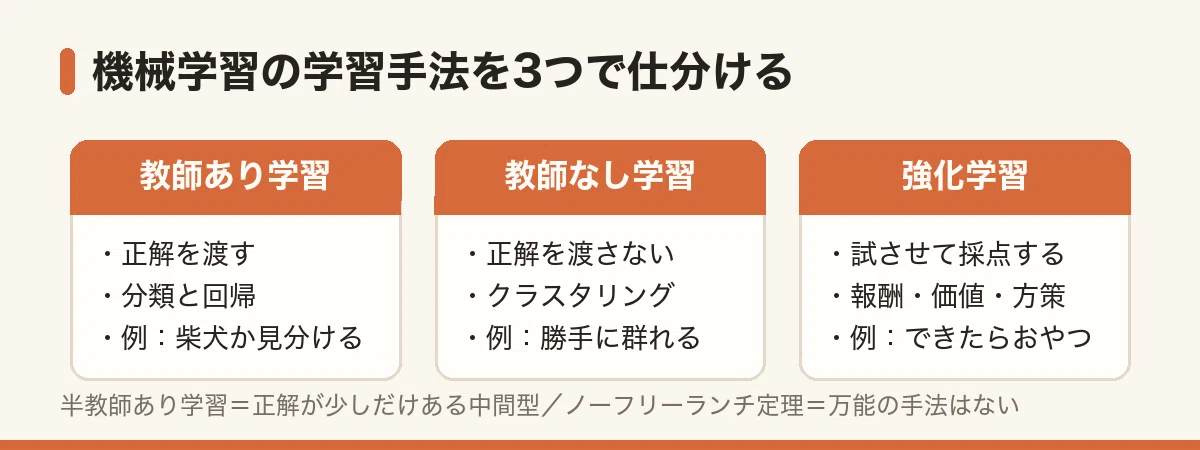
Shiba-sensei “Actually, you can, woof. There are three methods that don’t rely entirely on correct answers.” Unsupervised learning: Groups form on their own.
Unsupervised learning is a method where you don’t provide correct answers, but only pass the data, and let the computer itself find the structure and features within the data. There are two representative types.
-
Clustering … Automatically grouping similar things together
-
Dimensionality Reduction … Narrowing down a large amount of information to only the essential axes to make it easier to handle
Imagine a dog run.
When you let dogs loose, even without anyone giving instructions, they naturally cluster together with those they like to play with .
This is clustering .
Dimensionality reduction is more like organizing notes.
If you write down 20 items about a dog’s characteristics, it’s unreadable, so you narrow it down to two: ‘body size’ and ‘hair length’.
Reinforcement Learning: A treat only when you do it well
Reinforcement learning is a method where you don’t teach the correct answer, but instead give points for the results of actions, allowing the learner to acquire better behavior through trial and error.
Three terms. I’ll list them with a Shiba Inu.
-
Reward … The points you get as a result of that action. A treat when you do it well
-
Value … The prospect of treats you might get in the future. Think in terms of the total amount rather than the one right in front of you
-
Policy … The habit of choosing actions, like ‘I will move like this in this situation’
Hajime ‘What is the difference between reward and value?’
Shiba-sensei ‘The treat you get right now is the reward. The prospect that if you go down this path you might get five at the end is the value.’
Hajime ‘So it’s about whether you can resist the one right in front of you?’
Shiba-sensei ‘Exactly. I couldn’t resist and failed three times.’
Hajime ‘Well, you are a dog.’
Semi-supervised learning: Labeling only the first few
Semi-supervised learning is a method of learning using both a small amount of labeled data and a large amount of unlabeled data. The task of labeling is done by humans, so it is expensive. That is why you teach it ‘this is a Shiba Inu’ for only the first few, and let it sort the rest itself.
No Free Lunch Theorem: There is no universal training method
Shiba-sensei “So Hajime, which of the four do you think is the most excellent?”
Hajime “…Judging by how you asked, that’s not the point, is it?”
The No Free Lunch Theorem is the idea that there is no single method that is universally superior for every problem.
If the problem changes, the suitable method also changes.
The name is long, but it only says one thing.
There is no universal training method that works for every dog. Some dogs respond to treats, while others respond to balls.
Hajime “How does this appear on the exam?”
Shiba-sensei “If a sentence like ‘there is a most excellent method for any situation’ appears, that is incorrect. That’s the only point, woof.”
This is what the exam targets
Since the exam tests the meaning of terms, pairs that are similar but different are targeted.
-
Supervised Learning / Unsupervised Learning … Whether or not to provide the correct answer (teacher data)
-
Classification / Regression … Whether the answer is returned as a group or as a numerical value
-
Binary Classification / Multi-class Classification … Whether there are two choices or three or more
-
Clustering / Dimensionality Reduction … Whether to group similar items together or to reduce the axes of information
-
Reward / Value … Whether it is the score received now or the prospect of what will be received in the future
-
Unsupervised Learning / Semi-supervised Learning … Whether there are zero correct answers or just a few
Hajime “Aren’t clustering and classification similar too?”
Shiba-sensei “Oh, sharp. Classification sorts after being taught the correct answers. Clustering groups things on its own without correct answers. I made a mistake here three times.”
Hajime “Three times again?”
Terminology Checklist
If you can say it without looking at the explanation, you’ve cleared it.
-
Machine Learning … A method that automatically finds patterns from data
-
Trained model … A state where training is complete and it can provide answers
-
Supervised learning … A method of learning using data with correct answers
-
Training data … Learning data consisting of sets of problems and correct answers
-
Classification … Answering ‘what is this’ by grouping
-
Regression … Answering ‘how much’ with a numerical value
-
Binary classification … Classification that chooses between two options
-
Multi-class classification … Classification that chooses from three or more options
-
Accuracy … The ratio of correct predictions out of the total
-
Unsupervised learning … A method of finding data structures without correct answers
-
Clustering … Automatically grouping similar items together
-
Dimensionality reduction … Narrowing information down to important axes to make it easier to handle
-
Reinforcement learning … A method of acquiring good behavior through trial and error and scoring
-
Reward … Points received as a result of an action
-
Value … The expectation of rewards likely to be received in the future
-
Policy … How to choose how to act in any given situation
-
Semi-supervised learning … A method of learning using a small amount of labeled data and a large amount of unlabeled data
-
No Free Lunch Theorem … There is no single universal method for all problems
Summary: Today’s Key Point
Shiba-sensei “Hajime, let’s summarize today’s topic in your own words.”
Hajime “Um… machine learning is a method of finding patterns from data, and the finished product is a trained model.”
Hajime “There are four ways to learn. Supervised learning uses labeled data. It consists of classification and regression, and classification is divided into binary and multi-class.”
Hajime “Unsupervised learning uses no labels and involves clustering and dimensionality reduction. Reinforcement learning is trial and error, involving rewards, values, and policies.”
Hajime “Semi-supervised learning is a pattern where there are only a few labels. And the No Free Lunch Theorem says ‘there is no universal method’.”
Shiba-sensei “Oh, well done. You included all 18 points.”
Hajime “In the end, what is the most important thing?”
Shiba-sensei “Whether to provide labels, not provide them, or have the model try things out. Sort them by these three choices. The names of the methods come after that.”
Today’s key point is: ‘Machine learning methods are categorized by whether you provide the correct answer, don’t provide it, or let the model experiment,’ woof!
Conclusion
Next time, we will proceed to the third part of Chapter 1, Neural Networks.
We will cover the contents of ‘stacking deeply’ that appeared briefly today, specifically the input layer, hidden layer, and output layer.
Hajime: ‘Are we finally talking about brains?’
Shiba-sensei: ‘Yes. Though it’s just a highly simplified imitation, so don’t be afraid.’
Hajime: ‘Will your brain be okay with that, Sensei?’
Shiba-sensei: ‘…I’m going for a walk.’
If you found this article helpful, please let me know by clicking ‘Like’.
The ‘Understandable Even by a Shiba Inu’ series breaks down all 5 chapters of the Generative AI Passport, one section at a time.
Follow me so you don’t lose track of the next article.













Leave a comment