
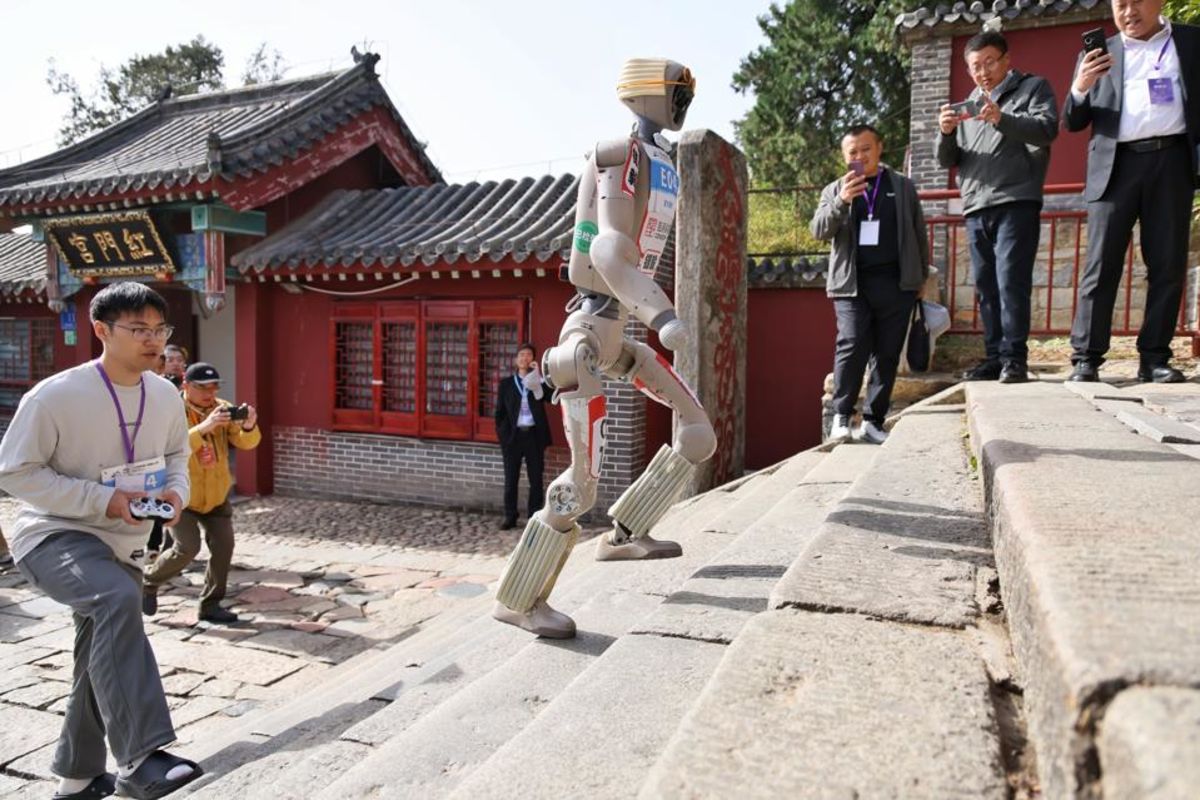
Visitors to Mount Tai, one of the Sacred Mountains of China, regularly ascend its steep stone steps to visit historic Buddhist, Confucian and Taoist temples, view cliffside stone inscriptions and admire sweeping scenic views. On Monday, it was dozens of robots that crowded the historic mountain, some hauling heavy cargo on their backs as they raced toward the top.
The bots took part in the inaugural CMG (Chinese Media Group) World Robot Mount Tai Competition, which aimed to test robots’ balance and motion control, as well as their ability to perceive and adapt to changing and unpredictable terrain. These capabilities are central to real-world applications from safely navigating workplaces in close proximity to humans to conducting reconnaissance and rescue missions following earthquakes, floods, forest fires or other emergencies.
Robot makers routinely put their machines through the paces in precarious real-world environments. But Mount Tai, a site of worship for at least 3,000 years and a UNESCO World Heritage Site, proved an unusual location to test their mettle.
Advertisement
Advertisement
Advanced two-legged and four-legged robots tackled a 2.8-mile course of more than 3,100 steps that stretched from Hongmen, a traditional starting point for walkers including emperors, to Zhongtian Gate, a famous landmark about half the way up the historic route to the peak. CMG called the route a “natural extreme testing ground,” with the competition’s stated goal to promote the deployment of humanoid robots and other embodied intelligent products in industrial settings and everyday life.

A robot dog hauls supplies up Mount Tai’s steep steps on Monday.
The contest, which took place in Tai’an in China’s Shandong Province, featured 90 domestic teams competing in humanoid robot racing; legged robot racing; legged robot load carrying (cargo included eggs and watermelons); exoskeleton robot assistance; and an all-terrain exploration task.
The robots’ biggest challenge was adapting to the mountain’s terrain, judge Sung Qingwei said in a video report from China Global Television Network. Steps on Mount Tai vary in height and width, with frequently changing gradients. Thick cobblestones protrude from some surfaces, while sharp bends and roadside obstacles present additional challenges. Competing robots used a range of technologies, from cameras to LiDAR, a remote sensing technology that uses laser pulses to measure and map surfaces in 3D.
This Robotic Dog Could Revolutionize Adventure Travel
Advertisement
Advertisement
China has become a major player in global robotics, with companies there developing machines for healthcare, logistics, manufacturing and home use. Chinese vendors accounted for 95% of humanoid robots shipped globally in the first half of the year, according to IDC data from September.
The Beijing Lingyi Technology Team, affiliated with Unitree Robotics, won the championship with the Unitree A2 robot dog, which took 43 minutes and 41 seconds to reach the top of the course. The Shanghai Gaoyi Technology Team, using Unitree A2 and B2 dogs, won second place in the legged robot racing competition and the load-bearing competition, respectively.
But not all the racing robots made it to the top. One humanoid collapsed and needed assistance from engineers, while another fell down a flights of stairs.

Competing robots faced challenges like uneven steps, cobblestone surfaces and roadside obstacles.
This article was originally published on Forbes.com















Leave a comment