

This might be sudden, but have you ever heard of machine learning?
AI, deep learning, machine learning. We hear these terms often in the news, but
if asked “What is machine learning?”, most people wouldn’t be able to explain it, right?
At first, I also thought it was a difficult technology used only by people good at math or programming experts.
However, the concept itself is simple enough for a first grader to understand. This time, I will start with a story about dogs and cats, and finally connect it to automated trading for GOLD. I won’t use any difficult formulas. Please read it casually.
1. How do we know the difference between a dog and a cat?
This might be sudden, but is this a dog or a cat?

For those who thought, “It’s obviously a dog (lol).”
You are correct lol
Then, why can we tell the difference between a dog and a cat?
Can you answer this?
The shape of the ears? The shape of the nose? The size of the body?
There are dogs with standing ears, and cats with floppy ears…
What do you think?
Isn’t it quite difficult to put into words?
Defining a dog with
perfect rules in words is surprisingly difficult.
Even so, the reason we can judge immediately when looking at a photo is because
we have seen many dogs and cats in our lives so far.
As we gained experience, we learned features that cannot be put into words.
Actually, this way of thinking is a hint to understanding machine learning.
2. Then, let’s have the computer learn it too
Suppose there is a computer that knows neither dogs nor cats.
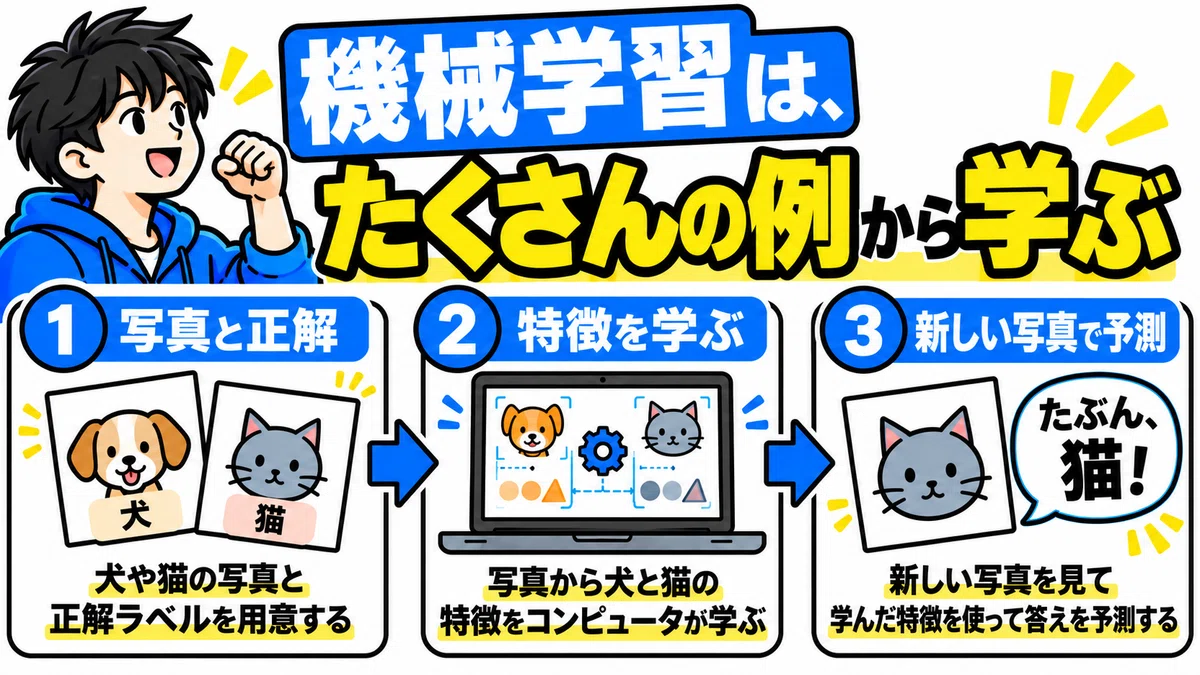
First, I show it a photo of a dog and teach it, “This is a dog.”
Next, I show it a cat and teach it, “This is a cat.”
We repeat this over and over again. 10 photos, 100 photos, 1,000 photos…
Then, the computer learns the patterns to distinguish between dogs and cats from the features contained in the photos.
Even if you give it a photo of a cat it has never seen before,
it can sometimes predict, “Probably a cat!”
Of course, it can also make mistakes.
But the memory capacity of a computer is incomparable to that of a human.
As the number of photos increases, the accuracy gradually improves, and
eventually, the computer becomes better at
making predictions than a human.
Learning patterns from a large amount of data and
making predictions about new data.
This is the basis of machine learning.
3. So, how is it different from rule-based programming?
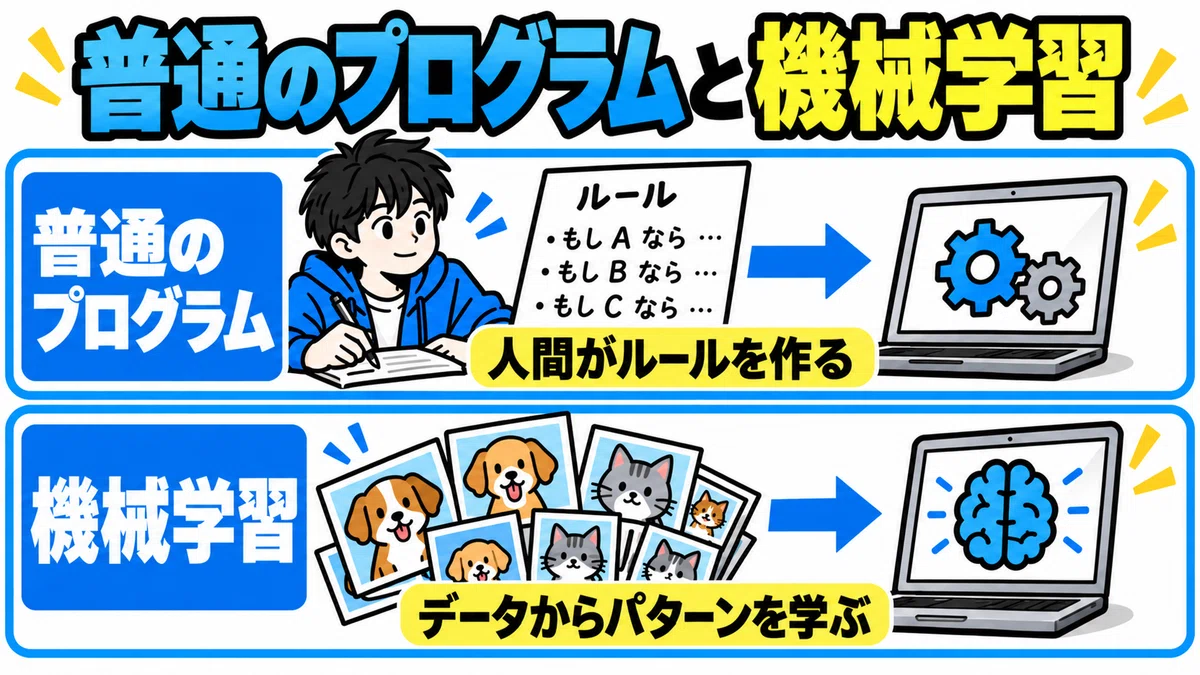
Before machine learning appeared, we wrote programs based on rules.
It is a method where humans decide conditions such as “if the ears are shaped like this, it’s a dog.”
But actual dogs and cats come in various breeds and appearances.
It is difficult for humans to write all the judgment rules…
Therefore, machine learning was born, a method that derives correct answers by preparing many photos and correct answers and
having the computer learn the patterns. It is the forerunner of today’s generative AI.
Rule-based: Humans specify judgment rules.
Machine learning: Learning judgment patterns from data.
Of course, even with machine learning, preparing data and setting up learning methods is a human job. It is not magic that understands everything on its own.
4. Actually, machine learning mechanisms are used in many familiar places
Machine learning is not a technology only for special research laboratories.
It actually appears a lot in our daily lives.
For example, when you watch Netflix, it recommends movies you might like, right? Actually, that also applies machine learning mechanisms.

1. Netflix: Predicting works you might like
Machine learning is used in the mechanism that predicts works you might enjoy using information such as works you have watched on Netflix and your reactions.
2. Marketing: Predicting people who might buy products
What you looked at on an online shop, what products you bought in the past. From such data, it predicts recommended products or the possibility of leading to a purchase. It is also utilized for automatic bidding in web advertising.
3. Weather forecast: Predicting future weather
We use information such as temperature, atmospheric pressure, humidity, and wind conditions to forecast future weather. While calculations based on physical laws are important for weather forecasting, methods combining machine learning have also been used in recent years.
④ Spam: Identifying suspicious emails
Based on characteristics of past spam, it determines whether a newly arrived email is suspicious. This is similar to classifying dogs and cats.
⑤ Credit cards: Detecting unauthorized use
It is also used to detect transactions suspected of being fraudulent based on transaction characteristics, such as whether it is being used in an unusual way.
⑥ Store sales forecasting: Predicting how many will sell tomorrow
It predicts product demand based on the day of the week, season, weather, and past sales. It also serves as material for considering order quantities for convenience stores and supermarkets.
What they have in common is “using past data and the like as hints to predict things that are not yet known”.
By using machine learning,
humanity has acquired a way to quantitatively predict the future.
So, what happens if you use this mechanism for FX?
5. How to use machine learning for FX
When you are doing FX, “I’ve seen this chart pattern before.” “I feel like this price movement is likely to go up.” Don’t you ever feel that way?
I have had that feeling many times too. But that “feeling” is tricky.
Because you don’t know if there is really a trend or if it just happened to leave an impression on you.
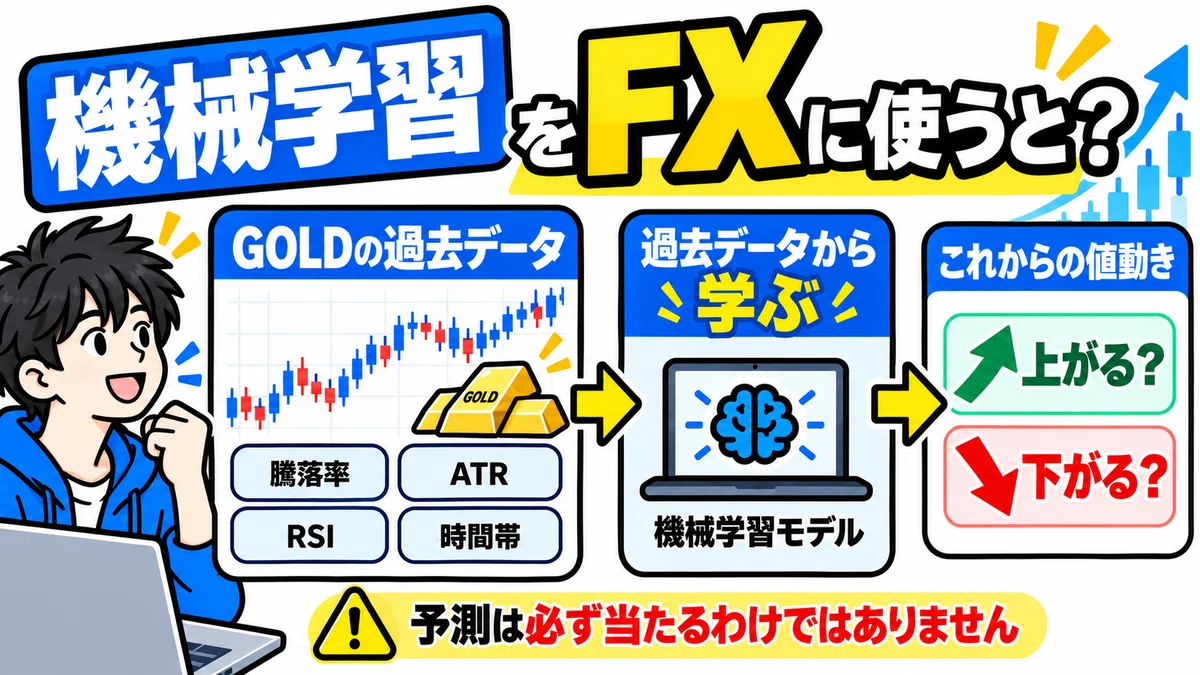
So, let’s think about using past price movements of GOLD instead of photos of dogs and cats.
For example, the rate of change over the last hour, the magnitude of price movement (ATR), RSI, time of day, and subsequent price movements. We collect this information from the past.
And then, we have the computer learn, “After this kind of market, how did the price tend to move?”
Instead of distinguishing between dogs and cats, we look for patterns from past markets to predict future price movements.
In other words, it is about predicting the market using machine learning.
6. How is it different from humans looking at charts?
Honestly, the way of thinking is a bit similar. However, machine learning has the strength of
being able to examine large amounts of data using the same criteria.
It is difficult to look at one year’s worth of 15-minute GOLD charts, one candle at a time, and remember multiple conditions and their subsequent results. But with a computer, you can analyze large amounts of prepared data using defined calculations.
Human memory has its limits, and extraneous information can cloud judgment.
Furthermore, how you see the chart can change depending on your physical condition or mood that day.
With machine learning, you can achieve stable trading without any wavering.
7. What I am predicting is the probability that GOLD will reach X yen
I am a trader who usually trades GOLD as my main asset.
I would like to share a concrete example of how I use machine learning.
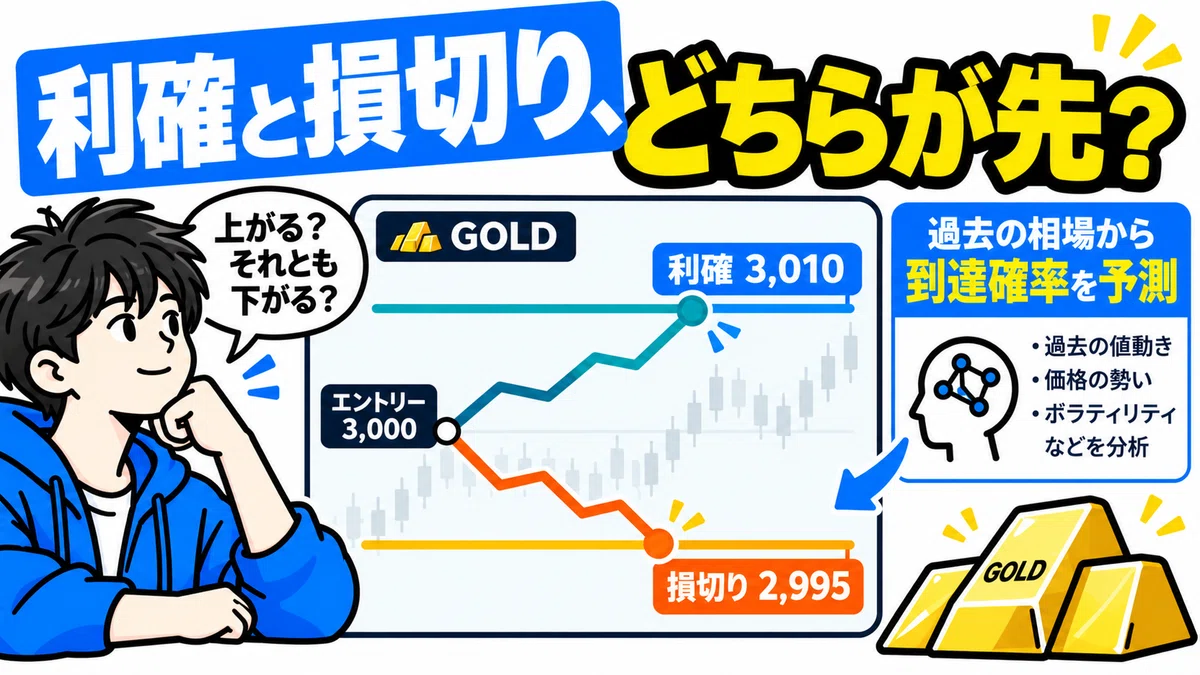
For example, assuming GOLD is currently at $3,000
-
Take profit: $3,010
-
Stop loss: $2,995
When you set your profit and stop loss like this
“Between $3,010 and $2,995, which one is more likely to be reached first?”
Everyone wants to know that, right?
I have machine learning predict this, and by combining the probability of taking profit with the win rate, I built a system that automatically trades only where the expected value is high.
Isn’t this quite interesting?
By utilizing machine learning, you can graduate from just having a feeling that it might go up and
start thinking about the market in terms of numbers.
And above all, wouldn’t it be even more interesting if you could build such a mechanism yourself?
8. Can I build such a system myself?
Reading this far, you might have thought, “I sort of understand the mechanism.
But there’s no way I can build it myself (lol).”
I understand. But it’s okay.
Actually, there is a way for anyone to easily build an automated trading system based on machine learning,
even without any knowledge at all!!
First, please read the note I poured my heart and soul into writing👇
9. Finally
To summarize.
Machine learning is a technology that learns patterns from a large amount of data and makes predictions about new data.
However, machine learning is not magic that can perfectly predict the future.
What is important is to verify what kind of data you use, what kind of predictions you make, and
whether it is actually useful.
What I find most interesting is that
I can now view trades that I previously made based on intuition through the lens of probability.
Please deepen your knowledge further and try applying machine learning to various things!











Leave a comment