
November 05, 2026
1 min read

Key takeaways:
- Machine learning identified a sustained gait loading pattern in patients with knee OA and high BMI.
- The pattern was linked to greater pain, inflammation, radiographic severity and slow gait speed.
Unsupervised machine learning identified a gait loading pattern associated with worse clinical and radiographic outcomes in patients with knee osteoarthritis and high BMI, according to data published in Arthritis Care & Research.
“The specific limb-level loading profiles associated with clinically relevant knee OA features in individuals with high BMI remain unclear,” Ashley N. Buck, PhD, of the University of Wisconsin-Madison, and colleagues wrote. “Characterizing latent biomechanical phenotypes is therefore fundamental to help inform rehabilitation strategies in individuals with knee OA and high BMI.”

Data derived from Buck AN, et al. Arthritis Care Res. 2026;doi:10.1002/acr.80186.
Buck and colleagues analyzed data from 431 participants in the Intensive Diet and Exercise for Arthritis trial to assess relationships between gait biomechanics and knee OA. Participants had a mean age of 65.6 years, mean BMI of 33.6 kg/m² and a mean walking speed of 1.2 m/s.
Researchers used vertical ground reaction force waveforms, principal component analysis and unsupervised machine learning to identify shared variation between gait loading patterns and clinical features, such as pain, physical function, inflammatory biomarkers and radiographic OA severity.
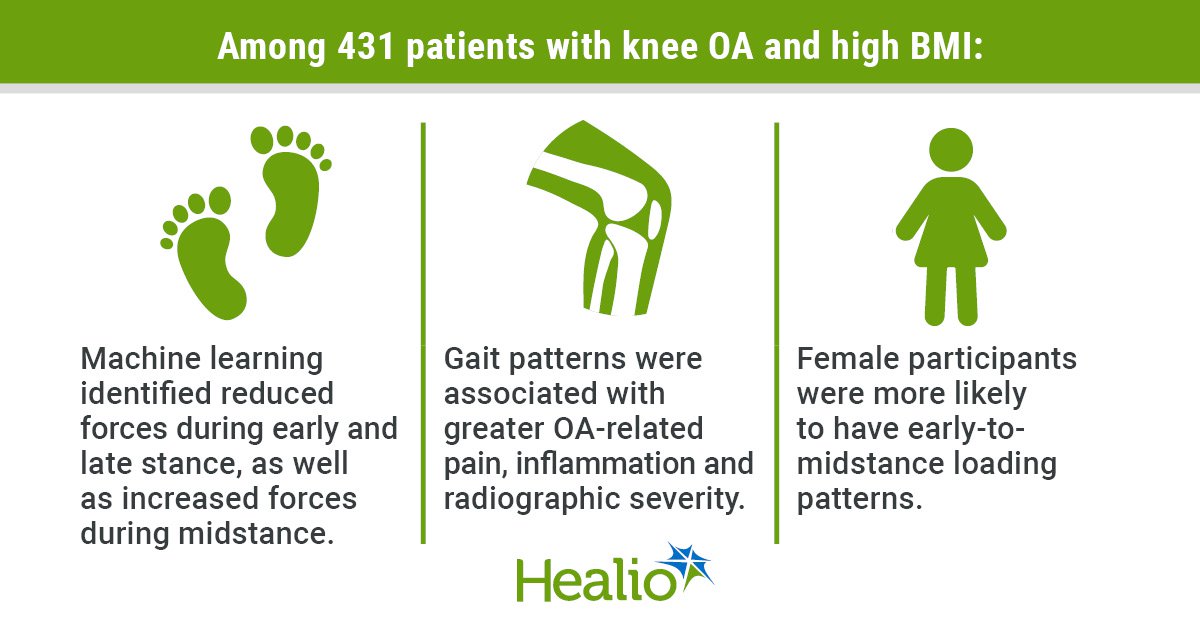
Researchers identified a sustained loading pattern characterized by reduced ground reaction forces during early and late stance and increased forces during midstance.
This loading pattern shared variation with higher BMI, increased inflammatory biomarkers, greater pain, worse Kellgren-Lawrence grade, poorer patient-reported function and slower walking speed, according to the researchers.
Buck and colleagues also identified an early-to-midstance loading pattern that shared variation with female sex, higher BMI, increased inflammation and worse radiographic severity.
Overall, the researchers found gait loading patterns may reflect broader clinical and biological characteristics of knee OA beyond traditional measures of peak joint loading.
“Future trials should evaluate whether modifying sustained loading patterns results in meaningful improvements in symptoms, function, biomarkers, or joint tissue health, and whether waveform-based targets provide benefit beyond modifying discrete peak loading,” they wrote.

Ask a clinical question and tap into Healio AI’s knowledge base.
- PubMed, enrolling/recruiting trials, guidelines
- Clinical Guidance, Healio CME, FDA news
- Healio’s exclusive daily news coverage of clinical data
















Leave a comment