
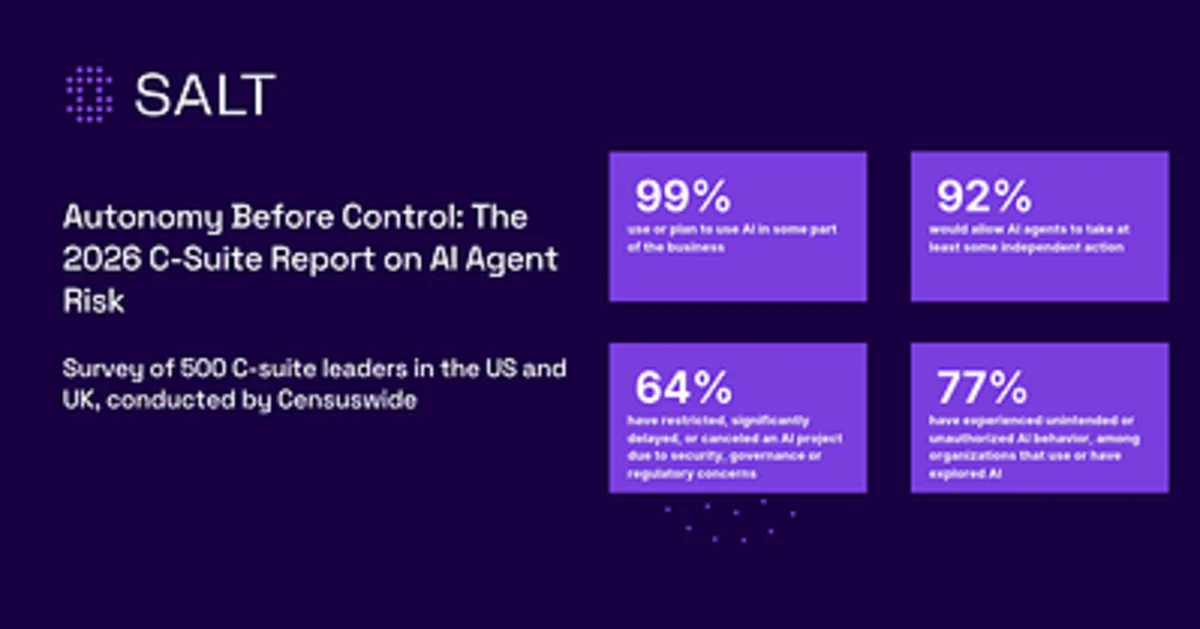
New report, Autonomy Before Control, finds 64% of US and UK C-suite leaders have already restricted, delayed, or canceled an AI project over security and governance concerns
PALO ALTO, Calif., Nov. 19, 2026 /PRNewswire/ — Salt Security, the leader in agentic and API security, today released Autonomy Before Control: The 2026 C-Suite Report on AI Agent Risk. The report is based on a Salt Security survey of 500 US and UK C-suite executives, conducted by Censuswide, and finds that business leaders are granting AI agents real authority faster than they are putting controls in place to govern them.

Key findings include:
-
92% would allow AI agents to take at least some independent action.
-
77% of organizations that use or have explored AI have experienced an AI system or agent acting outside its intended or authorized behavior.
-
64% have restricted, significantly delayed, or canceled an AI project because of security, governance, or regulatory concerns.
-
97% of organizations using AI say they maintain an inventory of their AI agents, yet 19% admit that inventory is not kept consistently up to date.
The full report also examines which high-consequence decisions executives are prepared to hand to agents without human approval, who leaders believe should be held accountable when an agent causes harm, and where US and UK executives differ sharply on autonomy and risk. It closes with five priorities for adopting AI agents securely.
“Executives are giving AI agents real authority over customers, code, data and money, and most have already watched an agent do something it was never meant to do,” said Michael Nicosia, Co-founder and COO of Salt Security. “Governance cannot be a one-time approval. Organizations need continuous visibility into every agent, what it can reach and what it actually does, so they can keep moving fast without losing control.”
Salt Labs research, published this fall, showed how this can play out: a single malicious email could have hijacked the Manus AI agent, and its guardrail detected the attack but could not stop it. The issue has since been resolved. The findings point to a gap between adoption and control. Agents are increasingly deployed across separate teams and inherit access through existing applications, identities and APIs, which makes a static inventory or a single approval step an unreliable basis for governance. Salt Security secures the entire agentic path, from AI agents and MCP servers to the APIs they call, giving security teams the visibility and control to support AI adoption rather than slow it.

















Leave a comment