

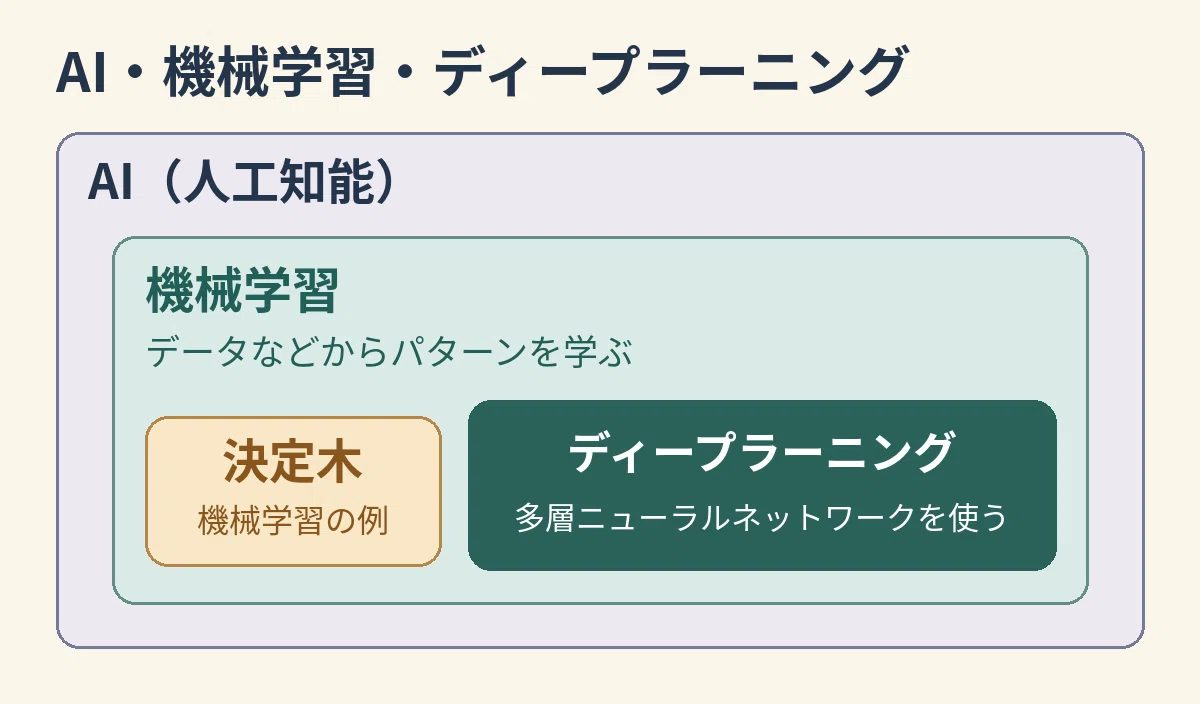
In my previous experience taking the G Test, I wrote about how I got confused about the difference between machine learning and deep learning, and went back to the first diagram in the textbook.
Looking at the diagram, I understood that deep learning is a type of machine learning.
But that brings up another question.
Decision trees are also a type of machine learning, so why aren’t they called deep learning?
This time, let’s compare decision trees and deep learning using the same task of distinguishing between photos of cats and dogs.
The key point lies in the approach to “what clues to use” in the photos.
The Relationship Between AI, Machine Learning, and Deep Learning
AI (Artificial Intelligence) is a broad field aimed at realizing intellectual functions such as recognition and reasoning through computers. One of its approaches is machine learning, which learns patterns from data and uses them for classification and prediction.
Within the framework of machine learning, both decision trees and deep learning are included. A decision tree is a method that makes determinations by branching according to conditions. Deep learning is a method that uses multi-layered neural networks.
Distinguishing Between Photos of Cats and Dogs Using Two Methods
Here, we use photos labeled with the correct answers “cat” and “dog.”
Both methods learn from pairs of photos and their correct answers, and ultimately classify photos they have never seen before.
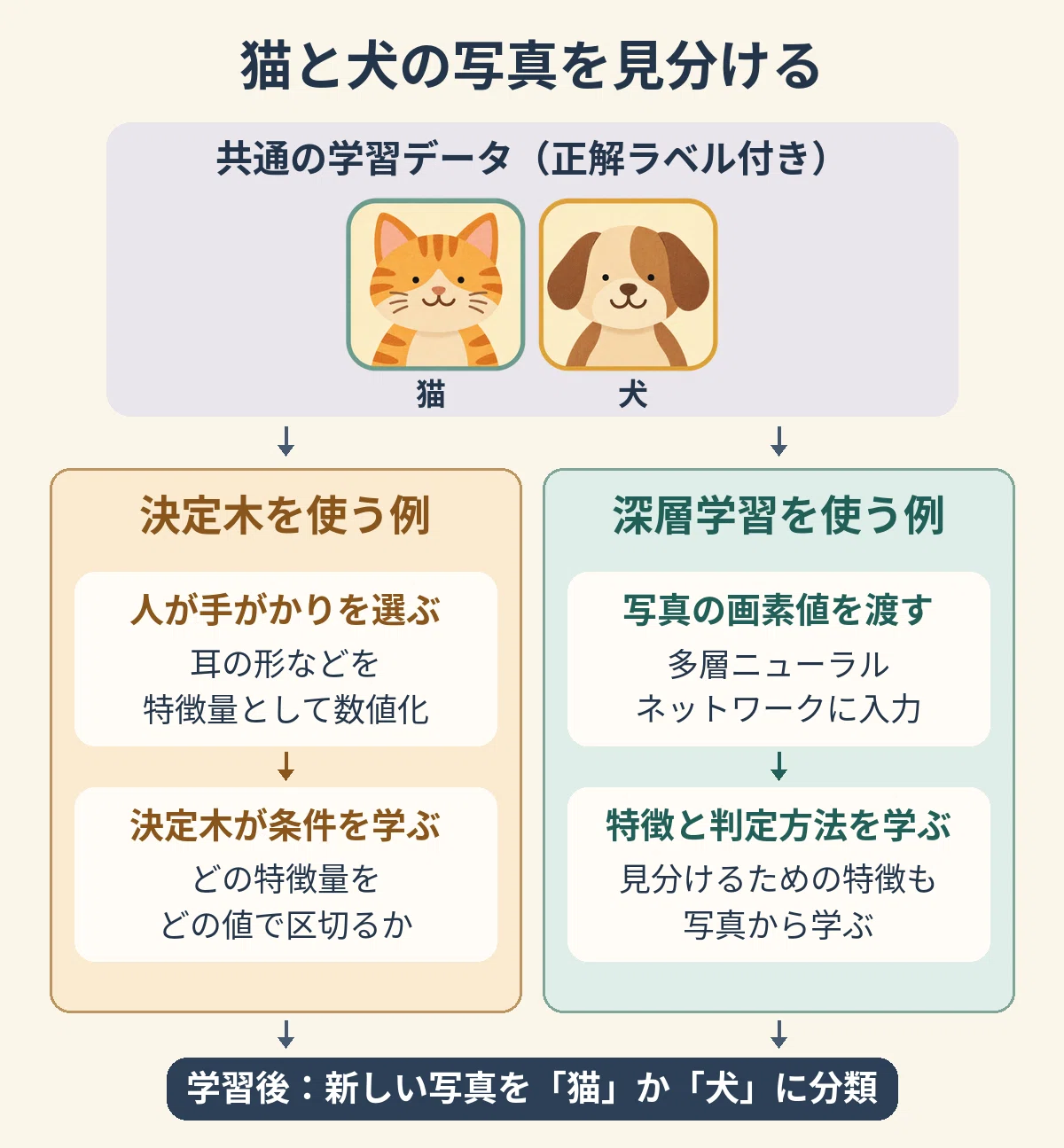
An Example Using Decision Trees | Humans Choose the Clues
If asked about the difference between a cat and a dog, I would look at the shape of the ears first.
So, how about turning “how pointed the tips of the ears are” into a number? The outline of the face also seems like it could be a clue.
Such numerical representations of image characteristics are called features. In this example, a human decides which features to quantify and how.
When you pass those numerical values and the correct labels to a decision tree, the decision tree learns the criteria for determination from the data, such as “which makes it easier to classify first: ear pointedness or facial outline?” and “what threshold value should be used?”
For a dog with floppy ears, the pointedness of the ears could be useful.
But there are also dogs with pointy ears. (Shiba Inus are so cute, aren’t they?)
That is why, rather than judging by ears alone, determinations are made by combining other features as well.
An Example Using Deep Learning | Learning the Clues Directly from Photos
Here, we feed the network the colors and brightness of the tiny dots that make up the photo—in other words, the pixel values. During training, the correct labels corresponding to the photos are also used.
The network learns both the features to distinguish them and the method for determination using those features from the photos. For example, in image recognition, the earlier layers capture simple patterns like parts of outlines, while the later layers handle more complex patterns made by combining them.
Comparing them in this example, the difference is that decision trees learn decision conditions using human-prepared features, while deep learning also learns the features useful for determination directly from photos. To make the difference easy to grasp, two commonly used approaches are presented side by side here.
So, which one is generative AI?
For example, the models in the GPT series used in ChatGPT and elsewhere—from GPT-3 up to GPT-6.1 Sol—are trained using deep learning.
Returning to the first diagram, deep learning is a type of machine learning.
Therefore, when it comes to GPT, both “trained with machine learning” and “trained with deep learning” apply.
Saying “deep learning” simply goes further to specify which method within machine learning was used.
In the G Test syllabus, “Overview of Machine Learning” and “Overview of Deep Learning” are listed as separate items. When studying, if you first establish that “deep learning lies within machine learning,” it will be much easier to follow along even as chapters change.
One final question
“Both decision trees and deep learning are types of machine learning.” Is this statement correct?
The answer is…
Correct.
In the cat and dog example, both learned from data. One learned how to use human-prepared features, while the other also learned the features needed to distinguish between them directly from photos.
In my case, once I was able to articulate that “both are machine learning, but what they learn is different,” I became much less confused by the two terms.













Leave a comment