
Among the 377 results that OpenAI announced on October 6, 2026, one stood out. It claimed to settle the “quasi-Riemann hypothesis” — a weaker version of the Riemann hypothesis, which is arguably the biggest open question in math. The new proof is, as Jared Duker Lichtman of Stanford University put it, “the most significant AI-for-math achievement so far, by quite a margin.”
The Riemann hypothesis has been an open problem for over 160 years. Resolving it would enable mathematicians to better understand the nature of prime numbers, one of math’s most crucial building blocks. And that’s just for starters.
The implications of even the more limited “quasi-RH” result are “staggering,” said Maksym Radziwiłł of New York University. “In a sense, the vast majority of consequences of RH already follow from quasi-RH.”
Moreover, contrary to what mathematicians had long expected, the proof didn’t need to introduce any new concepts — it instead unearthed hidden connections between old ones. “The proof is a surprising synthesis of well-known ideas,” said Alexander Dunn of the Georgia Institute of Technology.
The result relied in part on techniques pioneered by Radziwiłł and Dunn. Alongside other number theorists, they have been working to understand the proof and what it could mean. Now they’re starting to get answers.
To Zeta and Beyond
To understand what the quasi-Riemann hypothesis says, you first have to understand the Riemann hypothesis. When the Clay Mathematics Institute announced seven Millennium Prize Problems at the turn of the century, the Riemann hypothesis loomed above the other six. It was the only one carried over from the celebrated agenda-setting list of problems that David Hilbert had announced a century earlier.
On its surface, the conjecture concerns the behavior of a particular function. Start with the sum $latex 1 + \frac{1}{2} + \frac{1}{3} + \frac{1}{4} + \cdots $. Now use that sum (together with a special mathematical trick to extend its scope) to build a more general function, called the Riemann zeta (ζ) function:
$latex \zeta (s) = 1 + \frac{1}{2^s} + \frac{1}{3^s} + \frac{1}{4^s} + \cdots$
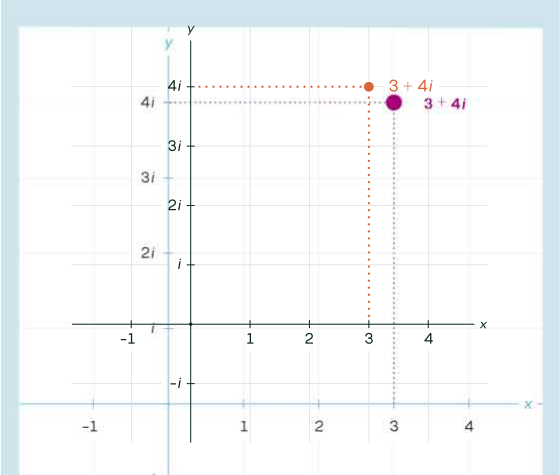
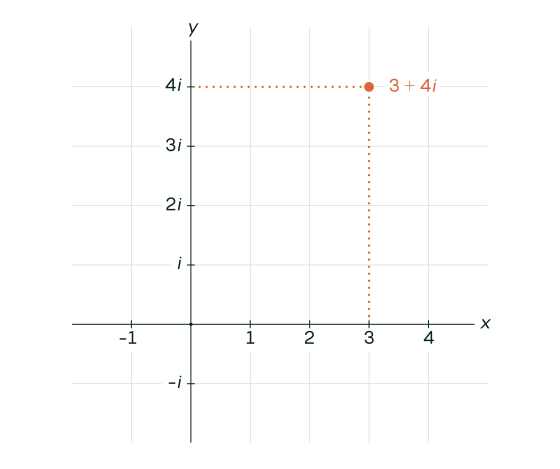
Here, the input s is a complex number. Complex numbers have two parts — a “real” part and an “imaginary” part, which is a multiple of the square root of −1 (written as i). Any complex number can be thought of as a point on a plane:
Mark Belan/Quanta Magazine
The Riemann hypothesis is about which values of s will make the zeta function equal zero.
But it is also about far more than how this particular function behaves. As Bernhard Riemann realized when he first made the conjecture in 1859, the function relates to patterns in the prime numbers — integers divisible only by 1 and themselves that many mathematicians call the “atoms of arithmetic.”
It’s long been known that as you move along the number line, the primes thin out. Riemann showed that exactly how the primes thin out is, in a sense, governed by the zeta function — in particular by the places where it equals zero.
It’s straightforward to prove that if s is a negative even number (−2, −4, −6, …), then ζ(s) = 0. These are called trivial zeros. The Riemann hypothesis says that the only other zeros of the zeta function, called nontrivial zeros, occur when s has a real part of 1/2. That is, they should all be located on a vertical line:
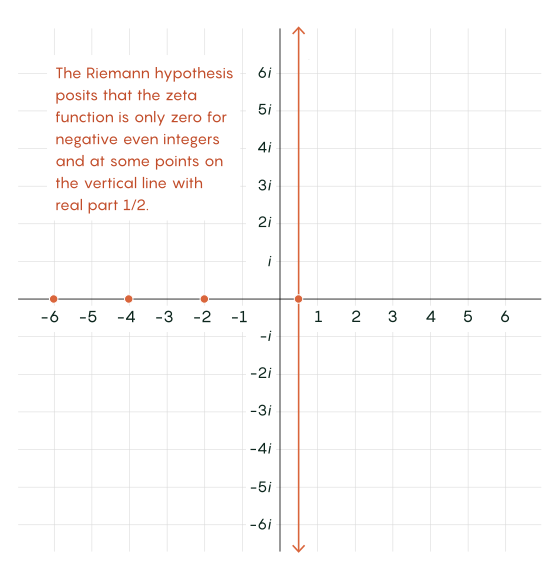
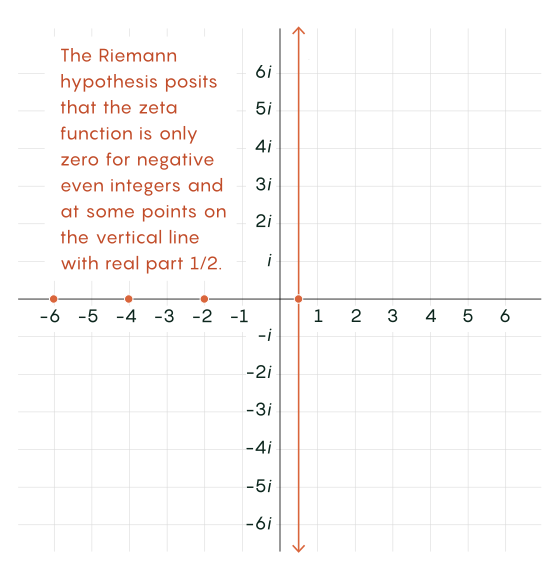
If any nontrivial zero were to be found somewhere away from that vertical line, it would imply that the primes must form an extremely surprising pattern, one that has never been observed to date.
Just narrowing the area where the nontrivial zeros can appear has had huge ramifications. Riemann himself proved that nontrivial zeros of the zeta function can only be found in a vertical strip between zero and 1. Then, in 1896, two mathematicians showed that zeros could not lie on the edges of the strip. As a direct consequence, they were able to prove an important result called the prime number theorem, a formula for how quickly, on average, the primes thin out.
If the Riemann hypothesis holds, then mathematicians can guarantee that any deviations from the average given by the prime number theorem will always be small.
Mathematicians have numerically verified that the first 12 trillion nontrivial zeros are on the 1/2 line. But they can’t be sure the hypothesis holds for all the zeros, and even one solitary outlier would land like an earthquake. As Enrico Bombieri wrote in the paper laying out the Millennium Prize formulation of the problem: “The failure of the Riemann hypothesis would create havoc in the distribution of prime numbers.”
Diamonds in the Slop
This brings us to the quasi-Riemann hypothesis. Where the Riemann hypothesis posits that all the nontrivial zeros are on the vertical line at 1/2, the “quasi” version just asks one to prove that they are all contained in a vertical strip that’s narrower than the known strip between zero and 1. The narrower the strip, the more one can say about how the primes are distributed.
OpenAI announced two different versions of their quasi-Riemann hypothesis proof. The first version, dated September 30, 2026, claimed to show that all nontrivial zeros must be between 1/8 and 7/8, and was formally verified using the Lean programming language. The second version, which was completed almost a week later (and is not yet formally verified), claimed to prove a weaker result: that the zeros must have a real part between 1/12 and 11/12. But while the first paper is 199 pages long, the second weighs in at a comparatively modest 49 pages.
As with many recent AI-generated results, both papers “are horribly written (in a way that would lead to immediate rejection at any mathematical journal),” Radziwiłł said in an email. “They fall short of the standard of exposition and clarity in our area by a wide margin.” And so mathematicians have set aside the 7/8 paper to focus on the 11/12 one, which seems to involve similar techniques and has similar consequences. “The reason why people look mostly at the 11/12 result is that it’s shorter,” Radziwiłł said.
















Leave a comment