
October 19, 2026
4 min read
Key takeaways:
- Patients who met all traditional low-risk extubation criteria but were high risk per machine learning spent more time on ventilation and had more patients with ARDS.
- About 19% died, and 15.4% had reintubation.
PHOENIX — Among ventilated adults who underwent extubation, 18.7% were high risk for extubation failure per machine learning even though they met traditional low-risk criteria, according to data presented at the CHEST Annual Meeting.

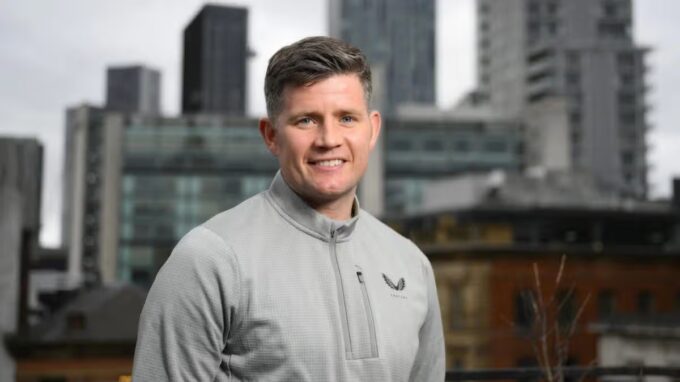
Jeril Lasington
“Passing a spontaneous breathing trial (SBT) doesn’t mean every patient is equally safe to extubate,” Jeril Lasington, MBBS, medical resident at New York Medical College, St. Clare’s and St. Mary’s Hospitals, told Healio. “For a patient who has been ventilated a long time, has ARDS, pneumonia or sepsis, or is significantly fluid-positive, passing the usual checks should prompt a second look.

Data derived from Lasington J, et al. Machine learning-based prediction of extubation failure beyond traditional weaning parameters: A MIMIC-IV analysis. Presented at: CHEST Annual Meeting; Oct. 18-21, 2026; Phoenix.
“That could mean diuresing before extubation, planning post-extubation support such as high-flow oxygen or noninvasive ventilation, or monitoring more closely,” Lasington said. “On the other hand, borderline weaning numbers alone shouldn’t automatically delay extubation in an otherwise low-risk patient. The model is meant to add to clinical judgment, not replace it.”
In this study, Lasington and colleagues developed a machine learning model to predict extubation failure (reintubation within 72 hours) in 23,379 mechanically ventilated adults from the MIMIC-IV electronic health record dataset who underwent first extubation, of which 8.3% had a failed extubation.
Fifty-two pre-extubation features — ventilator mechanics, hemodynamics, laboratory values, vasopressor status, ventilation duration and comorbidities — were included in the training of the machine learning model using the gradient boosting technique.
“About 8% to 15% of extubated patients fail and need reintubation, and that failure roughly doubles their risk of death,” Lasington said. “At the bedside, we mostly decide on extubation using breathing-mechanics measures: rapid shallow breathing index (RSBI), FiO2 and positive end-expiratory pressure. In practice, many patients who pass those checks still fail, which suggests whole-body factors drive reintubation in ways those measures miss.
“We wanted to know whether machine learning on routinely collected pre-extubation data could find these patients, and how many are being missed,” she continued.
Researchers found an area under the curve of 0.699 for predicting extubation failure with the model. They noted that it also had “good calibration across risk deciles.”
In SHapley Additive exPlanations (SHAP) analysis, six factors emerged as key predictors of extubation failure: ventilation duration, acute respiratory distress syndrome (ARDS) diagnosis, PaO2, pneumonia, body weight and SpO2 features not captured by traditional weaning indices.
The three traditional predictors of extubation failure are FiO2, PEEP and RSBI, and a patient is deemed low risk for this outcome if they have an FiO2 of 50% or less, a PEEP of 8 cmH2O or less and an RSBI less than 105, according to the presentation.
Using these traditional low-risk extubation criteria and predicted risk from the machine learning model, researchers divided patients into four groups. “Truly safe” patients met traditional criteria and were low risk by machine learning, “occult high risk” patients met all traditional criteria but were high risk by machine learning, “over-flagged” patients failed traditional criteria but were low risk by machine learning and “obvious risk” patients failed traditional criteria and were high risk by machine learning.
The studied population included 8,331 (35.6%) “truly safe” patients, 4,370 (18.7%) “occult high-risk” patients, 9,203 (39.4%) “over-flagged” patients and 1,475 (6.3%) “obvious risk” patients.
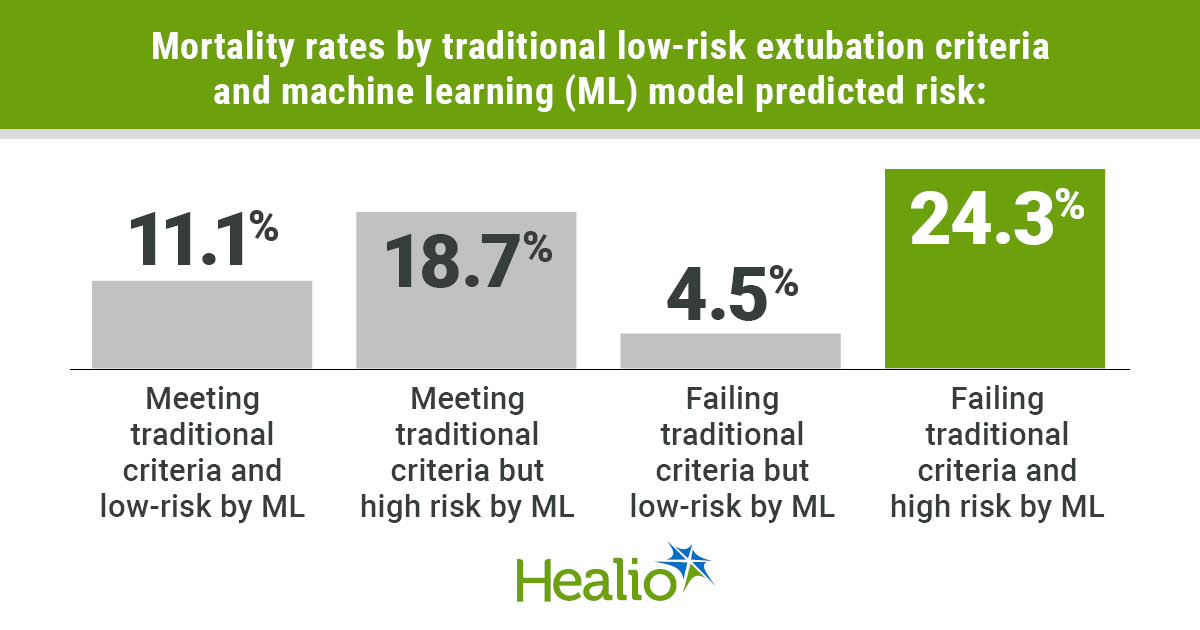
In the “obvious risk” group, mortality was observed in 24.3% of patients, and reintubation within 72 hours was observed in 18.6%.
In the “occult high-risk” group, 18.7% died and 15.4% had reintubation. These proportions were greater than those of the “truly safe” group (11.1% and 7.3%) and the “over-flagged” group (4.5% and 4.2%).
“About 40% of patients who failed traditional criteria were rated low-risk by the model, and they had the lowest reintubation (4.2%) and mortality (4.5%) of any group,” Lasington said. “That suggests we may be keeping some patients on the ventilator longer than needed.”
Compared with “truly safe” patients, researchers found that “occult high-risk” patients spent more time on ventilation (123 hours vs. 52 hours) and had more patients with ARDS (49% vs. 21%), pneumonia (34% vs. 6%), sepsis (23% vs. 9%) and congestive heart failure (31% vs. 20%).
“Nearly 1 in 5 extubated patients (18.7%) met every traditional weaning criterion, yet their reintubation rate (15.4%) and mortality (18.7%) were about double those of the truly low-risk group,” Lasington told Healio. “Their risk came from long ventilation, ARDS, pneumonia, sepsis, heart failure and a large positive fluid balance, not from poor breathing mechanics.”
According to the presentation, the traditional low-risk criteria that was met the least was FiO2 of 50% or less (57.1%), whereas PEEP of 8 cmH2O or less and RSBI less than 105 were met by 94.6% and 98.7% of patients, respectively.
Looking ahead, Lasington said there are three focuses for future studies.
“In the future we need to validate the model in external, multicenter and prospective cohorts; improve its discrimination by adding time-series and SBT-specific data; and test whether acting on the risk score actually changes outcomes, such as targeted diuresis or prophylactic high-flow oxygen/noninvasive ventilation in the hidden high-risk group, and earlier liberation in the over-flagged group,” she told Healio. “The aim is a real-time decision-support tool built into the EHR.”
For more information:
Jeril Lasington, MBBS, can be reached at jeril.lasington@gmail.com.
Sources/Disclosures
Source:
Lasington J, et al. Machine learning-based prediction of extubation failure beyond traditional weaning parameters: A MIMIC-IV analysis. Presented at: CHEST Annual Meeting; Oct. 18-21, 2026; Phoenix.
Reference:
Disclosures:
Lasington reports no relevant financial disclosures.

Ask a clinical question and tap into Healio AI’s knowledge base.
- PubMed, enrolling/recruiting trials, guidelines
- Clinical Guidance, Healio CME, FDA news
- Healio’s exclusive daily news coverage of clinical data














Leave a comment