
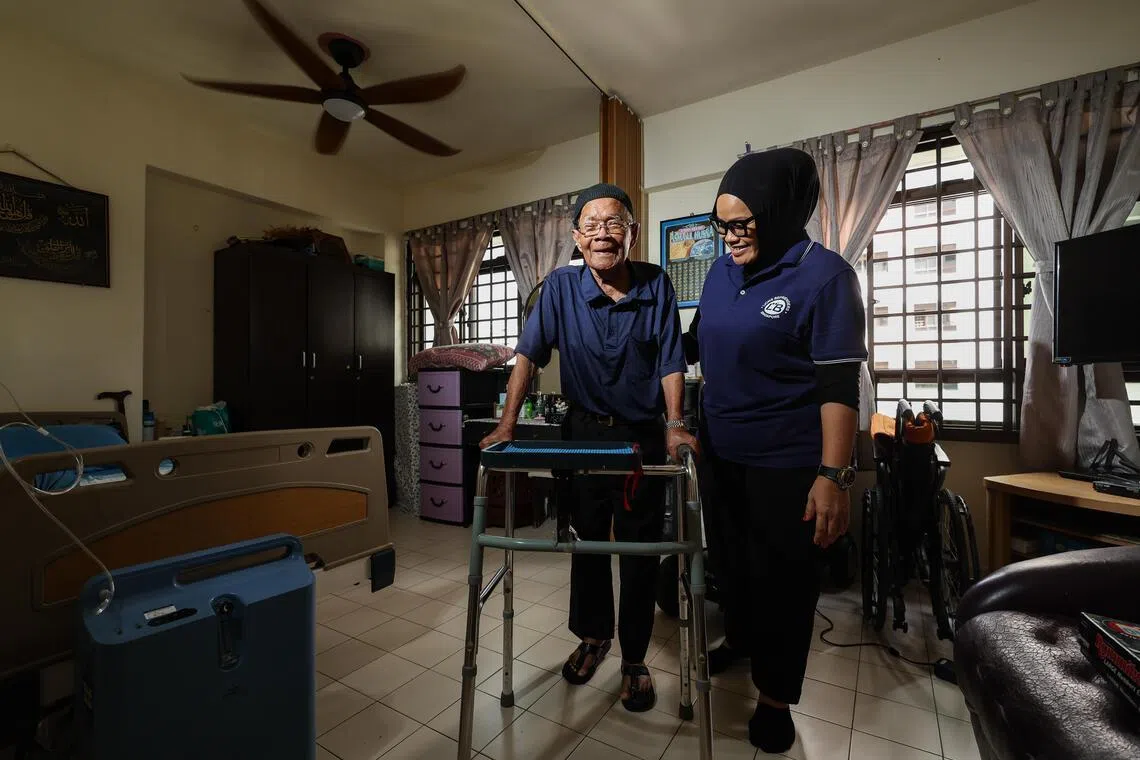
SINGAPORE – When healthcare assistant Radiana Ahmad visits elderly residents in their homes, her duties range from checking blood pressure and dressing wounds to helping the seniors shower, exercise and manage their medications.
The work can be physically demanding and emotionally complex, she said, adding that some seniors have dementia while others experience mood swings or loneliness.
The 49-year-old, who has worked with Lions Befrienders for over eight years, believes her job cannot be replaced by artificial intelligence (AI).
“Honestly I’m not too worried as AI can help do paper work but can’t bathe a senior, talk to them or notice when they are sad,” she said. “My job involves a lot of human touch and interaction.”
However, despite working in a sector that has been described as more “AI-resilient”, she feels some pressure to keep up with the technology amid a government-led push to adopt AI nationwide.
She started playing around with ChatGPT three months ago at the encouragement of her daughter, and now relies on it to translate for seniors who speak different languages.
Radiana said her company also ran a workshop recently on how to use Microsoft’s AI chatbot Copilot. “I think as long as we use AI to help us and not replace us, we’ll be okay.”

Radiana Ahmad (right), a healthcare assistant, guides her 89-year-old patient, Abu Alias Man, through a cup-stacking exercise during a home visit in Clementi on June 29.
ST PHOTO: BRIAN TEO
Other workers in AI-resilient sectors told The Straits Times that they have also started using AI to support or enhance their productivity, even though they are less worried than their peers about disruption to their jobs.
Deputy Prime Minister Gan Kim Yong had said in May that domestic-facing and essential sectors such as healthcare, early childhood education, social services and skilled trades will continue to provide important employment opportunities.
“Many of these roles rely on judgment, empathy, trust and human interaction. They can be augmented by AI but not easily replaced by it,” said Gan, who is also Minister for Trade and Industry, as he laid out the recommendations by the Economic Strategy Review (ESR) committees.
He added that Singapore must make these jobs better through productivity improvements, stronger skills recognition, and clearer career and wage progressions.
Licensed plumber Geraldine Goh believes skilled trades like hers remain highly resilient even as AI reshapes the economy.
“AI can help to acquire information but you need to process and apply it. It is mostly about experience, expertise and physical work,” said the 32-year-old who started her plumbing business Agraffe in 2017.

Plumbers Geraldine Goh and Yeo Kai Xun pictured with their plumbing equipment and tools in their van.
ST PHOTO: JASON QUAH
She has been using AI for administrative work like preparing quotations, allowing her to spend more time on technical and client-facing tasks since two years ago.
She does not think she will be left behind in an AI era, but feels the need to keep up with AI and digital trends.
“We do need to constantly keep ourselves aligned and updated with new innovations and technologies,” she said.
Her apprentice Yeo Kai Xun, 23, said he feels AI can help with non-physical tasks like planning and marketing though the core plumbing work requires a human.
Other workers in skilled trades like Edwin Wong, director of waterproofing and painting company Atlas Works, agree.
Waterproofing is like detective work, said the 38-year-old. “Every building is different, so solving the problem requires technical knowledge, practical experience and careful investigation.”
He uses AI in his work, including for inspection reports, technical proposals and developing marketing materials.
“To me, AI is not replacing skilled workers. It is helping skilled workers become more productive.”
While some workers seek out AI on their own, some firms have rolled out AI tools to help their employees with their tasks.
Senior security officer Razali Jais, who works at Alexandra Point, uses Frasers Property’s in-house centralised smart building platform in his daily operations. The platform was enhanced with AI capabilities in April 2025, allowing it to analyse CCTV footage and automatically flag unusual events or activities for the security team’s attention.
The 50-year-old said: “AI can help us do our work faster and more efficiently, but on the ground, there is still a need for officers to respond to incidents, talk to people and make decisions.”

Razali Jais, a senior security officer at Alexandra Point, says that AI can help workers work faster, but officers remain essential for responding to incidents on the ground.
ST PHOTO: BRIAN TEO
What appears unusual on camera may turn out to be harmless, while other situations may require immediate action. These decisions rely on human judgment and experience, Razali said.
Ratheesh Kumar, a senior lift troubleshooter with KONE Singapore, has been using AI tools since 2025 to analyse data, identify trends, and support faster fault diagnosis.
“When a complex fault occurs, a skilled technician still needs to inspect the equipment on site, understand the operating conditions, and make the right technical and safety decisions,” he said.

Ratheesh Kumar, 44, senior troubleshooter with KONE Singapore, believes a lift technician’s job is AI-resilient.
PHOTO: KONE SINGAPORE
Other workers highlighted to ST the individual touch that is required of their jobs.
Damien Chan, a community engagement manager with St Luke’s ElderCare, said community engagement is built on trust between the seniors and the staff or volunteers. Having empathy and understanding helps him to better cater to each senior’s individual needs.
The 33-year-old engages seniors through outreach efforts, including knocking on their doors, but uses AI to enhance programme planning, develop activities tailored to seniors’ needs, and simplify administrative tasks.
“At the heart of community care, it is the heartware and we will always need that human connection that people crave.”
Likewise, restaurant captain Chen Mei Sien of Yum Cha Restaurant said AI cannot replace personal service.
“Customers like to talk to real people, especially when they need help or have special requests. A smile, good communication, and experience are things AI cannot replace.”
She uses AI for tasks like checking which dishes are popular and preparing simple reports.
Trainer Rayner Ng, 28, feels his job is difficult to replace due to the human connection he develops when he teaches others.
He uses AI to develop training materials, put together presentations and analyse data.
“But when it comes to actually delivering training, a big part of the job is reading the room, responding to questions on the spot, and adjusting my approach depending on how people are reacting,” said the specialist in product training at Skechers Singapore.
Using AI to strengthen, not replace
Karen Wee, executive director of Lions Befrienders, said care and social service roles are among the most AI-resilient professions because they depend fundamentally on empathy, trust, judgment, relationship-building and compassion.
However, AI can remove administrative work, improve documentation, identify risks earlier and support better decision-making, allowing care professionals to spend more time with the people they serve, she said.
“The future is not AI replacing caregivers; it is caregivers empowered by AI to deliver better, safer and more personalised care,” she said.
Skills and workforce consultant Ives Tay said such jobs are harder to automate because workers often encounter unique situations and must make decisions on the spot. Rather than replacing such workers, AI is more likely to help with diagnostics, documentation, scheduling and administrative tasks.
But he cautioned against assuming any occupation is completely immune to technological disruption.
“Even if AI does not perform the physical work itself, it can still improve productivity significantly,” he said. “Over time, the productivity gap may increasingly be between workers who use AI tools effectively and workers who do not.”
Some employers are hence seeing the value in equipping their staff with AI capabilities now, ahead of wider economic transformation.
Monica Kong, managing director of KONE Singapore, said that as AI transforms industries, the firm is investing in AI-enabled tools and continuous upskilling to help its technicians work smarter, strengthen their expertise, and stay future-ready.
“We believe skilled frontline professions will continue to thrive alongside AI, making them resilient, rewarding careers that are essential to building a safer, smarter and more sustainable Singapore.”












Leave a comment