
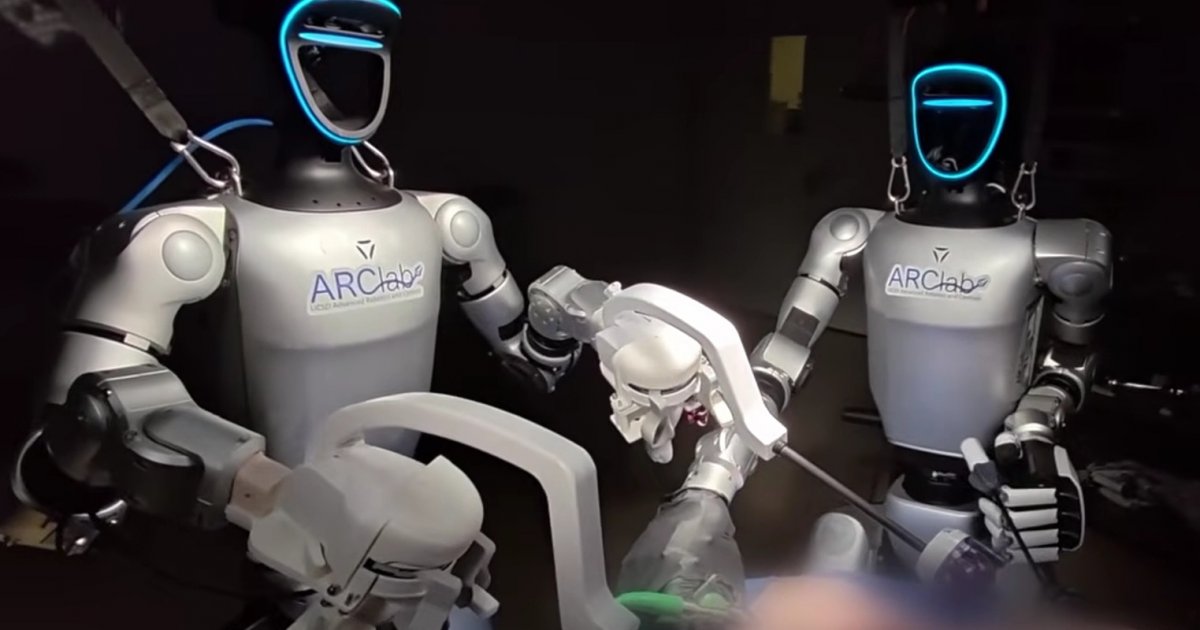
Two humanoid robots have carried out gallbladder-removal procedures on live pigs in what researchers say is the first demonstration of its kind, marking a milestone in the quest to bring versatile robotic assistants into the operating room.
The experiments, conducted by engineers and surgeons at the University of California San Diego and published in Nature, involved laparoscopic cholecystectomies in which the robots retracted tissue, dissected and clipped structures and removed the gallbladder from the liver bed.
The procedures were fully teleoperated by trained surgeons and the robots were tethered to ensure the animals’ safety.
A Historic Proof of Concept
In one operation, a humanoid robot worked alongside a human surgeon. In a second, two humanoid robots completed the procedure together. The achievement represents the first time humanoid robots have successfully performed such surgery on living tissue.
“As a proof of concept, it absolutely worked,” Dr. Ryan Broderick, interim director of the Center for the Future of Surgery at UC San Diego, told ABC News.
Off-the-Shelf Robots Take the Stage
Rather than building a custom surgical machine, the team used commercially available Unitree G1 humanoids equipped with dexterous hands and advanced sensors.
The researchers noted in their GitHub overview, “Humanoid form factors offer unique potential, particularly for assisting with surgical tasks. Traditionally, robotic systems for surgery are purpose-built platforms such as Intuitive Surgical’s da Vinci Surgical System, and it remains unclear how close current humanoid systems are to meeting the precision, control, and safety requirements of minimally invasive surgery.”
The use of relatively inexpensive, general-purpose robots suggests that future surgical systems may not need to be multimillion-dollar, purpose-built platforms like today’s dominant robotic surgical systems.
Designed for Places Surgeons Cannot Reach
The UC San Diego team envisions the technology eventually extending specialist care to remote settings.
“You can imagine this device being deployed on a ship, in a village somewhere, in a smaller operating environment that’s not in major cities,” colorectal surgeon Dr. Shanglei Liu said.
Researchers believe such systems could one day help address surgeon shortages in rural communities, isolated research stations and even future space missions.
Challenges Remain Before Human Use
Despite the breakthrough, the scientists stress that the technology is still in its infancy. The accompanying Nature paper notes that there are “key technical challenges that must be addressed before clinical deployment”.
For now, the humanoids, nicknamed “Surgie” by the team, remain an impressive demonstration rather than a replacement for human surgeons.
Yet, as UC San Diego professor Michael Yip said, “I believe we’ve shown that it is possible to use humanoid robots in an operating room to do real procedures that can eventually save lives.”
The milestone suggests that a future in which versatile humanoid robots assist doctors in places where traditional surgical infrastructure is unavailable may be nearer than once imagined.















Leave a comment