
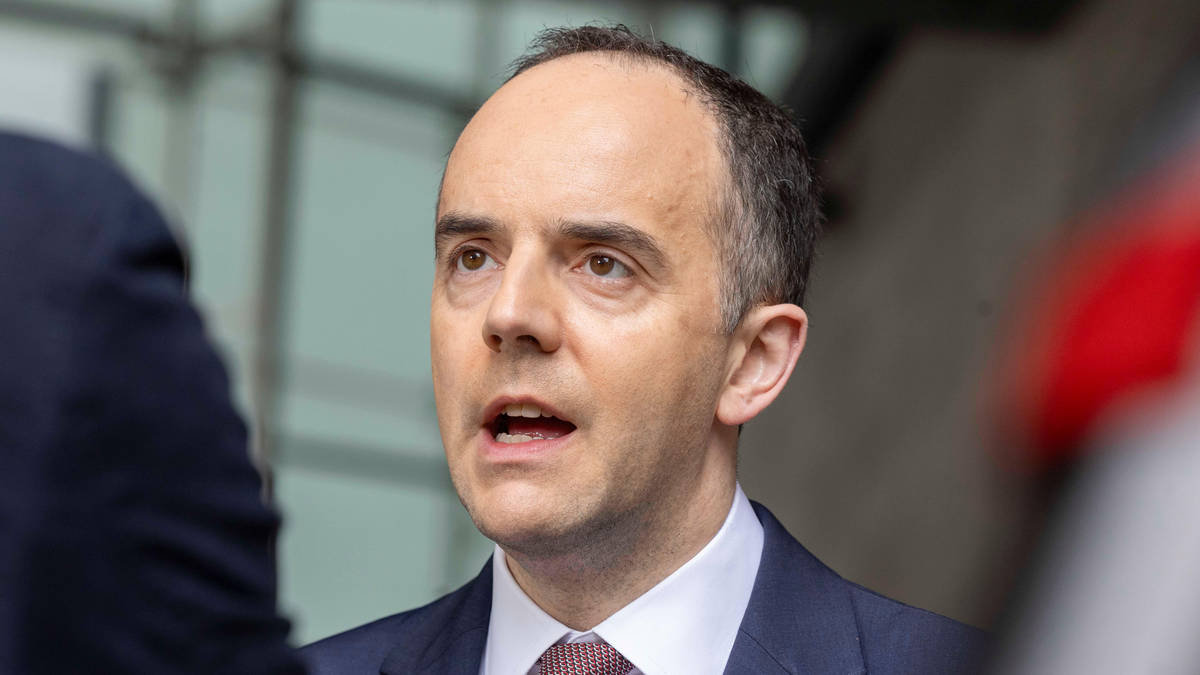
Health secretary James Murray said a new AI triage tool piloted in Sussex reduced the volume of GP calls by about a third.
The program on the NHS app deploys AI to asks patients about their symptoms and experiences, why they’re contacting the GP surgery, and directs patients towards the right help – including booking an appointment or visiting a pharmacy.
Mr Murray told LBC’s Lewis Goodall on Sunday that the pilot in Sussex “reduced the volume of calls for the 8am rush by about a third.”
When pressed on whether this was a productive solution to the pressure on GPs – instead suggesting resources would be better prioritised on improving the appointment booking process – Mr Murray insisted the AI would help determine which patients actually needed appointments, directing others away to different services.
“Sometimes people might not need an appointment at the GP. It might be more appropriate for them to go to their pharmacy and get some direct support there.
Read more: Burnham ranked a ‘more capable’ future Prime Minister than Farage and Badenoch, LBC poll reveals

Picture:
Alamy
“That’s why it’s a triage tool. It’s about directing people in the right direction.”
Mr Murray likened the decision to his digital transformation of HMRC, explaining that by increasing the amount of digital processes, it was “freeing up capacity of people working at HMRC to help people who were vulnerable or, or more confused about their tax affairs, or who had complicated tax affairs”.
“It’s the same principle here in the NHS. If we can have this service where people who want to engage with the AI app can do so, it then frees up capacity to help those people who don’t want use that – and want to call up and go and see a GP straight away.”
Funding is also being prioritised for other AI tools within the NHS, including AI note taking – a process where AI “listens in” to appointments and summarises notes between medical professionals and patients, meaning doctors just have to “sign off” on notes, rather than manually typing them out themselves.

Picture:
Alamy
“That can save a clinician 47 minutes a day on average out of their regular shift. And if you scale that up…if it was in every emergency department across the country, you could have 9,000 extra A&E consultations a day.
That’s about 3.4 million extra a year.
“To put that in context, there’s about 28 million attendances at A&E a year.
“So on the back of 28 million attendances, another 3.4 million A&E consultations a year, you know, it’s a really sizable increase.
“And that’s an example of where we can make AI work for patients, for NHS staff on the front line, and for the benefit of the NHS.












Leave a comment