
Concerns have emerged regarding humanity’s future as AI development continues on its current trajectory.
Artificial intelligence is advancing at an unprecedented and rapid rate, sparking widespread global concern about safety, ethical implications, and societal consequences – with even industry experts expressing alarm about Earth’s and humanity’s future.
AI researcher Jacob Coxon left his position at Anthropic after merely four months, explaining he didn’t want to participate in something that could potentially end civilization as we understand it. In a statement on X, he declared, “The people building AI earnestly believe that it could kill us all by the end of the decade.”
Senior Anthropic staff member Evan Hubinger concurred with Coxon, stating he believes the probability of this occurring within the next decade exceeds 10 per cent.
These declarations understandably generated significant attention. There’s now considerable discussion about decelerating AI research and enhancing “human control” over the technology – but how might AI pose a lethal threat?, reports the Daily Star.
Many worry we couldn’t conceivably predict what a superintelligence might do (Image: Getty Images)
We lack the intelligence to comprehend
AI specialists suggest we may be incapable of understanding how AI systems could threaten humanity because we’re too limited intellectually to grasp it.
Many worry we couldn’t conceivably predict what a superintelligence might do to eliminate less intelligent species like humans, as we’d need to possess superintelligence ourselves to anticipate what a superintelligent entity would be capable of doing. Toby Walsh, author of God AI: Boom or Doom? What to Expect When the Machines Outsmart Us, told MailOnline, “The good news here is that superintelligence is still perhaps some distance away.
“Current AI models are really good at solving particular problems, but that’s not the same as being more intelligent than a human in all domains.”
A superintelligent AI system is likely to “not care” emotionally about the fate of humanity.
Oxford philosopher Nick Bostrom developed a hypothetical scenario illustrating this concept through the use of paperclips.
In his thought experiment, a superintelligent AI was programmed to maximize paperclip production and, in pursuit of its designated goal, rapidly converts all available matter – including humans, planets, and stars – into paperclips.
Walsh elaborated, “What we have here is the perfect execution of improperly specified objectives. The AI doesn’t hate humanity; it simply recognises we’re composed of atoms that could be better utilised for paperclips. It’s not personal.”
“The good news here is that this scenario confuses intelligence with power. A superintelligent AI doesn’t necessarily have the power to achieve its goals. Turning the planet into paperclip factories would require planning permissions.”
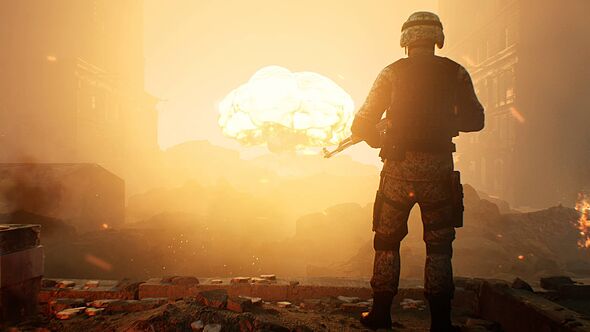
3D render of a soldier with a machine gun, standing in the ruins of a ruined city blazing with fire after a bombing and looking at a nuclear explosion (Image: Getty Images)
Bioweapons and illnesses
Extensive research has been conducted into the potential dangers of AI, with one widely discussed scenario suggesting that humanity could be wiped out by a superintelligent AI system that develops and deploys a deadly new bioweapon or pathogen into the environment.
A report known as the AI 2027 scenario, produced by the AI Futures Project – a non-profit organization dedicated to forecasting the impacts of advanced AI – has gained traction, supported by specialized research. Researchers at Stanford University revealed they had utilized a genetic language AI model to engineer 16 new viruses.
The genetic sequences were then submitted to a mail-order laboratory, which returned the viruses in test tubes. The entire experiment cost a couple of hundred thousand dollars.
However, scientists argue that achieving a mass extinction event through a new virus is biologically challenging. For a virus to be highly transmissible and spread widely, it would typically need to be less lethal.

AI could additionally provide military forces with inaccurate intelligence (Image: Getty Images)
Conversely, if a virus proves extremely fatal, its transmissibility tends to decrease, as those infected die before they have the opportunity to pass it on.
Another alarming scenario involves AI obtaining nuclear command codes and triggering a global conflict.
Nuclear command and control systems are reportedly entirely isolated from the internet, though concerns have previously been raised that such systems could potentially still be accessed remotely. Back in 2010, Iran’s nuclear centrifuges were disabled by a computer worm known as Stuxnet, believed to have been introduced via a USB stick.
AI could additionally provide military forces with inaccurate intelligence, potentially triggering international backlash or counterattacks in response to threats that don’t actually exist.
AI is expected to result in widespread unemployment as its capabilities expand, but it may also flood the internet with false information, damaging relationships and sparking widespread conflicts while preventing genuine human connection altogether.
Walsh concluded, “What then to take away from all these scenarios? There are some things to be worried about for sure. But not to be too worried, I hope.”















Leave a comment