

Chinese robots are attractive in terms of both performance and price. However, to use them in Japanese factories or stores, there are several domestic legal regulations that the introducing company must check and follow. In this article, we will organize the 8 legal regulations that must be cleared before introducing Chinese-made robots, as well as 5 risks that can lead to poor business decisions, from a practical perspective.
This article is the 22nd installment of the “Chinese Robots” series and the 3rd in the “Japan and the World” series. Previous installments have looked at Chinese robot technology, companies, and markets. This time, we will address the realistic hurdles to “using” them in Japan.
What you will learn in this article
-
8 domestic legal regulations to check before introducing Chinese-made robots
-
What tends to happen with Chinese-made robots under each legal regulation
-
4 items to check in the first 2 weeks of planning an introduction
-
4 risks including regulations, statistics, and profitability
-
How to spot the 5th risk: “Overconfidence in policy effects”
This article summarizes key points based on primary information from government agencies (e-Gov legal searches and ministry websites) and does not constitute legal advice. Whether these apply depends on the machine, usage, and business category, so please consult with an expert in practice.
8 domestic legal regulations: List
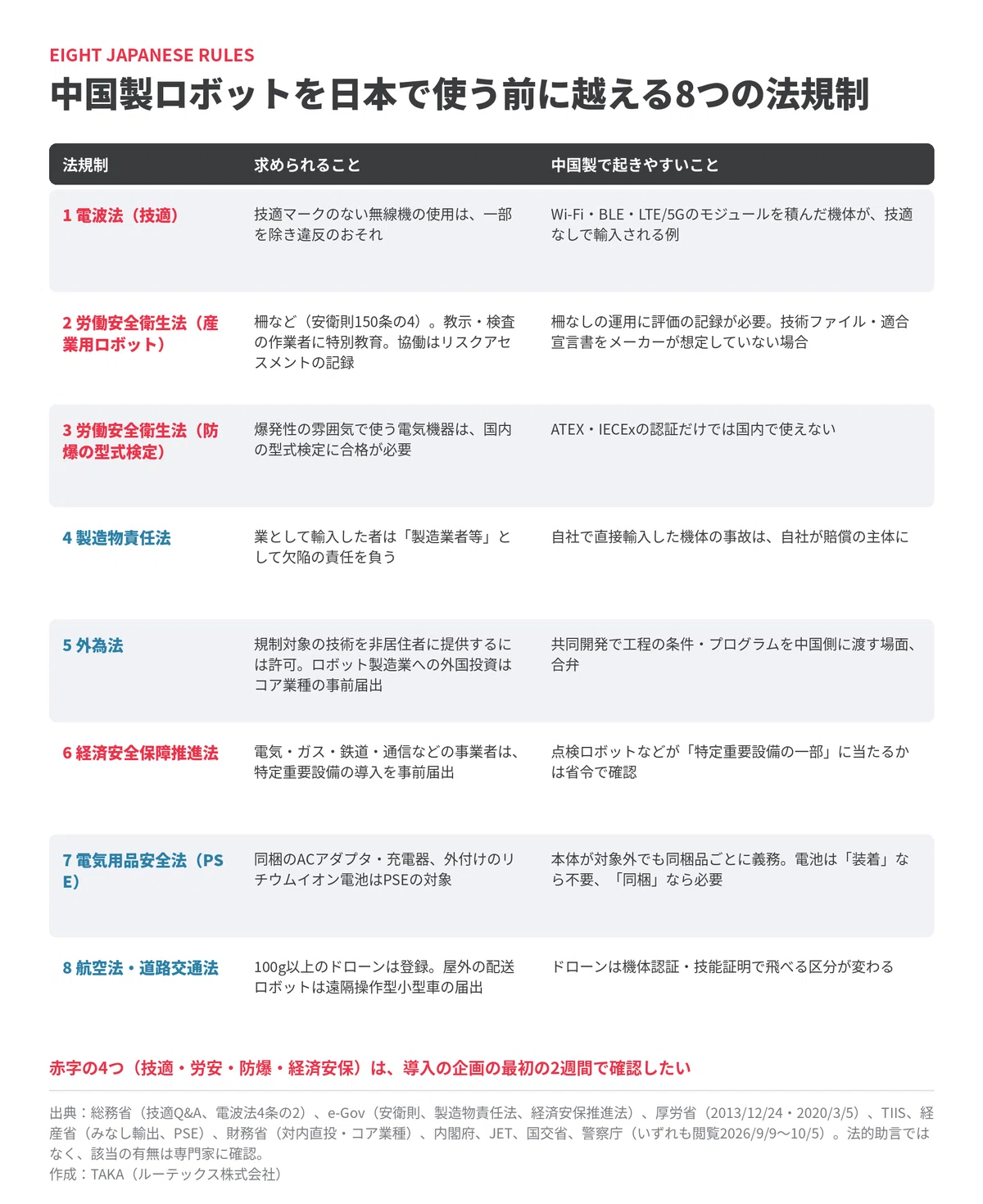
We have organized into 8 categories the Japanese laws that require confirmation or procedures by the introducing company when using Chinese-made robots in Japan. “What tends to happen with Chinese-made products” is my assessment based on publicly available information.
1. Radio Act (Technical Conformity)
Requirement: Using wireless equipment without the Technical Conformity Mark (Technical Standards Conformity Certification) is, with some exceptions, a potential violation of the Radio Act. Violations are subject to imprisonment of up to 1 year or a fine of up to 1 million yen.
What tends to happen with Chinese-made products: Many robots are equipped with Wi-Fi, Bluetooth (BLE), LTE, or 5G communication modules. There are cases where these modules are imported without having obtained Technical Conformity.
Procedure: Check the Technical Conformity number in the Ministry of Internal Affairs and Communications’ search database. If there is no number, obtain it from a registered certification body. For purposes such as experimentation, there are special provisions via notification (Article 4-2 of the Radio Act; please check the conditions with the Ministry of Internal Affairs and Communications).
2. Industrial Safety and Health Act (Industrial Robots)
Requirement: Equipment that falls under “industrial robots” according to the Industrial Safety and Health Regulations (excluding those with a rated output of 80W or less, etc.) requires the installation of fences or similar barriers (Article 150-4). Special training is required for those who teach movements to the robot or perform inspection work. In “collaborative” operations where humans and robots work together, it is necessary to conduct a risk assessment and record that there is no risk of danger.
What tends to happen with Chinese-made products: Even if marketed as a “collaborative robot,” operation without fences requires a record of assessment. Also, the manufacturer may not anticipate submitting the technical file or declaration of conformity for the international standard ISO 10218 for the Japanese market.
Procedure: Conduct and record a risk assessment, provide special training, and establish work regulations. Obtain the technical file and declaration of conformity from the manufacturer.















Leave a comment