
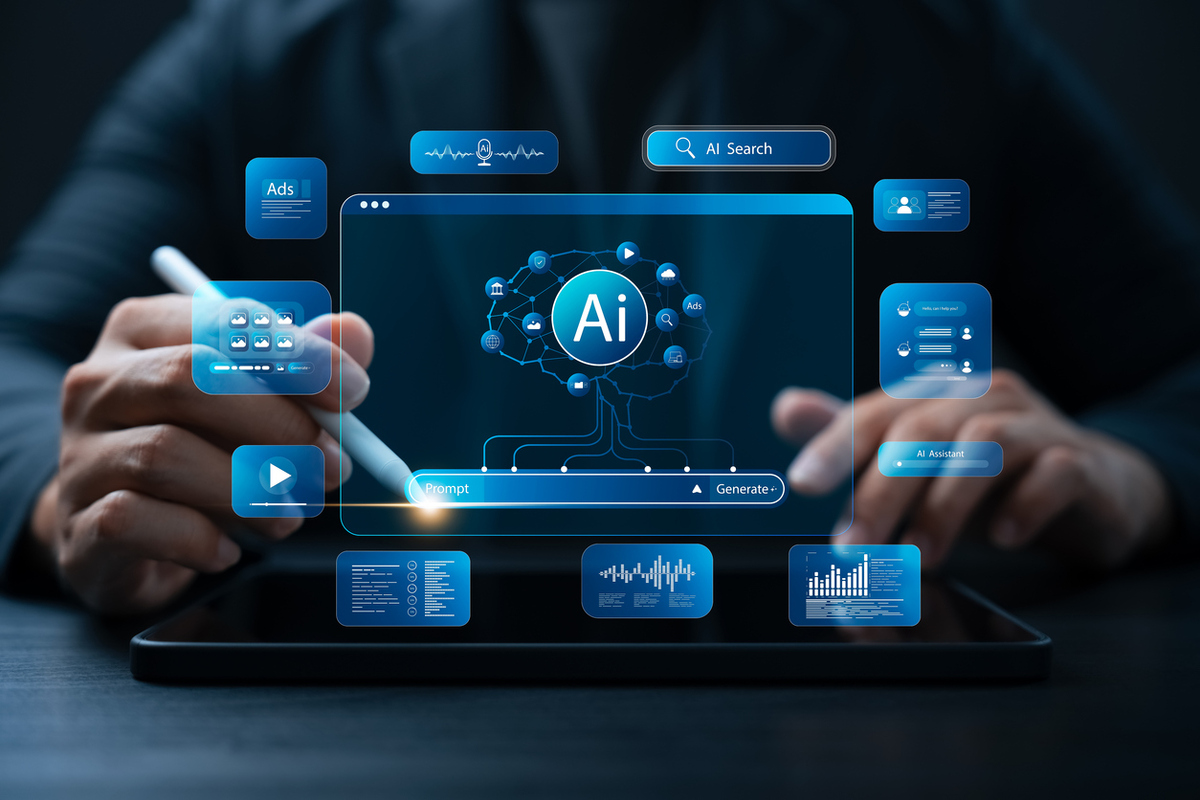
As artificial intelligence – at least on the surface – acquires a broadening range of human-like capabilities, humanity is exercising more self-reflection on what it means to be a human.
The latest evidence for this new surge in introspection is that “human” was chosen as the Cambridge Dictionary’s Word of the Year in 2026. The selection team may have fallen victim to what is known as affinity bias, favouring the form of existence that shares their own traits and experiences.
Although ranking buzzwords is hardly a scientific endeavour, one might argue that “AI agent” was another contender.
AI agents, the poster children of the current AI frontier, have captured people’s imagination, stoked their anxiety and prompted ontological musings.
From a more pragmatic perspective, however, it’s the concepts of autonomy, agency and responsibility that deserve closer examination in relation to the human-versus-artificial intelligence dichotomy.
Making work more humane
Over the years, some once-revolutionary ideas have become table stakes in the world of work. Precisely 50 years ago, J Richard Hackman and Greg R Oldham published their paper Motivation Through the Design of Work: Test of a Theory. Their Job Characteristic Model identified the attributes that can make a job motivating and fulfilling.
Although the lockdown-era social experiment with home offices added flexible working to the list of employee desirables, any white-collar worker today would instinctively recognise Hackman and Oldham’s five criteria: skill variety, meaningful tasks, autonomy and feedback are still held dear by employees; and while the fifth criteria, task identity, may no longer be part of everyday discourse, its underlying principle remains relevant. Following a project from start to finish and receiving recognition for the achievement have remained a major source of job satisfaction.
What today’s workforce might add is that removing repetitive, robotic aspects of workflows can enhance fulfilment even further. But HR departments are still shaping roles around these principles – proof that they have stood well the test of time.
To stay compliant with the UK’s Management of Health and Safety at Work Regulations, employers must by law alleviate monotonous work and reduce its negative impact on employees’ health.
Within a broader productivity context, employee engagement and wellbeing also remain top priorities for people management, with considerable HR budgets devoted to improving them and minimising the risk of burnout.
The autonomy-monotony trade-off
AI, at its current level of development, has the potential to both improve and deteriorate job characteristics. Generative AI-powered solutions are automation tools, just like their rules-based predecessors.
They are more flexible, context aware and, as a result, smarter but their primary purpose is still to automate dull, monotonous tasks.
Ideally, they should achieve this without creating new, more dispiriting ones. Looking from our current vantage point, it seems that the old saying still holds – humans can’t have their cake and eat it.
Capable as AI agents may be at solving repetitive tasks with occasional variety, the ambitions of the people creating them are considerably greater. An AI driven future could be one where work is removed from the three-by-eight equation altogether to be replaced by more entertainment or rest; or one where new types of activity that haven’t been invented yet simply replace those that have been automated.
But more important than debating whether gen AI’s positive impact will outweigh collateral damage or bring about an automated dystopia is the road humanity takes to get there, through endless cycles of promises and disillusionment, anticipation and anxiety. While vague expressions and metaphors describing how humans and artificial intelligence should share agency are being thrown around, there is little clarity about how this transformation should be optimised for the human part of the workforce.
When world chess champion Garry Kasparov lost to IBM’s Deep Blue in May 1997, his optimism remained unruffled. Rather than feeling daunted by the machine’s performance, he envisioned a future where human intuition and strategy is combined with the speed and capacity of computers. He used the mythical centaur, with a horse’s body and a human torso, arms and head, to represent this hybrid.
Almost 30 years and a revolutionary breakthrough later, journalist, blogger and activist Cory Doctorow reversed the components of the centaur to reflect how power relations between humans and machines had changed.
In Doctorow’s metaphor, the head is that of a horse, the machine that the human body is forced to serve, desperately trying to adjust to its clockwork operating mode.
The inverted centaur points to a dilemma also manifest in a shift in terminology around AI autonomy: the move from human-in-the-loop to human-on-the-loop. Until recently, human-in-the loop has been a catch-all term used to reassure sceptics that people would retain agency over AI activity.
Ernst & Young defines stages of human control in AI as a workflow in which people and AI systems work alongside each other. AI performs tasks defined by humans, processes data and generates options, which humans then review and leverage to make decisions.
Existing applications for human-in-the-loop agentic AI include medical image evaluation, fraud detection and demand forecasting.
While the next stage, human-on-the-loop, is a subtle change, it marks a highly consequential shift regarding human role in the division of labour.
In this model, humans set objectives and review outcomes but only intervene during the process when an AI agent escalates a task, raises an alert or flags an anomaly.
The human is no longer directly involved in the workflow. They are “on the loop” to remediate flawed outcomes, pause anomalous action or shut the system down if the agent goes rogue.
When such systems become common, people may find themselves evaluating signals generated at machine speed, sitting in front of dashboards and control towers. They must maintain their domain knowledge despite no longer participating in the processes that produce the outcomes they are expected to assess.
Most stressful of all, they must take responsibility for decisions made by teams of AI without having had much, if any, agency over how those decisions were made.
And responsibility without agency may feel like scapegoating, particularly until AI agents’ autonomy is reliably controlled through non-human identity, access management and authorisation protocols.
Let’s not abandon the Job Characteristic Model just yet
We are not quite at the on-the-loop stage yet, where people’s only task is to orchestrate efficient agentic teams, review their output and take responsibility for their decisions. Although given the unprecedented speed of technological advancement, this may happen earlier than we expect.
In December 2025, a UC Berkeley study found that 68 per cent of production agents executed 10 steps at most before requiring human intervention and 47 stopped at five, so teams could verify outputs at checkpoints.
Forrester’s report published in July this year already describes agents running for hours, days, even months, citing companies at the cutting edge of agentic software development such as OpenAI and Anthropic.
The report’s title, The State of Agentic AI in 2026: Companies Are Chasing, Few Are Catching, however, suggests that this remains rather far from common practice.
Gary Marcus, an outspoken critic of agentic AI hype, who is, nevertheless, convinced that “we will all have our own AI agents and companies will have armies of them in the long term” references a study conducted by researchers from Stanford, MIT CSAIL and Carnegie Mellon, which found that 89 per cent of participating AI agents drifted from their goals after about 30 steps into their processes.
Another issue is agent sprawl, with agents still often overriding each other’s outputs. A case for hanging on to the human workforce is strengthened by the high cost of agentic tasks, which can consume a thousand times more tokens than code reasoning and code chat.
Timelines of wider human-on-the loop agentic AI adoption are impossible to predict. While developers are progressing with their demos and deployments, the white-collar workforce deserves considerably more attention than it currently receives.
How much autonomy can people retain as workflows become automated by the day? And what can employers do to ensure that roles retain some variety as employees increasingly become managers of swarms of AI agents?
Alongside accelerating agentic AI adoption, businesses must find ways to preserve as much fulfilment and dignity in human jobs as technological disruption allows.
Eventually, in the unforeseeable future, humans may get completely shut out of the loop as work becomes, by definition, a thing that only machines do. Until then, employers would do well to hang on to the human characteristics that have made work meaningful as long as possible.













Leave a comment