
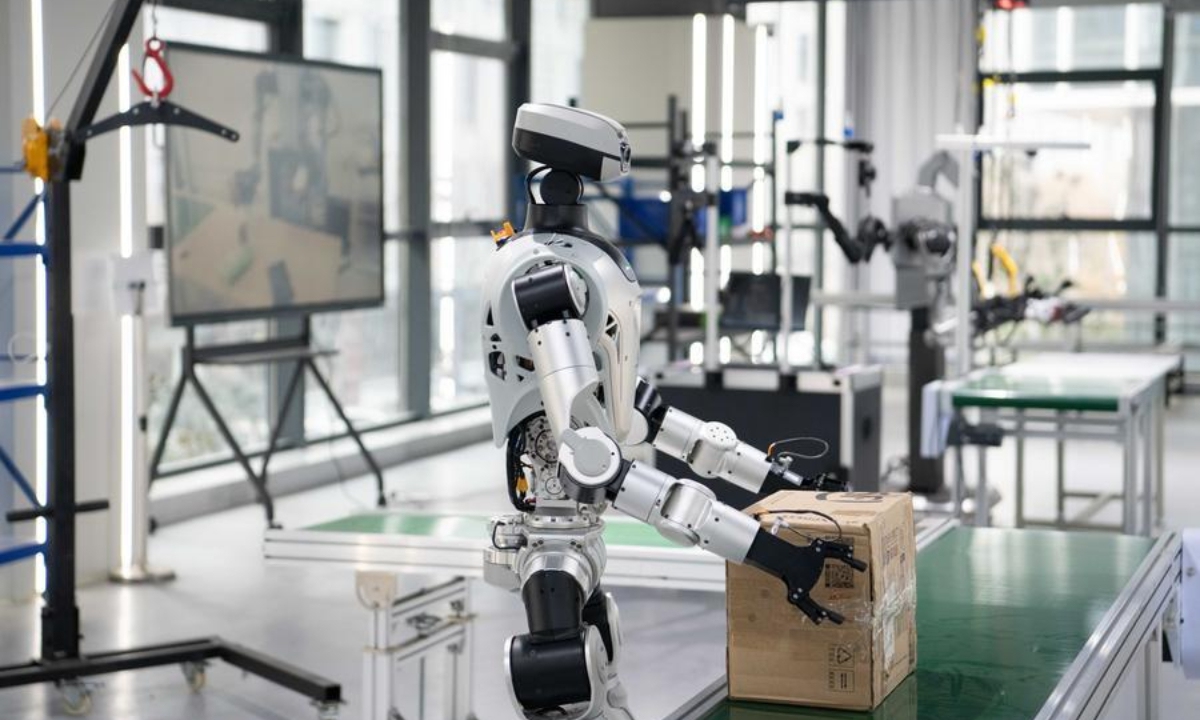
A humanoid robot conducts box-carrying training at a data collection pre-training center for humanoid robots in Hefei, east China’s Anhui Province, Dec. 4, 2025. (Xinhua/Zhang Duan)
China exported 10.377 million robots across individual categories from January to May this year, with total export value approaching 20 billion yuan ($2.98 billion). The products were shipped to more than 150 countries and regions worldwide, with the European Union and ASEAN emerging as the primary destinations, China Media Group reported, citing customs data.
China’s robot exports expanded rapidly in the first five months of the year, with a more optimized product mix injecting new momentum into the country’s high-end manufacturing going global, Chinese experts said.
Diversified export structure
In terms of product, China’s robot exports are highly diverse, with cleaning robots dominating, with exports worth 14 billion yuan, accounting for more than 70 percent of total exports, according to the report.
Backed by core technologies such as autonomous navigation, automatic dust collection and intelligent wastewater recycling, Chinese-made cleaning robots are well adapted to differentiated residential environments overseas, giving them a clear competitive advantage, said the report.
In the industrial applications segment, China exported around 70,000 industrial robots in the first five months of the year, with overseas application scenarios continuing to expand.
Handling robots equipped with vision recognition and intelligent algorithms have been widely deployed in large-scale infrastructure and transport projects overseas. Welding robots with automatic scanning and modeling capabilities can calculate optimal processing parameters in real time. Collaborative robots are also increasingly used in light manufacturing sectors abroad, including food processing, pharmaceuticals and daily chemicals.
In emerging frontier segments, exports of intelligent bionic robots exceeded 8,000 units, covering diverse applications such as equipment inspection, scientific research and education, and public services. Supported by a fully integrated domestic industrial supply chain, China’s robot exports have continued to expand steadily in scale.
Amid continued overseas expansion, multiple companies have maintained steady growth. Keenon Robotics told the Global Times that its service robot operations overseas have expanded steadily across scenarios including restaurants, hotels and retail, with cumulative global shipments surpassing 100,000 units, covering more than 70 countries and regions and over 600 cities, forming a mature global commercial deployment network.
The company said its core products, including the C40 cleaning robot and T10 delivery robot, continue to see stable demand overseas. According to IDC data, Keenon Robotics holds a 22.7 percent share of global commercial service robot shipments, ranking first in the industry. Overseas revenue now accounts for more than half of total revenue, with operations and service networks established in the US, the Netherlands, Japan, South Korea and in the Hong Kong SAR.
Dobot is accelerating its overseas deployment in collaborative robotics, with applications expanding across automotive new energy, 3C electronics, semiconductors, surgical healthcare and new retail.
Li Jiaxian, a representative of Dobot, told Global Times that in 2025 the company’s revenue rose 31.7 percent year-on-year, while shipments of collaborative robots ranked first globally. The company now serves more than 80 Fortune Global 500 firms, with operations spanning 15 major industries and over 200 sub-scenarios.
In service applications, coffee robots powered by Dobot’s Nova-series robotic arms have been deployed in airports, high-speed rail stations and shopping malls, serving hundreds of thousands of cups without failure.
What’s more, Fourier told the Global Times that its overseas wellness robotics segment recorded a 100 percent year-on-year increase in sales in 2025, with particularly strong growth in Europe and the Asia-Pacific region.
Booster Robotics told the Global Times it delivered 1,000 units in 2025, serving more than 200 global customers and over 70 research institutions, with overseas customers accounting for 60 percent.
Ma Jihua, a veteran tech analyst told the Global Times that the EU and ASEAN are the main destinations for China’s robotics exports due to both industrial structure and demand-side factors. In Europe, high manufacturing costs and strong demand for industrial automation, combined with the competitiveness of Chinese smart products, underpin steady market demand.
In ASEAN, manufacturing relocation is driving demand for automation equipment, while the China-ASEAN free trade framework further supports demand for cost-effective and service-oriented Chinese robots, Ma said.
A report released by the National Data Administration (NDA) on June 8 showed that China’s industrial robot exports grew by 48.7 percent in 2025 for the first time exceeding imports, making the country a net exporter of industrial robots.
High-end manufacturing upgrade
In recent years, both the number of Chinese robotics companies and robot production have continued to grow. Behind these figures lies not only manufacturing capacity, but also an ongoing industrial upgrade toward higher value-added exports, experts said.
Ma told the Global Times that China’s exports have continuously upgraded from the “old three” to the “new three,” and are now, driven by the opportunities of the AI era, beginning to form the so-called “future three.” Robotics, involving precision transmission, electronic control and intelligent algorithms, is far more technology-intensive and carries higher value-added.
He noted that China’s exports are not only maintaining volume growth, but also achieving a qualitative leap, shifting from labor-intensive to technology-intensive industries, and from low value-added to high value-added products.
China has the world’s most complete industrial system and supply chain, enabling fast iteration and customized production for overseas markets, Ma said. He noted that capabilities built into China’s large and diverse domestic market have been scaled globally, with companies developing strong expertise in scenario segmentation and product tailoring, which has evolved into global responsiveness.
Building on this, Chen Jing, vice president of the Technology and Strategy Research Institute, told the Global Times that China’s robotics sector also stands out in scenario-based adaptation. Cleaning robots are designed for differentiated overseas environments, from large households in Europe and the US to compact apartments in Japan and South Korea, as well as varied flooring conditions in Southeast Asia.
Industrial robots are likewise aligned with segmented demand, serving ASEAN’s cost-sensitive automation needs and the EU’s high-precision manufacturing requirements. Chen said that Chinese firms are shifting from selling products to delivering solutions, with increasingly strong localized application capabilities.
This export growth is also being driven by rising self-reliance in core technologies. Key robotics components such as precision reducers, servo motors and controllers were once dominated by foreign suppliers, but domestic substitution has now scaled up, with performance reaching international levels, Chen said, adding that China has not only broken key technological bottlenecks but also gained a cost-performance advantage.
As of the first quarter of 2026, the localization rate of core components in humanoid robots in China has exceeded 75 percent, according to data from the China Academy of Information and Communications Technology. The supply chain localization rate for humanoid robots in China has surpassed 90 percent, according to a Morgan Stanley report, media reports said.
The NDA report showed that in 2025, China had more than 140 complete robot manufacturers, with over 330 humanoid robot products released. Industrial robot output rose 28 percent year-on-year, while service robot production reached 18.581 million units, up 16.1 percent from the previous year.
At the same time, there are around 1 million active and existing robot-related enterprises nationwide. By the end of 2025, China recorded 744 investment deals in embodied intelligence and robotics, with total financing reaching 73.54 billion yuan, said the NDA report.














Leave a comment