
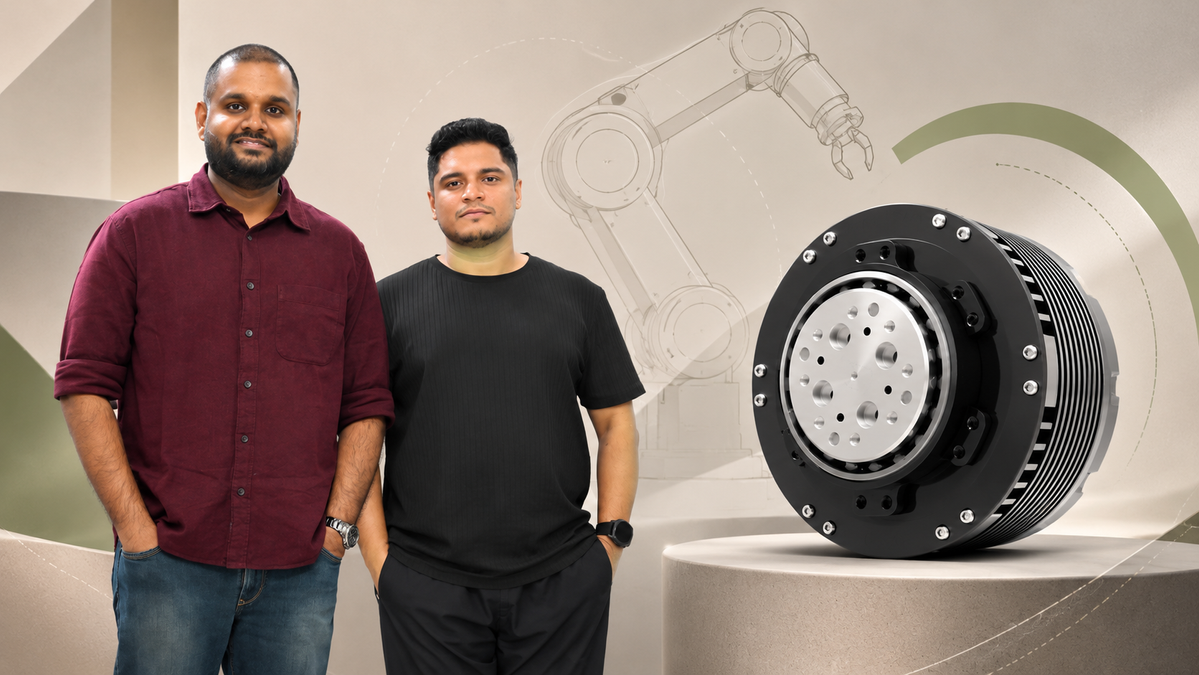
Bengaluru-based deep-tech startup Cosine Robots has raised Rs 22.36 crore in a funding round led by Avaana Capital, as it looks to expand the domestic manufacturing of precision components used in industrial robots, collaborative robots and humanoid systems.
The round also saw participation from WEH Ventures and angel investors. The company plans to deploy the capital towards establishing a dedicated research and development (R&D) and production facility, expanding its engineering team and accelerating the development of its integrated servo actuator portfolio.
Founded by Kiran Mathew Koshy and Delip Thomas, the startup develops robotic actuators and motion systems that control the movement, speed, torque and precision of robotic joints. These components play a critical role in determining how efficiently robots perform physical tasks, particularly in applications requiring controlled and repeatable movements.
Unlike companies that primarily develop complete robotic systems, the Bengaluru-based venture is focusing on the underlying motion technology that powers them. Its integrated servo actuators combine motors, gearboxes, sensors, electronics and proprietary control software into a single unit.
The company is also developing different types of actuators designed to meet the movement and force requirements of industrial robotic arms, collaborative robots, four-legged robots and humanoid robots.
According to the company, its proprietary control architecture uses dual-position sensing and a 25 kHz control loop, enabling 25,000 updates per second to regulate movement and torque. The approach is designed to improve motion precision, responsiveness and stability.
“Our goal is to make high-quality robotics more accessible. This funding will help us strengthen our research and development and establish production capabilities for actuators designed and built by our team,” said Kiran Mathew Koshy, co-founder and CEO of Cosine Robots.
India’s robotics hardware opportunity
The funding comes as robotics adoption expands across industrial applications, increasing demand for components that can deliver reliable movement at competitive costs.
According to the International Federation of Robotics (IFR), global installations of industrial robots reached 603,307 units in 2025, marking an 11% year-on-year increase. The organisation expects annual installations to reach 655,000 units in 2026.
India’s robotics ecosystem is also seeing activity across different segments, including warehouse automation, autonomous mobile robots and humanoid platforms.
Companies such as Ati Robotics, Addverb Technologies and Unbox Robotics are developing robotic systems for industrial and logistics applications. Ati Robotics has been expanding its industrial robotics portfolio, while Addverb has been exploring physical AI-powered robots for industrial and defence applications. Business Standard reported in August 2026 that both companies were also looking at domestic manufacturing of critical components, including actuators.
However, the development of a domestic component supply chain remains an important challenge for the sector. A July 2026 report by Mint highlighted India’s continued dependence on imported high-precision sensors, motors and manufacturing equipment, pointing to localisation as a key requirement for scaling robotics manufacturing.
This creates an opportunity for companies developing specialised hardware rather than competing solely in the finished robotics market. Actuators, in particular, influence a robot’s payload capacity, movement accuracy, energy efficiency and overall manufacturing cost.
Moving towards production
The latest capital infusion will support the expansion of Cosine Robots’ manufacturing capabilities, with its planned facility bringing precision machining, assembly, calibration and endurance testing under one roof.
The company also intends to strengthen its multidisciplinary engineering team as it moves from product development towards larger-scale production.
Avaana Capital partner Vikas Verma said the company was addressing a fundamental engineering challenge in robotics by combining precision mechanics, proprietary controls and manufacturing capabilities. Deepak Gupta, managing partner at WEH Ventures, said the development of domestic actuator suppliers could support the broader Indian and global robotics ecosystem.
For the startup, the next phase will involve translating its engineering capabilities into commercially deployable products and building a manufacturing operation capable of serving robot manufacturers.
As more Indian companies develop industrial and humanoid robotic platforms, the availability of locally engineered motion systems could become an important factor in reducing component dependence and improving the economics of domestic robotics manufacturing.
















Leave a comment