
 26 May 2026
The Japanese robot-maker Fanuc has formed a strategic collaboration with Google to advance the use of physical AI in its robot systems, using Google technologies. As part of the initiative, Fanuc is developing an open platform to accelerate robotic automation by applying the latest AI developments across its portfolio, from small robots with 3kg payloads to large machines with 2.3-tonne payloads, including its CRX collaborative robots.
Fanuc and Google have already developed a physical AI system for robots that incorporates Google innovations, including its high-security Gemini Enterprise generative AI technology.
At its 34th New Products Open House held recently in Japan, Fanuc demonstrated a next-generation physical AI robot system using Gemini that understands spoken instructions, recognises objects, and can operate robots autonomously. Fanuc describes the system as “revolutionary” and says it will enable collaborative and standard robots to work together in single cells using simple natural language instructions.
At the International Robot Exhibition in Tokyo last December, Fanuc released a physical AI system that, it reports, has sparked a lot of interest. Since the exhibition, the company has shipped more than 1,000 robots for physical AI applications, and says that demand is continuing to grow. Under the agreement with Google, Fanuc will enhance this system using Google technologies.
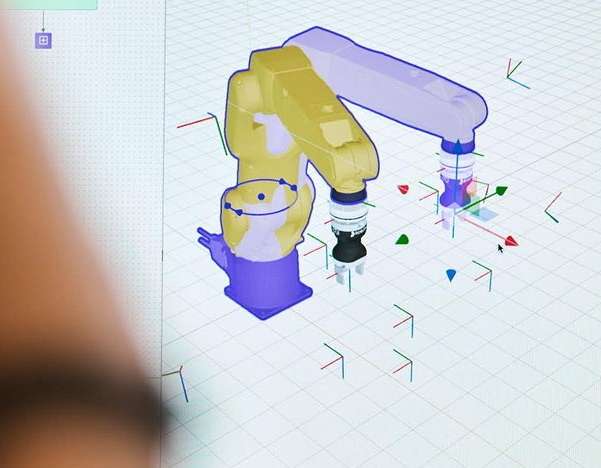
Under their new agreement, Google Intrinsic’s enterprise software platform will support Fanuc robots, allowing users to build, test and implement AI robot systems. Fanuc will offer robot controls that are compatible with Intrinsic’s Flowstate digital twin development environment. Flowstate software is interoperable with the ROS (Robot Operating System) open platform for robot control, allowing the quick and easy development of adaptable AI systems.
Google is a prominent contributor to ROS through its Intrinsic robotics AI group. Fanuc offers open-source ROS drivers that are compatible with the Python programming language for developing AI, as well as high-speed communications interfaces for external robot control, and interfaces that allow easy operation from PLCs.
Google’s Intrinsic software and AI robotics business says that its deeper integration with Fanuc will bring AI-accelerated workflows to ROS developers, making it easier for them to develop applications from prototyping to production lines. It predicts that AI applications will become more affordable to build and maintain in real production environments, adapting and optimising vision, motion and manipulation tasks continuously.
“The Intrinsic team has been working for years to enable access to intelligent robotics through a democratised platform, so more people can build and benefit from robotics applications,” says Intrinsic’s CEO, Wendy Tan White. “Combined with Google’s incredible AI and infrastructure, we’re going to unlock the promise of physical AI for a much broader set of manufacturing businesses and developers. This will fundamentally shift production, from its economics to operations, and enable truly advanced manufacturing.”
“Manufacturers are moving beyond the question of whether to use AI and focusing on how to apply it where it matters most – on the factory floor,” adds Mike Cicco, president and CEO of Fanuc America. “By combining Fanuc’s industrial-grade robotics with Google’s advanced AI, we’re enabling customers to take on more complex, variable production, while maintaining the reliability and performance that production environments demand.”
Physical AI – the integration of cognitive intelligence with physical action – has attracted considerable global attention recently. It includes robots that perceive their environments through sensors, make autonomous decisions and execute tasks accordingly.














Leave a comment