
Three Companies Compete for Market Leadership with Unique Strategies
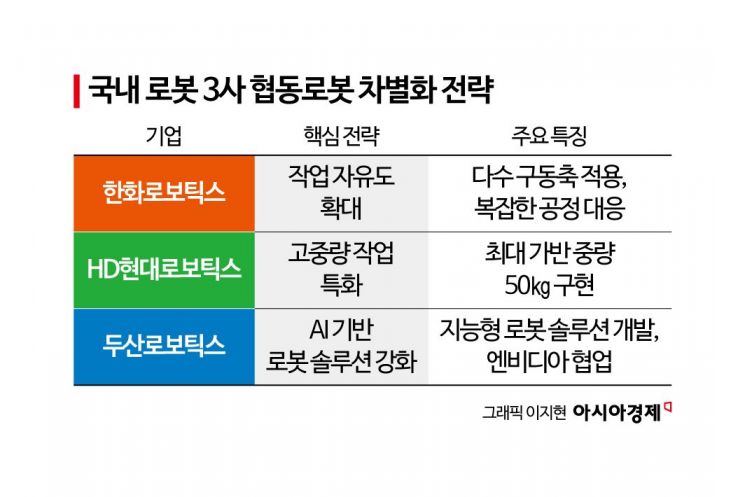
Hanwha Focuses on Enhancing Operational Freedom
Adopts More Drive Axes than Competitors
HD Hyundai Specializes in High-Payload Tasks
New Products after Six Years… Up to 50 kg Capacity
Doosan Pursues AI-Based Robotics Solutions
Focuses on Strengthening Software and AI Capabilities
As the scope of collaborative robot applications expands at smart factory sites, the three leading Korean robotics companies are now deploying distinct differentiation strategies to secure market leadership.
Hanwha Robotics is focusing on enhancing operational freedom, HD Hyundai Robotics is pursuing a strategy specialized in high-payload tasks, and Doosan Robotics is accelerating its transformation into an AI-based robotics solutions provider. Each company is shaping the future of ‘K-Robotics’ in its own way.

Hanwha Robotics will launch the HCR-32, a collaborative robot with a payload capacity of 32 kg, in the fourth quarter of this year. Hanwha Robotics
According to industry sources on June 17, Hanwha Robotics is set to launch the HCR-32, a collaborative robot with a payload capacity of 32 kg, in the fourth quarter of this year. Collaborative robots, or cobots, are designed to work alongside humans, addressing issues such as the high risk, operational complexity, and cost that have been pointed out as limitations of conventional industrial robots.
The HCR-32 is a high-payload model with a maximum operating range of 182 cm and a payload capacity of 32 kg. Compared to the existing top-level collaborative robot models with a 22 kg payload, Hanwha Robotics has increased the payload by 10 kg.
The company has focused not only on boosting payload capacity but also on improving operational freedom. A Hanwha Robotics representative said, “The HCR-32 is characterized by its adoption of more drive axes than competitors’ products, maximizing the robot’s degree of operational freedom. We expect it to be applied more flexibly to increasingly diversified industrial processes.”

HD Hyundai Robotics will launch the collaborative robot HDC 50-17 on the 1st of next month. It has a payload capacity of 50 kg and a maximum operating range of 170 cm. HD Hyundai
HD Hyundai Robotics, which holds the number one market share in Korea’s industrial robot sector, will also launch its HDC series on the 1st of next month, further strengthening its presence in the collaborative robot market. The HDC series marks the company’s return to collaborative robots six years after the debut of its first-generation ‘YL Series’ in the first half of 2020.
Among the three new models, the flagship HDC 50-17 is specialized for high-payload tasks. Its payload capacity is 50 kg, the highest among major collaborative robot manufacturers in Korea. The maximum operating range is 170 cm.
The HDC 25-18, which will be released alongside, has a payload capacity of 25 kg and a maximum operating range of 188 cm. The HDC 35-18 has the same operating range but a higher payload capacity of 35 kg. All three models offer repeatability of ±0.04 to 0.0 mm, enabling high-precision tasks.

Doosan Robotics’ P Series, a dedicated palletizing collaborative robot introduced in 2024. Doosan Robotics
Doosan Robotics, currently the number one collaborative robot company in Korea and ranked fifth globally, is rapidly transitioning from simple manufacturing and sales to becoming an AI-based robotics solutions provider.
Within its existing lineup, the P Series (P3020) introduced in 2024 is the top model in terms of payload and operating range. The P3020 supports a payload capacity of 30 kg and a maximum operating range of 203 cm.
However, Doosan Robotics plans to focus on strengthening its software and AI capabilities rather than expanding its hardware lineup of high-payload collaborative robots in the near term. The company aims to differentiate itself through intelligent robotics solutions that offer AI-based autonomous operations and workflow optimization, moving beyond simple collaborative robot sales.

A Doosan Robotics official stated, “At present, we have no plans to develop higher-end versions of our collaborative robots. Since last year, our focus has shifted from hardware-centric development to creating integrated robot solutions that combine AI, software, and hardware.”
The company’s potential collaboration with Nvidia is also drawing attention. To advance robotics technology, it is necessary to evolve the software that governs robot cognition, which in turn requires data and manufacturing expertise accumulated in real industrial environments.
Hot Picks Today
“Everyone Gets Rich But Me?” Impatient Retail Investors Flock In… Foreign Media Issues Warning
The official said, “Nvidia possesses strong AI robot platform capabilities, while Doosan Robotics has accumulated data and operational experience from real industrial sites. We plan to begin our collaboration focusing on the software domain to generate synergies.”
This content was produced with the assistance of AI translation services.
© The Asia Business Daily(www.asiae.co.kr). All rights reserved.















Leave a comment