
The Environment the Robot Must Survive
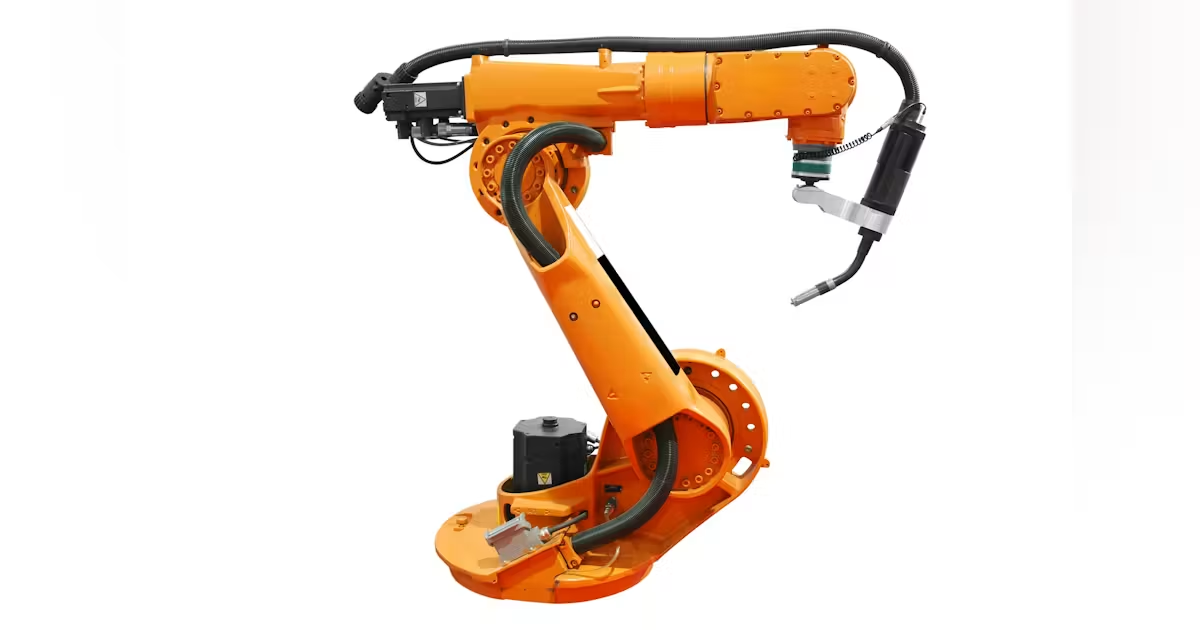
Once the payload is understood, the next question is whether the robot can survive its operating environment. Washdown conditions, abrasive dust, high temperatures and human-robot interaction zones all narrow the field quickly. A robot that performs well in a lab may fail on a food-processing line or in a machining cell. Environmental compatibility is not a secondary filter; it is a primary design constraint.
Alongside the physical environment sits a human-centric decision that is equally consequential: whether the robot must operate collaboratively with people. This is not simply a safety question, but a design choice that affects speed, stiffness, payload and long-term reliability.
READ MORE: Beyond the Sticker Shock: The Real Reason Companies Hesitate to Adopt Robotics
Collaborative robots intentionally limit force, acceleration and structural rigidity to ensure safe interaction, making them well-suited for light assembly, machine tending and ergonomic assistance but less appropriate for high-throughput or high-inertia tasks. Traditional industrial robots assume physical separation from people and therefore operate with higher stiffness, greater acceleration and more demanding duty cycles.
The decision to go collaborative or not is ultimately a question of workflow design: whether the human and robot share the same workspace, work simultaneously or both.
Matching the Robot to the Shape of the Task
With the environment defined, engineers must consider workspace geometry. Every robot architecture has a natural workspace and forcing a robot outside that natural shape costs performance. SCARAs excel in cylindrical, planar assembly tasks. Deltas dominate dome-shaped, top-down picking. Gantries provide rectangular, deterministic motion.
Articulated arms offer dexterity but introduce singularities that can cause velocity spikes or sudden loss of stiffness. If the task requires reaching into machines, avoiding fixtures or maintaining vertical rigidity, workspace geometry often eliminates half the candidate architectures before dynamic performance is even discussed.
Even when the workspace fits, the end-effector can become the dominant constraint. A heavy gripper may disqualify a delta robot. A long tool may cause excessive deflection on an articulated arm. A vision-guided end-effector may require the vibration-free behavior of a gantry.
Robot and tool must be evaluated as a single mechanical system. Many integration failures trace back to treating them as separate decisions rather than a coupled dynamic system, a mistake that shows up only after commissioning when it is expensive to correct.
Reliability, Stiffness and the Physics of Accuracy
In high-volume manufacturing, uptime often matters more than raw speed. Gantries offer exceptional reliability due to their simple linear motion. SCARAs are famously robust for repetitive planar tasks. Articulated arms require more maintenance because of gearboxes and brakes.
Cobots, by design, trade stiffness and speed for safety, which limits their duty-cycle ratings. For 24/7 operations, the simplest mechanism that meets the requirements is almost always the most reliable one.
READ MORE: Flexible Robots, Messy Worlds: Inside Siemens’ Push for Practical Industrial AI
Reliability connects naturally to stiffness, the factor most closely tied to accuracy. Encoder resolution means little if the structure deflects under load. Articulated arms have the lowest stiffness due to serial compliance. SCARAs offer excellent in-plane stiffness. Deltas provide strong vertical stiffness but limited horizontal rigidity. Gantries deliver the highest stiffness overall.
Static stiffness matters but dynamic stiffness under acceleration is often the true limiting factor in high-speed applications, a distinction that catalog specifications rarely make clear.
Acceleration, Settling Time and the Real Drivers of Cycle Time
With stiffness understood, engineers must evaluate whether the robot can meet the required acceleration and cycle-time demands. Cycle time is governed by moving mass, torque limits, inertia matching and allowable settling time.
In many systems, settling time rather than travel time is the dominant contributor to cycle time, a fact that surprises engineers who focus only on peak velocity. This is why deltas dominate sub-500-millisecond cycles, SCARAs excel in the 0.5 to 1.5-second range, and articulated arms are best suited to applications where dexterity matters more than speed.
READ MORE: Avoiding Obstacles: Ati’s Pallet Mover AMR Simplifies Existing Floors
All of these dependencies ultimately converge on throughput, the real production rate the system must sustain. Vision processing, conveyor tracking, end-effector motion and safety interlocks all shape the true cycle time.
Throughput sits at the end of POWERSET because it is the result of every dependency that precedes it. Optimizing throughput without first resolving the upstream dependencies is the root cause of most over-specified, under-performing automation systems.
A Real-World Example
Consider a packaging line requiring 120 picks per minute with a 300-gram product. POWERSET narrows the architecture choice quickly. Payload inertia eliminates articulated arms almost immediately. Acceleration requirements favor delta robots for sub-500-millisecond cycles. Workspace geometry confirms that a dome-shaped workspace is ideal.
Stiffness modeling shows that deltas maintain vertical rigidity during high-speed motion. A final throughput analysis predicts a delta robot achieving 118 picks per minute with margin, while a SCARA tops out at 92. The mechanism-centric evaluation makes the decision clear and defensible.
Making POWERSET Quantitative
To move beyond qualitative reasoning, POWERSET can be expressed as a scoring function: POWERSET (robot, task) produces a suitability score that is a weighted combination of the eight dependencies. The weights are application specific. High-speed packaging emphasizes acceleration and throughput. Precision assembly emphasizes stiffness and end-effector behavior. The table below illustrates how weights shift across two common application types.
|
Dependency |
High-Speed Packaging |
Precision Assembly |
|
Payload |
0.8 |
0.5 |
|
Operating Environment |
0.5 |
0.5 |
|
Workspace |
0.5 |
0.8 |
|
End-Effector |
0.5 |
0.8 |
|
Reliability |
0.8 |
0.5 |
|
Stiffness |
0.5 |
0.9 |
|
Energy/Acceleration |
0.9 |
0.2 |
|
Throughput |
0.9 |
0.5 |
This function transforms POWERSET from a conceptual checklist into a scoring model that engineers can use to compare architectures quantitatively and communicate selection rationale to project stakeholders.
It is worth noting where POWERSET works best and where it has limits. The framework is most effective when the task is well-defined and the candidate architectures are conventional.
It is less prescriptive for custom or hybrid mechanisms, applications where cost dominates all other constraints, or early-stage feasibility studies where task parameters are still evolving. In those cases, POWERSET serves best as a structured thinking tool rather than a definitive scoring instrument.
A Common Language for Robot Selection
Robot selection is not about brand familiarity, catalog specifications or legacy preferences. It is a mechanical engineering decision shaped by inertia, stiffness, workspace geometry and reliability. POWERSET provides a structured, physics-based method for making that decision with confidence.
As automation complexity grows and collaborative and traditional robots increasingly share the same facilities, a common evaluation language becomes more valuable—not just for individual projects but for the discipline as a whole. POWERSET gives engineers a repeatable, physics-based starting point for a decision that has too long relied on intuition and vendor preference.














Leave a comment