
Coptis chinensis is a slow-growing perennial that takes five years from planting to harvest, making conventional cross-breeding nearly impossible. Farmers have relied on cloning—dividing rhizomes to propagate genetically identical plants—for generations. This practice has created a genetic bottleneck: whole-genome resequencing of 235 accessions from across China’s major production regions revealed nucleotide diversity below 0.002, a level of uniformity that typically signals vulnerability to pests, pathogens, and environmental change. Yet paradoxically, different growing regions still produce rhizomes with distinct medicinal properties—a phenomenon central to the “Dao-di” (geo-authentic) concept in Chinese medicine, but one that defies simple genetic explanation. Based on these challenges, or due to these problems, an in-depth investigation is urgently needed to understand how medicinal quality and adaptive traits are maintained despite extreme genetic homogenization, and to develop breeding strategies that do not rely on sexual recombination.
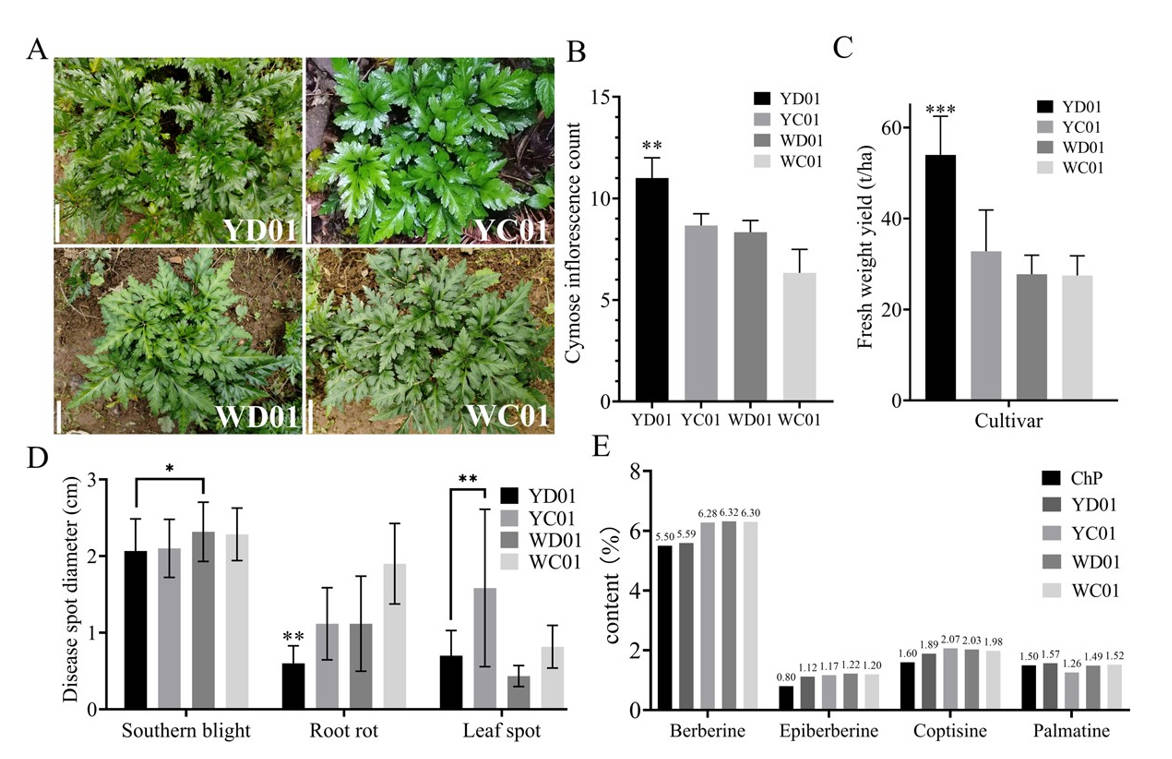
Now, a team from the Hubei Academy of Agricultural Science’s Institute of Chinese Herbal Medicine in Enshi, China, reports (DOI: 10.1093/hr/uhag112) a comprehensive genomic and machine-learning study of C. chinensis in Horticulture Research. The researchers constructed a high-quality chromosome-level genome for the elite cultivar ‘Chulian No. 1’—which shows 34% higher yield and robust disease resistance—and analyzed genetic variation across 235 accessions using a novel geospatial-autoencoder model.
The genome assembly, spanning 983 megabases across nine chromosomes, achieves a contig N50 of 13.14 Mb—16 times greater than previous C. chinensis assemblies—and a BUSCO completeness score of 98.2%, making it the most complete genomic resource for this species to date. The analysis revealed that long terminal repeat retrotransposons (LTR retrotransposons) comprise 41.92% of the genome and cluster near genes involved in stress responses and alkaloid biosynthesis, suggesting they may have helped maintain phenotypic innovation despite genetic uniformity. Whole-genome duplication (WGD) analysis uncovered two events: an ancient Ranunculaceae-wide duplication and a more recent lineage-specific event about 3 million years ago. Notably, alkaloid biosynthesis genes were retained from the recent WGD at nearly three times the genome-wide average (58.6% vs. 21.2%), indicating strong selection for enhanced secondary metabolism. When the team applied a variational autoencoder—a machine-learning model that compresses complex genomic data into interpretable patterns—to 235 resequenced accessions, they uncovered three ecogeographic groups that PCA and ADMIXTURE analysis had completely failed to detect, demonstrating that AI can extract biologically meaningful structure even when genetic differentiation is extremely low.
“The biggest surprise was that traditional population genetics tools simply gave us a blank wall—they showed one homogeneous population with no structure at all,” the authors said. “But when we fed the same data into our autoencoder and layered in geographic information, three distinct ecogeographic groups emerged. That tells us that clonal propagation doesn’t erase all meaningful variation—it just hides it in ways that conventional methods can’t see. For medicinal plants where breeding has been stuck for decades, this is a game-changer.” The team also identified a gene on chromosome 1, CcHAB1, that is associated with leaf glossiness; glossy leaves accumulated nearly three times more cuticular wax than nonglossy ones, and the gene’s expression pattern suggested it acts through abscisic acid (ABA) signaling to regulate wax biosynthesis.
The findings offer a practical roadmap for breeding medicinal plants that cannot be improved through traditional crossbreeding. The high-quality reference genome provides a foundation for marker-assisted selection, allowing breeders to screen for desirable traits—such as disease resistance or high alkaloid content—without waiting through the five-year growth cycle. The machine-learning framework is transferable to other clonally propagated crops, endangered species with genetic bottlenecks, and self-pollinating plants with narrow genetic bases. For the traditional Chinese medicine industry, the work provides genomic evidence that “Dao-di” quality may be maintained through mechanisms beyond DNA sequence variation—possibly involving epigenetics or microbiome interactions—opening new research directions for authenticating and sustainably cultivating region-specific medicinal materials.
###
References
DOI
Original Source URL
https://doi.org/10.1093/hr/uhag112
Funding information
This work was supported by the Project Supporting High-Quality Development of the Seed Industry Fund of Hubei Province (HBZY2023B00506); the Youth Science Foundation Project of Hubei Academy of Agricultural Sciences (2024NKYJJ38, 2025NKYJJ36); the Postdoctoral Project of Hubei Province (2024HBBHCXB005); the Youth B Project of Natural Science Foundation of Hubei Province (JCZRQNB202600511); the Enshi Prefecture Qihang Program (D20250009); and the Natural Science Foundation of Hubei Province (2025AFD152).
About Horticulture Research
Horticulture Research is an open access journal of Nanjing Agricultural University and ranked number one in the Horticulture category of the Journal Citation Reports ™ from Clarivate, 2023. The journal is committed to publishing original research articles, reviews, perspectives, comments, correspondence articles and letters to the editor related to all major horticultural plants and disciplines, including biotechnology, breeding, cellular and molecular biology, evolution, genetics, inter-species interactions, physiology, and the origination and domestication of crops.
















Leave a comment