
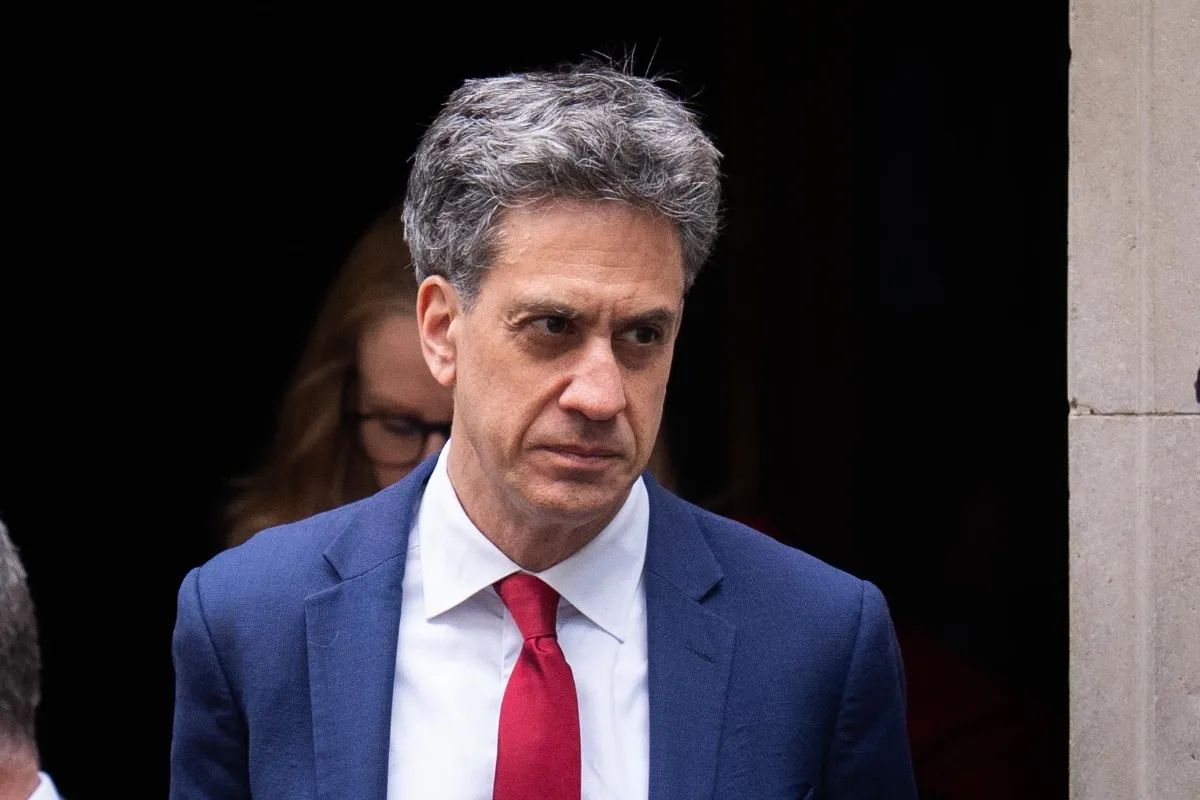
Ed Miliband has vowed Britain will use its G20 presidency next year to push for global rules on AI, warning governments “cannot leave it to corporations” to police the technology.
The foreign secretary said the economic potential of AI was “inspiring” but warnings from the companies developing the technology meant governments needed to act.
“The threat it poses, according to its own inventors, is daunting”, Miliband said.
“Some are calling for us to act, but other tech companies are saying we should leave it all to them”.
Miliband said history showed companies could not be relied on to set safeguards in the public interest because their purpose was to “maximise profits”.
“We cannot and will not allow that to come at the expense of our children or indeed humanity”, he said.
“That’s why, as part of our G20 presidency next year, this country will lead the efforts to manage AI”.
The comments build on Andy Burnham’s pledge at the UN last week to make frontier AI a focus of Britain’s G20 presidency.
Burnham said the UK would seek a single set of global principles and standards” covering transparency, access to advanced models and safe development, pitching Britain as an “honest broker” between the US, Europe and other major economies.
The push comes as some of the world’s biggest AI companies call for greater oversight.
OpenAI has urged the UK to introduce stronger rules for companies developing the most powerful models, while chief executive Sam Altman has backed common international standards for assessing capabilities and risks.
Anthropic chief Dario Amodei has also called for developers to slow the development of ‘frontier’ models where necessary to ensure safety measures keep pace.
US pushed back on tighter AI rules
Britain’s approach contrasts with the Trump administration, which has pushed for lighter regulation as it seeks to maintain America’s lead over China.
The US used its G20 presidency this year to promote the so-called Carolina Principles, which favour fewer barriers to the development and deployment of AI.
At a G20 technology meeting in North Carolina last month, Elon Musk argued new technologies should be “default legal”, while Nvidia boss Jensen Huang warned governments against focusing too heavily on the risks of AI.
Huang told ministers that countries needed to treat AI computing capacity as infrastructure alongside electricity, roads and the internet, arguing governments risked being left behind if they failed to invest.
OpenAI’s Altman told the same meeting that adoption of AI was “non-negotiable”, but added that concern over the technology was warranted.
It comes as former Anthropic researcher Jacob Coxon, who previously worked at OpenAI, resigned this month and accused the companies of “racing straight to self-improving superintelligence and gambling with our lives”.
Britain’s AI Security Institute has also faced questions over its ability to scrutinise the most advanced models. Its testing remains voluntary and Anthropic did not provide its latest model for pre-release testing after the White House asked US developers to give the American government first access.
The government has said it should not be assumed that the existing framework will remain sufficient as AI capabilities advance.
Britain takes over the G20 presidency from the US next year, giving the government a platform to try to turn its proposed international standards into an agreement between the world’s largest economies.













Leave a comment