
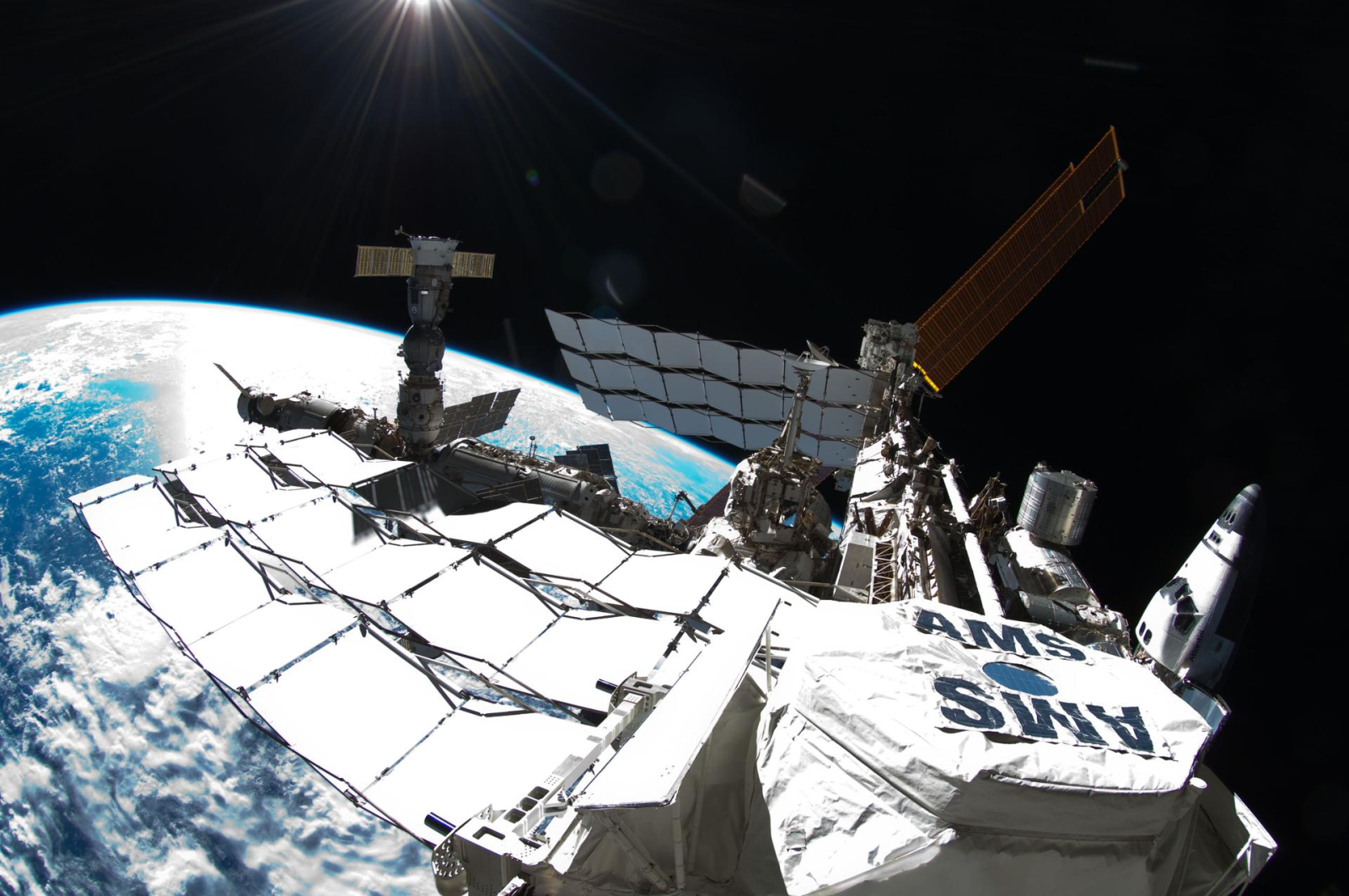

NASA
Masayoshi Son, the SoftBank founder who chairs the $500 billion Stargate AI infrastructure initiative alongside OpenAI, told shareholders on June 23 that Elon Musk’s plan to put AI data centers in orbit fails the most basic cost test — and that the AI race will be settled on Earth long before orbital compute can mature. The dismissal came at the annual meeting of SoftBank’s mobile unit, in response to a shareholder question about whether the company planned to follow SpaceX’s lead into low Earth orbit.
The problem, Son argued, is that electricity is not actually what drives data center costs. Hardware — chips, above all — is. Whatever savings an orbital data center might achieve by running on near-constant solar power, it would hand back immediately in launch costs, on-orbit maintenance, and the communication latency that would strangle the kind of tightly synchronized GPU workloads that modern AI training demands. “In the battle for AI,” Son told shareholders, “the next few years will be far more important than what might happen a decade or so from now.”
A TechCrunch analysis published June 27 widened the lens on the debate: every prominent voice rejecting orbital AI compute — Son, OpenAI’s Sam Altman, and Amazon Web Services CEO Matt Garman — also has enormous financial stakes in terrestrial infrastructure winning. There are, as TechCrunch observed, no disinterested parties in this argument.
What Musk Actually Proposed: Servers at 500 Kilometers
To evaluate Son’s case, it helps to understand the ambition he is rejecting.
In January 2026, SpaceX filed with the Federal Communications Commission for authorization to launch up to one million satellites configured as orbital data centers, operating between 500 and 2,000 kilometers above Earth. The filing came just days before SpaceX completed its acquisition of xAI — Musk’s AI company and developer of the Grok large language model — in the largest private merger in history, valuing the combined entity at $1.25 trillion. The merger’s stated rationale was vertical integration for orbital compute: one company spanning rockets, satellite internet, chip manufacturing ambitions, and AI models.
On June 8, Musk released a detailed technical briefing on the first-generation orbital data center design, a spacecraft designated AI1. The craft has a deployed wingspan of 70 meters — wider than a Boeing 747-8 — and can sustain an average compute payload of 120 kilowatts, peaking at 150 kilowatts. It draws power from solar panels designed to generate roughly 250 watts per square meter in orbit, where there is no atmosphere to absorb sunlight and no night cycle to interrupt generation. Waste heat is shed through large liquid radiators oriented to radiate from both faces while absorbing as little sunlight as possible.
Musk’s commercial pitch is built on the scale of demand that currently exists for AI compute on the ground. SpaceX’s S-1 filing with the Securities and Exchange Commission, submitted ahead of the company’s June 12 Nasdaq debut — which raised more than $85 billion at a day-one valuation of $1.77 trillion, the largest IPO in history — disclosed that Anthropic agreed to pay $1.25 billion per month through May 2029 for access to xAI’s Colossus 1 data center near Memphis, Tennessee. A separate filing on June 5 disclosed that Google agreed to pay $920 million per month starting in October 2026, running through June 2029. Combined, those two agreements represent roughly $26 billion in annualized compute revenue from two of the best-funded AI companies in the world — and xAI built those facilities to train Grok, not to rent out compute. The customers arrived because xAI had more capacity than it could use, which Musk has cited as evidence of the hunger for compute that orbital infrastructure would be designed to feed at a scale Earth cannot.
How Inter-Satellite Latency Kills AI Training in Orbit
The technical obstacle Son pointed to — and the one engineers consistently name as the most fundamental — is latency. Satellites in low Earth orbit sit roughly 500 to 2,000 kilometers above the ground. Even using laser inter-satellite links, which travel at the speed of light in vacuum, the physical distance between satellites means signal round trips between orbital nodes take on the order of 25 milliseconds at minimum.
That number collides with a hard constraint in how modern AI training actually works. Large-scale distributed training relies on tightly synchronized all-reduce operations: at the end of each training iteration, every GPU in a cluster must exchange gradient updates with every other GPU before the next forward pass can begin. On terrestrial InfiniBand networks, this synchronization happens at sub-microsecond to single-digit microsecond latency — speeds that allow GPU utilization rates above 60 percent on large clusters. At 25 milliseconds of inter-node latency, the math collapses: GPUs finish their computation and then sit idle, waiting for signals from satellites tens or hundreds of kilometers away. Independent analysts at SemiAnalysis concluded in June 2026 that achieving space-to-Earth cost parity for AI training workloads would require resolving this latency gap, which is not merely an engineering improvement but a structural constraint of orbital geometry.
Google’s own published feasibility study for its Project Suncatcher initiative, which plans to fly prototype satellites by early 2027 in partnership with Planet Labs, acknowledged this constraint directly: large-scale machine learning workloads distributed across orbital satellites require inter-satellite links supporting tens of terabits per second, achievable only with satellite formations flying in very close proximity — kilometers or less apart. That requires a fundamentally different constellation architecture than what SpaceX has proposed for its million-satellite buildout, which spans altitudes of 500 to 2,000 kilometers.
The latency problem does not disqualify orbital compute from every AI workload. Inference — where a trained model responds to user queries — has much looser synchronization requirements than training. Edge processing of satellite imagery and sensor data, which does not need to be returned to Earth in real time, is a natural fit. The near-term orbital compute market is more likely to be won by those use cases than by distributed training at hyperscale — a distinction that raises questions about how central orbital data centers are to the AI race Son and Musk are both trying to win.
The Cost Arithmetic: Chips Dominate, Power Is a Footnote
Son’s core financial argument is that orbital data centers solve the wrong problem.
Electricity costs are real: terrestrial data centers pay on the order of 8 to 9 cents per kilowatt-hour in the United States on average, and power is a genuine constraint on where new capacity can be built. But power is not the dominant cost in AI data center economics. Epoch AI’s May 2026 analysis of a one-gigawatt AI data center found that servers — the hardware itself, primarily GPUs — account for roughly 60 percent of total cost of ownership. Electricity accounts for about 7 percent of annualized costs. An analysis published in IEEE Spectrum in March 2026, drawing on independent engineering estimates, found that a one-gigawatt orbital data center constellation would cost approximately $51 billion over five years of operation, compared to roughly $16 billion for an equivalent terrestrial facility — about three times more expensive, even after accounting for the free solar power.
Launching hardware into low Earth orbit using SpaceX’s current rockets costs roughly $5.6 million per 800 kilograms. A single Nvidia NVL72 GB200 rack-scale solution — the kind of hardware that would go into an orbital data center — weighs between 1,360 and 1,472 kilograms, without connectivity, cooling, or power infrastructure. At current launch prices, putting one rack into orbit costs more than the rack itself. SpaceX’s entire orbital data center thesis rests on its Starship rocket dramatically reducing the per-kilogram cost to orbit before that math changes — and Starship’s commercial launch cadence is still a future-tense proposition.
Son is not the only prominent figure making this argument. Sam Altman called orbital data centers “ridiculous” in an interview earlier this year, adding that they will not matter at scale “this decade.” Amazon Web Services CEO Matt Garman said at a conference this past spring that there are not enough rockets yet to launch a million satellites. Jeff Bezos, whose Blue Origin filed plans in March 2026 for a constellation of more than 51,000 data center satellites of its own, predicted that orbital timelines being discussed publicly are “probably a little ambitious.”
Every Skeptic Has a Book to Talk
The most significant editorial note on this debate is also the one most often omitted: none of the voices above are disinterested observers.
Son’s SoftBank is the party with primary financial responsibility for Stargate, the $500 billion terrestrial AI infrastructure initiative. A rival who spends the next several years putting servers into orbit is a rival distracted from the terrestrial buildout that Son’s investment thesis depends on. Altman’s OpenAI depends on ground-based compute contracts — the company recently secured a reported $122 billion funding round, with much of that capital tied to terrestrial infrastructure expansion. Garman runs Amazon Web Services, which competes directly with SpaceX’s emerging compute-rental business. Bezos’s Blue Origin filed its own rival orbital satellite application with the FCC, giving him financial stakes on both sides but a launch-economics interest in keeping the timeline credible rather than dismissing the concept entirely.
As TechCrunch’s Anthony Ha noted on June 27: “There’s just no objective, impartial observers here. It’s all these people with baggage and tremendous amounts of money at stake.”
The point does not invalidate Son’s engineering argument, which is technically grounded and shared by named analysts at MoffettNathanson and Forrester. It does mean that investors and enterprise buyers evaluating AI infrastructure decisions cannot treat any of these authorities as objective assessors of when and whether orbital compute becomes viable. Every forecast in this debate comes with a financial disclosure that should be read first.
What the Timeline Actually Looks Like
SpaceX plans to launch two prototype AI1 satellites in early 2027, with a commercial constellation to follow. The company’s S-1 filing cited 2028 as the earliest plausible date for commercial orbital data center operations. Google’s Project Suncatcher plans to launch its own prototype satellites by early 2027 in partnership with Planet Labs. Analysts at MoffettNathanson have projected that commercial viability at scale is more likely a 2030s proposition, contingent on Starship reaching mass commercial cadence and driving launch costs below $200 per kilogram — a threshold Google’s own feasibility study identified as the point at which orbital compute could compete economically with terrestrial energy costs.
SoftBank, meanwhile, committed in early June 2026 to develop five gigawatts of AI data center capacity in France in an investment that could reach €75 billion, anchored in the nuclear grid that gives France abundant, low-carbon power at a moment when electricity availability is the primary constraint on new terrestrial data center construction. The message embedded in that commitment aligns directly with Son’s June 23 remarks: the decisive window in AI will close before the orbital bet can mature, and the companies that win will be the ones building on the ground today, not waiting for launch costs to fall.
Whether that is right depends on a judgment call that Son openly acknowledges he cannot make with certainty — and one that Musk’s SpaceX is betting its post-IPO story on being wrong. For now, all the AI compute that Anthropic and Google are paying billions of dollars per month for runs in warehouses in Memphis, Tennessee. The orbital servers do not yet exist.
Frequently Asked Questions
Why does inter-satellite latency make AI training in space so difficult?
Distributed AI training requires all GPUs in a cluster to synchronize gradient updates after every training iteration, an operation called all-reduce. On terrestrial InfiniBand networks, this synchronization takes less than five microseconds. Satellites in low Earth orbit are hundreds to thousands of kilometers apart, and even laser inter-satellite links cannot reduce the signal travel time below roughly 25 milliseconds — thousands of times slower than what training synchronization requires. At that latency, GPUs finish their computation and then sit idle waiting for network responses, driving utilization rates far below the 60-plus percent achievable on terrestrial clusters.
Do Elon Musk and Masayoshi Son actually disagree on whether orbital data centers will ever work?
Not exactly. Son’s argument is about timing, not physics. He acknowledged the theoretical advantages of solar power in orbit but argued that hardware costs, launch costs, and latency mean orbital compute will not be competitive during the years that matter most to the AI race. Musk contends that Starship will reduce launch costs dramatically within two to three years. Son’s position is that the decisive window in AI closes before that bet pays off.
Is every major opponent of orbital AI data centers financially invested in terrestrial compute winning?
According to a June 27, 2026 TechCrunch analysis, every named skeptic — SoftBank, which backs Stargate; OpenAI’s Sam Altman, who runs a company dependent on ground-based compute; and Amazon Web Services’ Matt Garman, who competes directly with SpaceX’s compute-rental business — has enormous financial stakes in terrestrial infrastructure succeeding. TechCrunch concluded there are no objective, impartial observers in this debate.
What are the actual near-term use cases where orbital compute does work?
Industry analysts and companies including Lonestar, Planet Labs, and Starcloud have identified edge processing of satellite imagery, secure data storage off-planet, and latency-tolerant batch computing as workloads where orbital data centers have genuine advantages. These use cases do not require the tight GPU synchronization that makes training in orbit impractical. Real-time AI inference for high-volume user queries is better suited to terrestrial infrastructure for latency reasons, though orbital inference may become viable for edge applications where ground connectivity is unavailable.














Leave a comment