
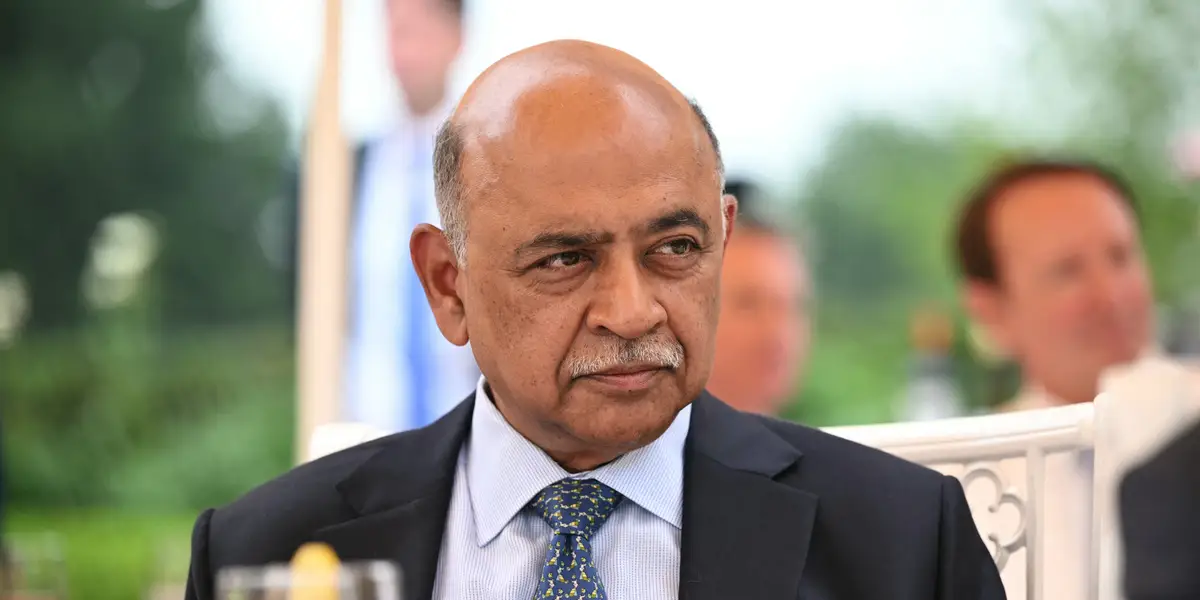
IBM is on pace to have its worst day ever on the stock market after saying it misread the AI spending boom.
On Tuesday, eight days before the company’s scheduled earnings call, CEO Arvind Krishna released a letter to shareholders that detailed a quarterly “performance shortfall,” including slimmer-than-expected revenue.
“While we anticipated some supply chain related impact in our expectations, we did not anticipate the magnitude of the capex reprioritization,” he wrote. “In addition, clients were distracted with rapidly-evolving, industry-wide cybersecurity concerns in the quarter.”
The warning quickly revived talk of a SaaSpocalypse — the fear that AI will erode the value of some traditional software companies. For months, investors have worried that businesses will need fewer software subscriptions as AI agents automate and build custom tools.
IBM is not a pure software-as-a-service company, and Krishna did not say AI had made its products obsolete. Instead, he said customers redirected spending toward increasingly expensive servers, storage, and memory — leaving less money available for some of IBM’s software and consulting services.
The shortfall is still touching a nerve among industry bigwigs. Companies are pouring money into the infrastructure needed to power AI, while investors increasingly question how much of that spending will ultimately flow to established software providers.
Here is what smart voices in business and tech are saying about the early announcement’s impact on the economy:
Chamath Palihapitiya — CEO at 8090 and Social Capital

Jesse Grant/The Hollywood Reporter via Getty Images
Chamath Palihapitiya said IBM’s stumble reflects a much bigger problem facing the AI industry: Companies selling intelligence are making enormous sums, but it’s unclear whether their customers can turn those costs into profits of their own.
“The downstream ecosystem has to make money as well,” Palihapitiya said Tuesday when asked about Krishna’s letter on CNBC. “And then, the ultimate buyer of these tokens also has to make money.”
He stopped short of blaming IBM’s problems on its pivot to AI and cloud computing, and praised Krishna for repositioning the company.
Palihapitiya was less forgiving of IBM’s suggestion that rapidly evolving cybersecurity concerns distracted some customers during the quarter.
He said AI companies and their investors have repeatedly swung between extremes: describing the technology as an all-powerful breakthrough when raising money, then warning that it poses an existential threat when seeking regulation.
Jacob Bourne — Analyst at EMARKETER
Bourne told Business Insider in an email that IBM was hit with a “triple whammy.”
He said the AI buildout is directing corporate spending toward hardware rather than software and services. At the same time, investors are punishing legacy companies that appear to be falling behind. Finally, AI-native challengers such as Anthropic are putting additional pressure on traditional software business models.
“We can expect more quarters like this one, but I think it’s a disruption story, not necessarily an extinction one for legacy software companies,” he wrote. “Spending patterns will shift from the present focus, and the vendors that adapt their products to the changing market will stay competitive.”
Nicholas Mugalli — CEO and Principal at World Trade Securities
NYSE
Mugalli wrote on X that he believes IBM is the first major casualty of a broader shift in enterprise spending.
He argued that IBM’s miss shows the limits of corporate budgets. As hardware became scarcer and more expensive, executives prioritized servers, storage, and memory over software deals that could be delayed.
“This is the SaaS reckoning arriving exactly the way it would,” Mugalli wrote, “not with cancellations, but with deprioritization. “
Mugalli predicted IBM would not be the last enterprise software company to feel that pressure, pointing specifically to Palantir and ServiceNow.
Dan Niles — founder of Niles Investment Management
Niles wrote on X that IBM’s warning was an example of the AI “speed bump” he has been expecting.
He also said that customers redirected spending toward AI late in the quarter, cutting into IBM’s mainframe and related software business. He said that much of that revenue is supposed to be recurring, making the shortfall more concerning.
“Given software is a back-end loaded business, I doubt this is the last casualty,” he wrote.















Leave a comment