
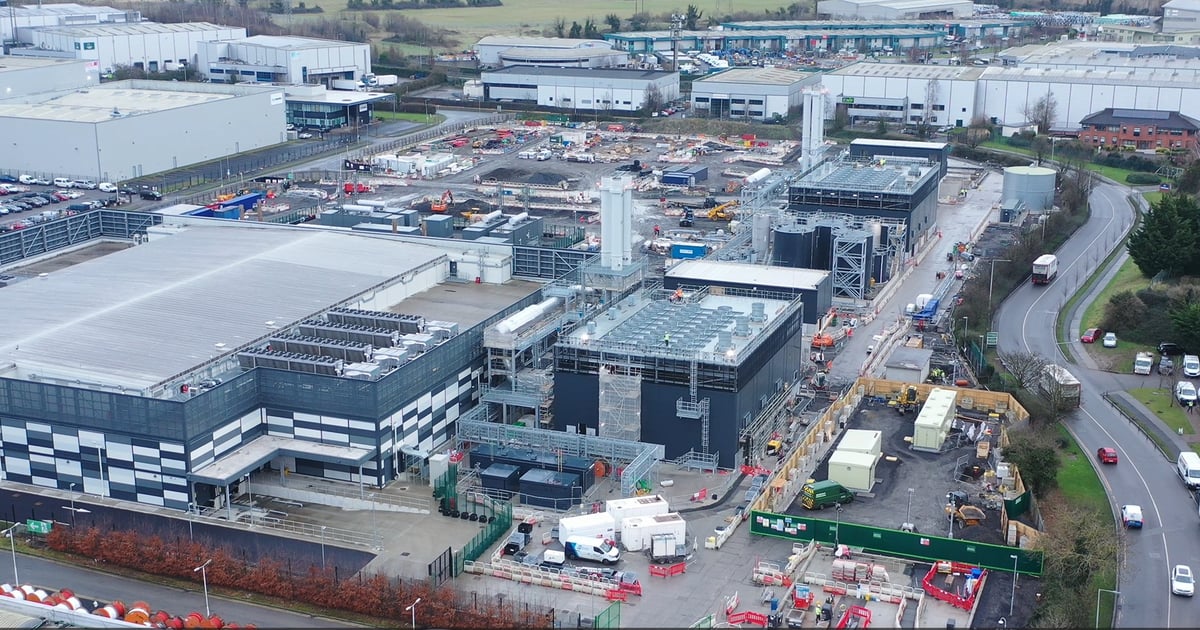
Data centres are being built globally at an exponential rate and show no sign of stopping. This could be a problem for the UK (and other countries) because electricity demand is already causing issues and is going to only get worse in the coming years.
The grid connection delays seen in the UK are a key barrier to data centre deployment in the country, with the wait time for a conventional grid connection reaching up to ten years in some cases.
One solution to solve the data centre power challenges in the UK is behind-the-meter (BTM) solar. Behind-the-meter is the generation of solar power on the asset owner’s side of the utility meter. This means that the energy generated by the solar power is converted to AC using an inverter and directly used on-site to power any systems requiring power, rather than the electricity flowing through to the electrical grid. Because the energy is generated on-site, it bypasses any UK grid connection queues and avoids transmission charges. In many cases, behind-the-meter solar is often co-located with large-scale battery energy storage systems (BESS).
Even though data centres have high energy demands, behind-the-meter solar has the potential to meet these ongoing needs. It’s expected that the UK solar market will grow by 5-5.5GW in 2026, a 50% year on year (YoY) growth for the second year in a row. According to the World Economic Forum (WEF), around 80% of data centre electricity demand will come from AI data centres by 2060, with potential energy demands of 6,400TWh per year.
Even though data centres have high energy demands, and potentially greater ones in the future, the UK has significant potential to meet these needs through behind-the-meter solutions. But it’s no secret that there will be challenges for developers when deploying behind-the-meter projects in the UK.
Why data centres can’t wait for the grid
The UK government has classified data centres as Critical National Infrastructure (CNI), mainly to support the continued advancement of AI use. CNIs receive substantial government support, and it’s expected that many data centres will be built across the UK. All data centres use a lot of energy, but AI data centres can consume vast amounts. While there are plans to build these data centres in the UK to support technological innovation and development, there is not the energy infrastructure to support it, and it is unlikely that the National Grid is going to be able to support the expansion at the rate it is currently going.
One reason for this is that there are serious grid connection delays in the UK, as well as in many parts of Europe. Given that data centres are CNI in the UK, this could help speed up their connection to the grid, but it is still likely to take some time.
Further, the longer that data centres wait to obtain a connection, the scarcer grid connections will become.
The WEF states that grid connections can take anywhere from four to ten years, but AI data centres can be built in between two and three years. That means that even in the best-case scenario, a data centre is constructed in half the time it will wait to connect to the grid.
These connection delays are caused by a combination of utility backlogs and long lead times for high-voltage equipment. The WEF has also stated that around 10% of new grid connection requests will be from data centres by 2030, and 12% by 2040, around the world.
National Grid has admitted that the significant growth of AI and data centres is causing a step-change in electricity demand, but has also gone on record to say that there are opportunities to rethink how these load demands interact with the grid. National Grid plans to increase capacity and improve grid resilience, providing more capacity for the growing number of data centres being built while ensuring that their high load demands don’t impact grid reliability. However, due to the current lack of grid connections, data centres need to rely on alternative energy sources. Representatives from National Grid have stated that behind-the-meter solar installations are going to be the expected strategy for meeting UK data centre power demands going forward until more can be connected to the grid.
Powering the AI boom: Why data centres are turning to behind-the-meter solar
There are many different options for powering data centres before they are connected to the grid. Gas peaker plants are one option, but because many companies are looking to meet ESG targets and want quick deployment of energy to get data centres online faster, behind-the-meter solar is an attractive option. Additionally, solar is a complementary power option for data centres because energy generation is maximised during hot, sunny afternoons, which are typically when cooling systems need the most power.
Data centres in the UK are turning to behind-the-meter solar for power generation while off-grid. As noted above, behind-the-meter solar provides power on-site to an installation without the energy passing through the meter. They are located on the ‘customer’ side of the meter, and their primary use is to supply that installation. Solar panels convert the solar energy into DC electricity, which is then fed through an inverter to convert it into AC, which can then be used to directly power the data centre.
When eventually connected to the grid, behind-the-meter solar installations can also sell excess energy back to the grid. By comparison, front-of-meter installations are located on the utility side and are primarily large-scale installations that are designed to supply and balance the grid. Because the energy doesn’t flow through the utility meter, behind-the-meter solar reduces a company’s (in this case, a data centre) reliance on the grid.
While behind-the-meter refers to any power that is generated and used on-site without passing through the meter, behind-the-meter solar can also be powered by private wire solar agreements where the energy generation is still behind-the-meter but is located nearby rather than directly on-site. This differs from corporate power purchase agreements (PPAs) which tend to be grid-connected.
A private wire solar agreement is common behind-the-meter agreement. All private wires are behind-the-meter agreements, but not all behind-the-meter agreements are private wires. Private wire solar agreements involve the physical connection of a solar generator asset on a nearby site directly to the offtaker, i.e. the buyer (in this case the data centre) ― where the power is supplied by a dedicated circuit, i.e. the ‘private wire’ is the dedicated physical transmission line that connects the solar asset to the data centre. In private wire agreements, the electricity is directed straight from the solar panels to data centre without crossing a boundary meter.
A true private wire solar setup is separate from the main electric grid and acts as an isolated microgrid. For this reason, many private wire agreements involve co-located solar and storage to power the data centre. Many private wire agreements come from council-owned energy assets or through the commissioning of new council-approved solar generation assets.
Behind-the-meter solar differs from corporate PPA solar agreements. A corporate PPA is a broader term for different off-site agreements that data centres can enter into. In a corporate PPA, the generator and buyer are geographically separated, with the public grid and utilities being used to route the power once it has been sold to the buyer, i.e. the data centre owner.
For new data centres, this is not a viable solution, as they are not connected to the grid; hence, private wire is a more common option. There are two types of corporate PPA solar agreements: a sleeved corporate PPA and a synthetic corporate PPA. Sleeved corporate PPAs are a way to buy energy between asset owners and the offtaker if they are on the same grid network, but in different locations. They both need to be connected to the same distribution network, and the energy supplier acts as an intermediary. A synthetic corporate PPA doesn’t involve the energy supplier and is a financial structure with no physical delivery of power. It has more flexibility but more complexity than sleeved corporate PPAs.
Why solar alone isn’t enough — the role of co-located solar and storage in the UK
Data centres, AI or otherwise, need consistent 24/7 power to stay online and to ensure that any cloud operations are not affected by power outages. Given that the UK is neither the Sahara Desert nor the Caribbean, there are intermittency problems due to the UK’s often dull and ever-changing weather. One minute it’s sunny, next it is raining. While us British often joke about the erratic nature of the weather, it’s not ideal when you need the solar panels to continually generate power.
This is why co-location of solar and storage is important in the UK, where the solar assets and BESS will share a grid connection point when one eventually becomes available. The solar panels can then generate as much power as possible during sunny periods, and rather than some of the energy going to waste if it isn’t all needed at one time, it can instead be stored for use when generation capabilities are low and to keep the data centre powered during the night.
Solar plus BESS data centre installations have a lot greater power flexibility to meet the varied weather that the UK is subjected to. There is also another benefit. Because solar and BESS installations can often store more energy than is needed, if connected to the grid, they can also become assets to support the grid and become a secondary money-maker for the asset owner. They also only require one grid connection, so are preferred over individual assets (which require more than one connection), some of which now face waits beyond 2030 to be connected to the grid.
Because of this, co-located solar and storage projects often get connected to the grid faster because they are more beneficial to the grid. So, if the UK is switching to a new grid connection model where beneficial projects are favoured over earlier ‘first to apply’ applications, solar plus BESS data centre installations are more likely to avoid some of the grid connection queues compared to standalone assets.
Beyond the grid connection queue reduction benefits, the business case for using BESS is stronger than ever. The cost of batteries is continually coming down, so the cost to install BESS is getting cheaper for data centre owners.
Once a data centre is connected to the grid, behind-the-meter and co-located storage will also benefit from negative pricing hours. When the grid is full of highly variable renewable energy generation but there is low demand, the data centre can benefit by using free energy from the grid and storing any energy generated by the assets in the BESS. The energy stored can then be used at times when the data centre needs it most and benefits from free energy, most likely at periods (if hot and sunny) when the data centre needs more cooling. So, the benefits of co-located solar and storage benefit data centres when purely operating of behind-the-meter storage and when they are finally connected to the grid.
Challenges for developers implementing behind-the-meter solar in the UK
Behind-the-meter solar that is co-located with BESS and structured via a private wire agreement is currently one of the best routes for data centres waiting on a grid connection. However, it is not without its challenges, and developers face several constraints when making this setup a reality.
On the infrastructure and siting side, the requirements are sophisticated, with BESS integration, load matching, and coordinating development timelines all requiring specialist personnel. However, there is currently a critical skills and labour shortage in the UK for behind-the-meter storage, where there are not enough qualified electricians to perform all the installation demands for all the new data centres, solar and storage assets being built. With increasing demand for data centres and plans for more to be built, the skills shortage is only going to get worse in the coming years if not addressed properly.
There is the potential for roofers and electricians who do basic electrical work to transition into specialist solar engineering installation, but this will take time as it requires targeted upskilling. Not only do modern-day solar engineers need advanced electrical installation knowledge for both solar and BESS, but the latest systems also incorporate extensive analytics and data-driven tools. While for a lot of installations, having a background in electrical wiring or roofing (for transitioning to rooftop solar, then to larger-scale solar) is crucial as a starting point, a lot more skills are now expected and required of PV engineers.
Next is the financial aspect. Private wire arrangements are not cheap, as the data centre owner, who is the offtaker, is responsible for the upfront investment in the solar and BESS hardware if they self-finance. This maximises long-term ROI but means that capital is taken from other business areas. However, third parties can fund the CAPEX for the solar assets in exchange for a long-term PPA, up to 15 years, but the data centre doesn’t own the asset. This brings risks, as long-term agreements open the possibility that one party will not meet their obligations, so robust contingency plans need to be put in place by designers.
The design, approval and construction of private wire solar assets can also take many years and involve multiple planning and regulatory bodies, especially as the cables ideally need to try to avoid major obstacles, such as roads, rivers, and other landowners. If they do need to cross any of these, permissions are required, which takes time and money and can trigger regulatory changes. If private wires do go across other people’s land, plans and insurance need to be in place in case the cables get damaged at any point when construction happens on other people’s land.
Even with all these challenges facing developers, one of the biggest issues in 2026 is the supply chain. A lot of the technology has become more advanced and there is a bigger focus on ESG within the European supply chain. This means that all these new components face more complex supply chain delivery environments, where manufacturers must demonstrate compliance with ESG requirements to build a transparent supply chain.
Within this, responsible sourcing and traceability are now important procurement decisions, not just the best technology at the lowest price, and all these factors have slowed the supply chain because there are fewer manufacturers that meet all the criteria. There are also larger, more ambitious solar and BESS projects that require more resources, leading to greater competition for components. For the UK specifically, Brexit has also added supply chain complexity by making it more difficult and/or more expensive to source components from the EU.
The future of behind-the-meter solar for powering data centres in the UK
The energy market is currently evolving, and more private wire and on-site generation capabilities are being built for data centres and other commercial and industrial (C&I) businesses. For some use cases, it is a way for businesses to circumvent energy price volatility, but for new data centres, it is a necessity to circumvent grid connection queues.
In 2026, there’s an increased interest in solar plus BESS data centres because they not only provide energy during periods of no energy generation, but they also get priority for grid connections―so developers are seeing the connection benefits now alongside the technical benefits. As more data centres get built at exponential rates, more developers are going to look at how solar and storage can either be installed on-site or nearby via private wire agreements (if there is no space on site to accommodate large energy infrastructure).
The Strategic Spatial Energy Plan (SSEP) will likely help with the siting of solar plus BESS data centres, as it not only identifies optimal areas for different energy generation and storage technologies but is also expected to revisit connection capacities for all technologies by 2031-2035. However, there have been delays that might have an impact in the near-term.
Without data centres installing BESS alongside solar, there’s very little chance that behind-the-meter solar is going to be effective, as there won’t be energy available when energy generation is low. Despite the ongoing challenges, developers need to have good strategies to ensure that their data centres are online as much as possible when off grid, while giving themselves the best chance to obtain early grid connections.











Leave a comment