
But panel cautions against confusing sovereignty with isolationism

Image:
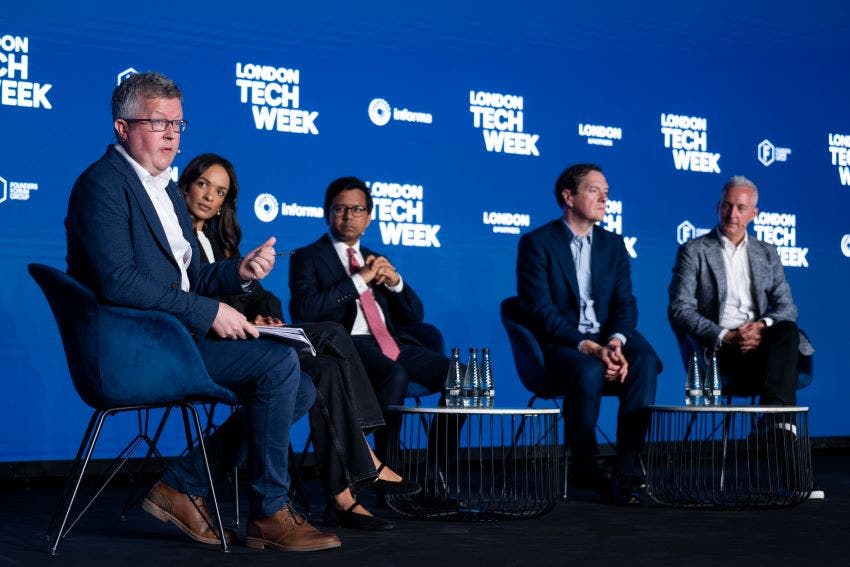
L to R Dan Milmo, Judith Dada, Kanishka Narayan MP, George Osborne, Matt Harris Image courtesy of London Tech Week
Sovereign AI emerged as one of the defining themes of the first day of London Tech Week, reflecting growing concern among governments and the wider public about just who controls the infrastructure, capabilities and economic benefits of AI.
The debate comes at an interesting time. In recent weeks, the European Commission has presented a European Technological Sovereignty package, while a UK parliamentary committee warned that the public sector remains overly dependent on US technology providers in key areas, including AI.
Against that backdrop, a London Tech Week panel chaired by The Guardian’s Global tech Editor Dan Milmo featuring UK AI Minister Kanishka Narayan, former Chancellor of the Exchequer turned OpenAI’s MD and Head of Countries George Osborne, Visionaries Club General Partner Judith Dada and Hewlett Packard Enterprise UK and Ireland Managing Director Matt Harris explored what sovereign AI means in practice, and what they thought it would take to get there.
Beyond self-sufficiency
The first task of the panel was to define AI sovereignty. For Kanishka Narayan, the goal is ensuring that Britain can “chart its course” when it comes to technologies that are increasingly central to economic growth, security and public services.
Rather than attempting to replicate the entire AI ecosystem within national borders, Narayan argued that countries should focus on building “sufficient strategic leverage” in areas where they possess genuine strengths.
The test, he suggested, is simple: when Britain sits at the negotiating table with partners such as the US, Taiwan or South Korea, does it have “enough chips on the table” to secure its interests?
Narayan was on message because it’s that philosophy which underpins the government’s recent sovereign AI initiatives, including the investments in compute, infrastructure and semiconductor capabilities it unveiled yesterday. However, according to Narayan, success depends on more than funding alone.
“What we are trying to do is effectively put every other lever of government alongside it,” he said, pointing to procurement, public-sector datasets, visa policies and government purchasing power as equally important tools.
Infrastructure is the new battleground
It is not a coincidence that one of the strongest themes to emerge from the discussion was the criticality of AI infrastructure.
As Judith Dada pointed out, much of AI-focused public discourse focuses on models and applications. However, it is access to the compute, energy, data centres and access to data that will determine long-term competitiveness.
“It’s not about owning everything in the stack,” said Dada. “It’s about owning the crucial bottlenecks that allow you to build leverage.”
Dada highlighted the EUs limited leverage, noting that the region currently accounts for only around 5% of global AI data centre capacity, compared with approximately 80% in the United States.
Closing that gap, she argued, will require difficult political choices.
“We need to face some pretty hard trade-offs,” Dada said, including reforms that allow data centres to be built more quickly and gain access to energy infrastructure faster. That isn’t a popular position. The more aware of AI datacentres the population becomes the more negative sentiment builds. Dada thinks that without significant action, Europe risks becoming politically sidelined, economically stagnant and increasingly dependent on technologies it neither controls nor governs.
Sovereignty is a business issue too
The discussion also underscored why sovereign AI is no longer solely a government concern.
The development of generative and agentic AI within enterprise means that it is, in some cases, transforming from being a productivity tool into one with operational capability. Matt Harris put the case that some organisations are increasingly relying on AI to support research, product development, decision-making and automation at scale.
“This is now becoming who owns the operational intelligence layer of organisations,” said Harris.
Harris said that this shift has profound implications for economic competitiveness. Countries and businesses that control critical AI capabilities will be better positioned to capture productivity gains and create new sources of growth. He argued that sovereign capabilities provide resilience and choice. Without them, organisations risk becoming dependent on external providers for technologies that may eventually underpin core business operations.
At the same time, Harris cautioned against trying to do build it all.
“We cannot go it alone as the UK,” he said, arguing that sovereignty must be built through a combination of domestic capability and international partnerships.
Partnerships remain essential
Ironically given the UKs politics over the last decade, there was broad agreement among the panellists that sovereignty should not be confused with isolationism.
George Osborne argued from the viewpoint of his new role at OpenAI that Britain’s success as a technology hub has historically depended on openness to international investment and talent. He pointed to the growth of London’s technology ecosystem, fuelled in part by the presence of major global firms, as evidence that international partnerships can strengthen domestic innovation.
“It can only be a good thing that companies like OpenAI and Anthropic are committing to doing more research here,” he said.
Dada took a similar view. Even as Europe seeks greater autonomy, she argued that collaboration with US hyperscalers is the fastest route to expanding AI infrastructure on European soil.
“The world we enjoy today is a hugely complex one that exists on the back of the division of labour,” she said.
In practice, that means sovereign AI may depend as much on smart partnerships as on domestic investment. Whilst Dada may well be right about that, the balancing of this pragmatism against social, democratic and environmental concerns will require excellent communication strategy and skilled political leadership.















Leave a comment