
Hello. I am Takahiro Ogawa, an agricultural management supporter.
For grape cultivation, berry thinning, which must be completed in a short period of time, is an extremely important task that significantly affects the quality and appearance of the grapes.
However, it is also a major challenge in the field, with issues such as ‘heavy strain on the neck and shoulders,’ ‘difficulty in sharing the work due to the need for a skilled eye,’ and ‘labor shortages during the busy schedule of the rainy season.’
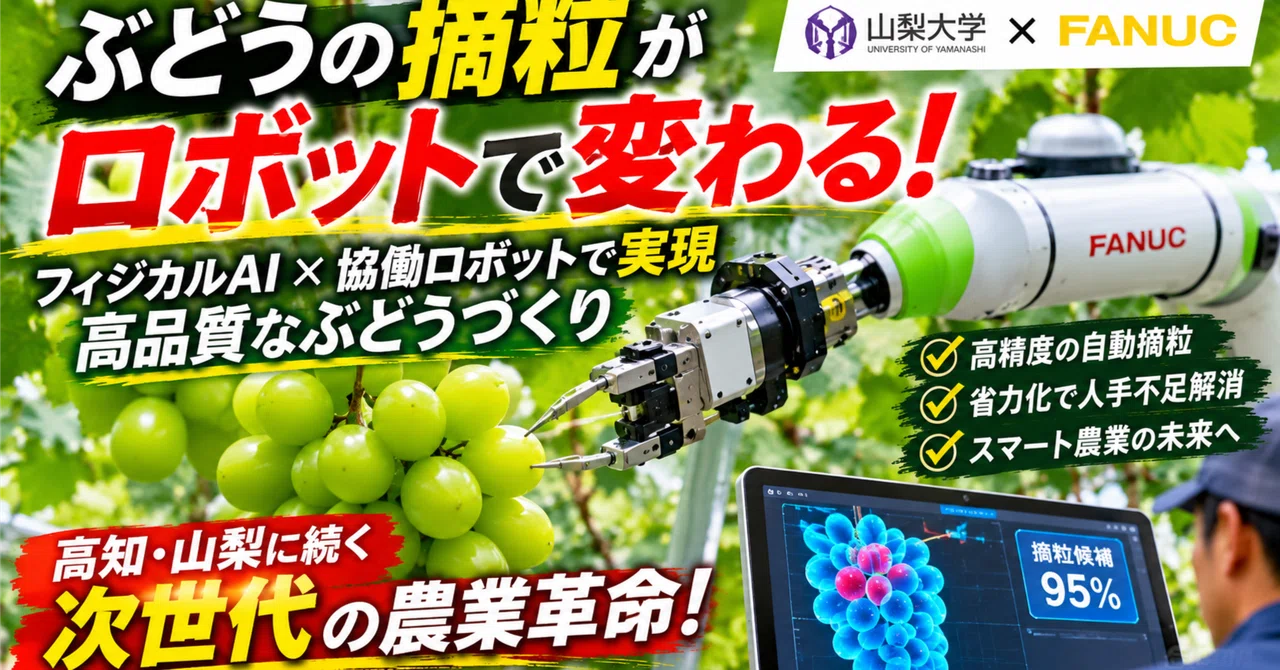
Groundbreaking technological innovation to resolve these concerns for fruit farmers is currently underway through joint research by a research team at the University of Yamanashi and the industrial robot giant FANUC Corporation.
In this article, I will introduce in detail the forefront of automating grape berry thinning using cutting-edge ‘Physical AI’ and ‘collaborative robots.’
The Wall of ‘Berry Thinning’ That Plagues Grape Farmers and the Difficulty of Automation
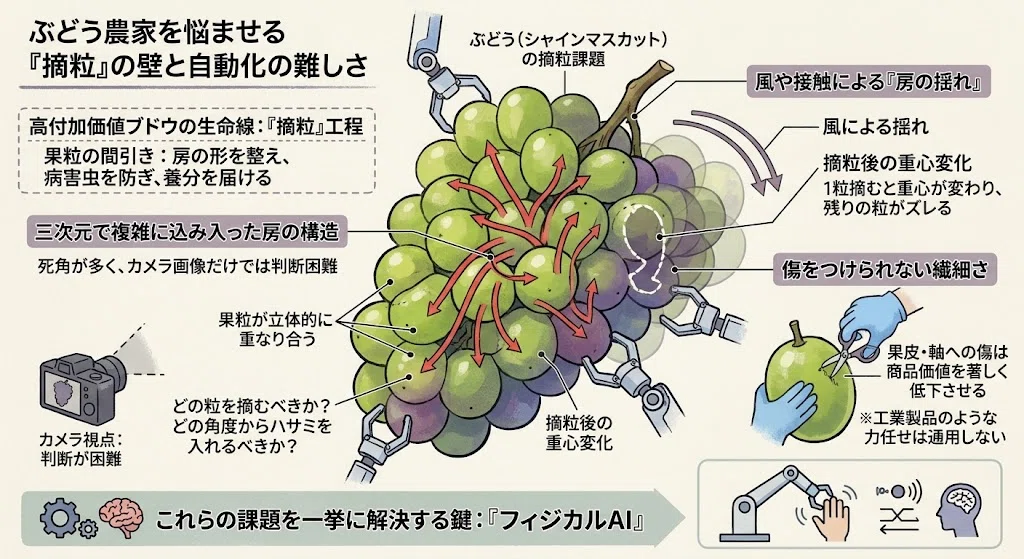
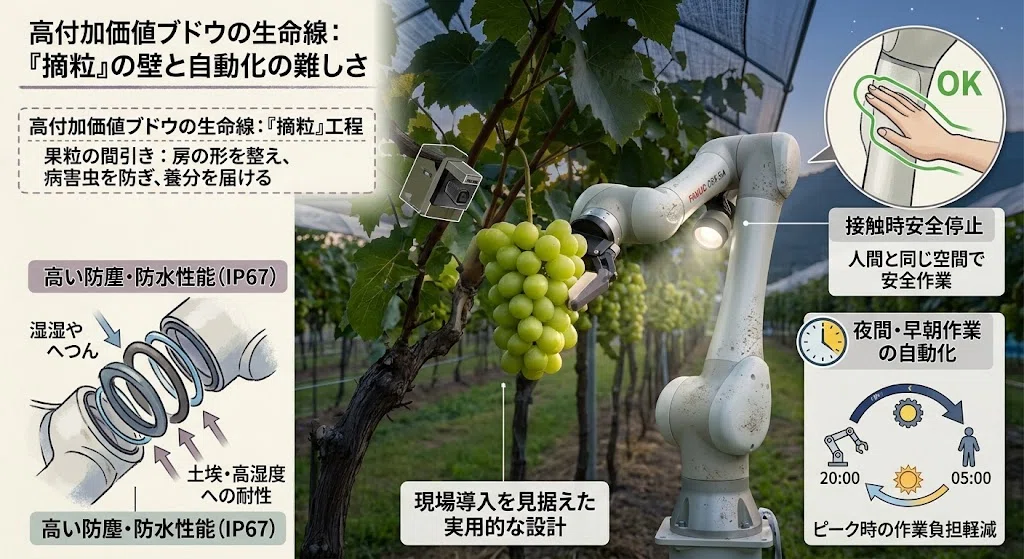
In the production of high-quality grapes such as Shine Muscat, berry thinning is an unavoidable process. By thinning out the berries, the shape of the cluster can be beautifully adjusted, the occurrence of pests and diseases can be prevented, and sufficient nutrients can be delivered to each individual berry.
However, in the world of robot technology, grape berry thinning has been considered ‘one of the most difficult agricultural tasks to automate.’ There are three main reasons for this.
Three-dimensional and complex, crowded cluster structure
Because the berries are layered three-dimensionally, it is extremely difficult to judge ‘which berries should be picked’ and ‘from which angle the scissors or gripper should be inserted’ using only camera images.
‘Cluster swaying’ due to wind or contact
In greenhouses or open fields, clusters sway in the wind. Furthermore, the moment the robot picks a single berry, the center of gravity of the entire cluster changes, causing the positions of the remaining berries to shift slightly.
Delicacy that prevents damage
Since damaging the skin or stem significantly lowers the commercial value, force-based control like that used for industrial products does not work.
The key to solving these challenges all at once is the concept of ‘Physical AI.’
Innovative Technology Created by Physical AI x Collaborative Robots
Physical AI is a technology that goes beyond simply recognizing and judging images on a screen; it senses the complex environments and changes in movement of the real world in real-time and immediately reflects them in the physical movements of the robot.
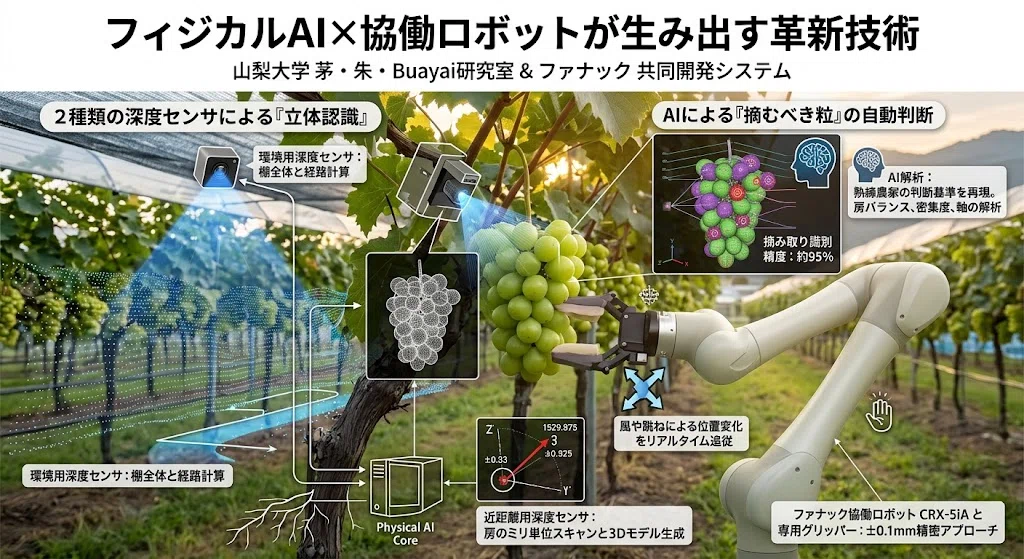
In the system being developed by the University of Yamanashi’s Kay-Zhu-Buayai Laboratory and FANUC, by highly integrating this Physical AI, they are aiming to realize a berry thinning robot that can truly be used in the field. Specifically, it operates through the following mechanism.
‘3D recognition’ using two types of depth sensors
First, an environmental depth sensor grasps the 3D space (point cloud data) of the entire grape trellis and calculates a path that the robot arm can safely approach. Next, a short-range depth sensor installed in close proximity to the cluster scans the grape cluster with high precision at the millimeter level to generate a 3D model.
Automatic judgment of ‘berries to be picked’ by AI
Based on the generated 3D model, the AI reproduces the judgment criteria of skilled farmers. It comprehensively analyzes the balance of the cluster, the density of the berries, and the way the stems grow, and automatically identifies ‘which berries should be thinned’ with a high accuracy of approximately 95%.
Real-time tracking and precision approach
Even if the grapes sway in the wind or the cluster bounces after a single berry is thinned, AI and sensors continue to track the positional changes in milliseconds. This allows the FANUC collaborative robot ‘CRX-5iA’ to accurately approach the target berry with overwhelming precision of ±0.1mm and safely pick it with a specialized gripper.
Practical design with field implementation in mind
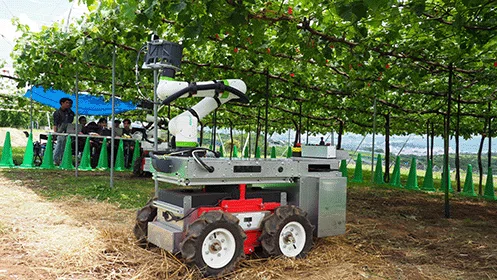
No matter how excellent an AI is, it is meaningless if it cannot be used in a farmer’s field. This project emphasizes practicality that can withstand the harsh environments of agricultural sites.
The collaborative robot ‘CRX-5iA’ used features high dust and water resistance (IP67), allowing it to operate without issues in the high humidity and dusty environments of greenhouses. Furthermore, it is designed to work safely in the same space as humans, with a mechanism that stops safely if a person touches it.
If robots can be entrusted with part of the berry thinning work during times when it is difficult for humans to work, such as at night or early in the morning, it has the potential to dramatically reduce the workload during peak periods.
The future of fruit cultivation opened by smart agriculture
This initiative is steadily being researched and developed as part of the ‘Smart Agriculture Development and Supply Commissioned Project’ of the Bio-oriented Technology Research Advancement Institution.
Delicate fruit tree management work, which for many years was resigned to being something that ‘could only rely on human intuition and manual labor,’ is finally entering the realm of practical application through the fusion of AI image recognition technology and precision control technology for industrial robots.
If the automation and labor-saving of berry thinning are realized, the area that can be managed per person will expand significantly, which will also lead to lowering the technical hurdles for new farmers. In addition, skilled workers will be able to focus on more advanced cultivation management and marketing, which will contribute to improving the quality of the entire business.
The realization of ‘smart fruit agriculture’ where humans and robots work together is just around the corner. Great expectations are gathering for the results of future demonstration experiments and social implementation for farmers.
[Inquiries]
TEL 080-3396-5399
MAIL t.ogawa19720117@gmail.com
[Related Articles]————————————————————————————-














Leave a comment