
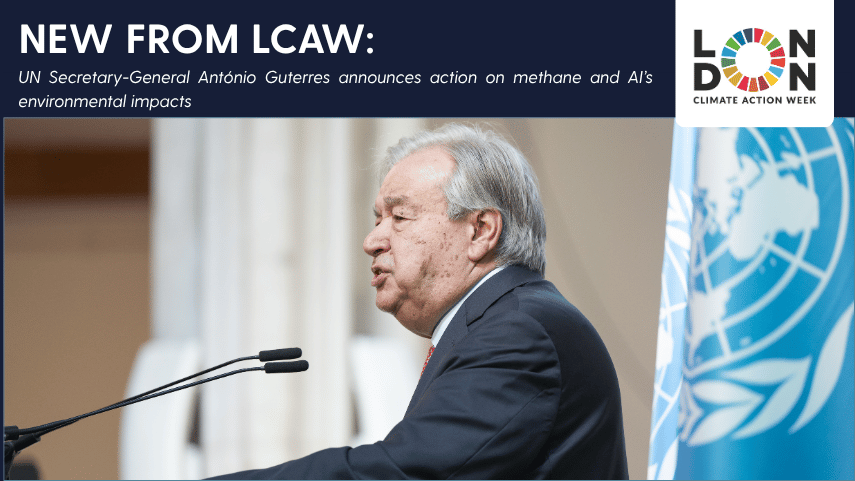

Pictured: UN Secretary-General delivering landmark climate address at Guildhall, London. Courtesy: Bloomberg Philanthropies
At the start of yet another day surpassing 30C in the UK, Secretary-General Guterres drew attention to the increasingly unavoidable, “deadly” and “costly” realities of climate change.
As temperatures crept up at the city’s historical Guildhall, Guterres quipped that “London isn’t just calling, it’s cooking.”
As global temperatures creep up and extreme weather becomes more severe and frequent, those losses are set to grow, too – in London and beyond. According to the latest Indicators of Global Climate Change (IGCC) report, human activity has increased the global temperature by 1.37C since pre-industrial levels, with warming expected to reach 1.5C by the end of the decade.
Related article: UN chief: World must now aim to reverse inevitable 1.5C overshoot
In his address, Guterres warned of the “irreversible change” that any additional and prolonged warming could trigger: “Because the higher and longer the overshoot, the greater the risk of crossing planetary tipping points”.
Central to preventing that is a rapid transition away from fossil fuels towards a fully renewable energy system in order to cut any future carbon dioxide emissions (CO2).
Making methane a priority
While CO2 remains the main overall driver of global warming, the Secretary-General highlighted that methane is 80 times more potent in the atmosphere. This is when looking at a 20-year period.
As such, slashing methane emissions would have a huge impact on slowing short-term warming.
At COP27 in 2022, it was confirmed that 150 nations had signed the landmark Global Methane Pledge (a number that has since edged up to 159, plus the European Commission). The Pledge includes a commitment to cut methane emissions by 30% by 2030 compared with 2020 levels. While good progress has been made in terms of methane monitoring, that has not necessarily translated to adequate mitigation.
To help drive progress in concrete methane reduction, Guterres used his address to launch a global Call to Action on Methane.
Under the Call to Action, the spotlight is on three sectors: fossil fuels, agriculture and waste.
To the fossil fuel industry, the UN demands that companies fix leaks and eliminate routine flaring, improve methane measurement and verification and adopt a science-based standard to establish a marketplace for near-zero-methane fossil fuels.
The plan also calls on the agricultural sector to urgently cut emissions while also protecting food security and farming livelihoods.
According to research from the Changing Markets Foundation, leading dairy and coffee companies across Europe and North America may be disclosing methane emissions and reporting against reduction plans, but most of the sector is still lagging.
The Call to Action requests that the industry: produce food more efficiently with less methane, halve per-capita food waste and loss and reform incentives in order to redirect agricultural finance to more sustainable practices.
Finally, the plan calls on the waste industry to phase out open dumping and unregulated landfills, encouraging companies to capture any methane emissions generated by waste and wastewater before it has a chance to reach the atmosphere. Guterres also highlighted the overall importance of building circular waste systems in urban areas that limit methane.
A call for AI transparency
A report published earlier this month by the UN University Institute for Water, Environment and Health (UNU-INWEH) highlighted the enormous environmental costs of AI growth and the data centres that underpin it, including increased emissions, energy usage and water consumption.
Data centre cooling requirements are increasing exposure to water-stressed regions, while land-use change is also becoming more visible in the expansion of AI-related electricity generation.
Data centres consumed an estimated 448 terawatt-hours (TWh) of electricity in 2025, placing them among the largest global electricity users if treated as a single system.
AI workloads currently account for around 20% of that demand, a share expected to double by 2030. Under current trajectories, AI-related electricity use could reach 945 TWh by the end of the decade, equivalent to nearly 3% of global electricity consumption.
This growth carries associated environmental impacts. The report estimates AI-linked electricity generation could produce around 400 million tonnes of CO2-equivalent emissions annually by 2030. It also projects a land footprint exceeding 14,000 square kilometres and water consumption reaching 9.3 trillion litres.
In response, the Secretary-General called for greater transparency from AI companies and a clearer commitment to sustainable growth, as part of the AI Environmental Transparency Initiative.
“I am calling on every major AI company to measure and publicly disclose the full environmental impact of its systems – carbon, water and land footprints – and to commit to power every data centre with renewable energy by 2030.
“No more hidden costs. No more shifting the burden onto those least able to bear it. It is time to come clean,” said Guterres.
This way, the Secretary-General explained, continued technological growth helps to accelerate the clean energy transition, rather than undermining it, ensuring that at-risk communities also do not have to carry the burden of more stretched resources.
The Global Urban Data Centres Pact
Skyrocketing demand for AI computing is driving the rapid expansion of data centres globally, putting pressure on local energy and water resources.
Later in the day, London’s Guildhall also saw the announcement of the Global Urban Data Centres Pact, an agreement between 36 mayors across six continents to ensure the sustainable growth of data centres in their communities.
Collectively, these Pact founding mayors represent almost 80 million people. Backers include Barcelona, Miami, Rio de Janeiro, Johannesburg, Phoenix and Melbourne.
Rather than rejecting the expansion of data centres, the Pact has been devised to ensure that the site serves the needs of cities and their residents, as well as the interests of investors and businesses.
It calls for data centres that are:
- strategically integrated into cities
- sustainable and resource efficient
- engaged with the local community
- focused on driving down costs and shared prosperity for cities
Mayor of Palo Alto, Vicki Veenker, said: “The Global Data Centres Pact aligns with Palo Alto’s legacy of disruptive technology built on a foundation of sustainability.
“We are committed to working with mayors and cities around the world to protect our local community and planet. Together we can build a zero-carbon roadmap for the next generation of global data infrastructure, ensuring that data centres are clean, efficient engines of global progress.”
Related article: Al Gore at LCAW: Clean Energy Shift Is Unstoppable














Leave a comment