

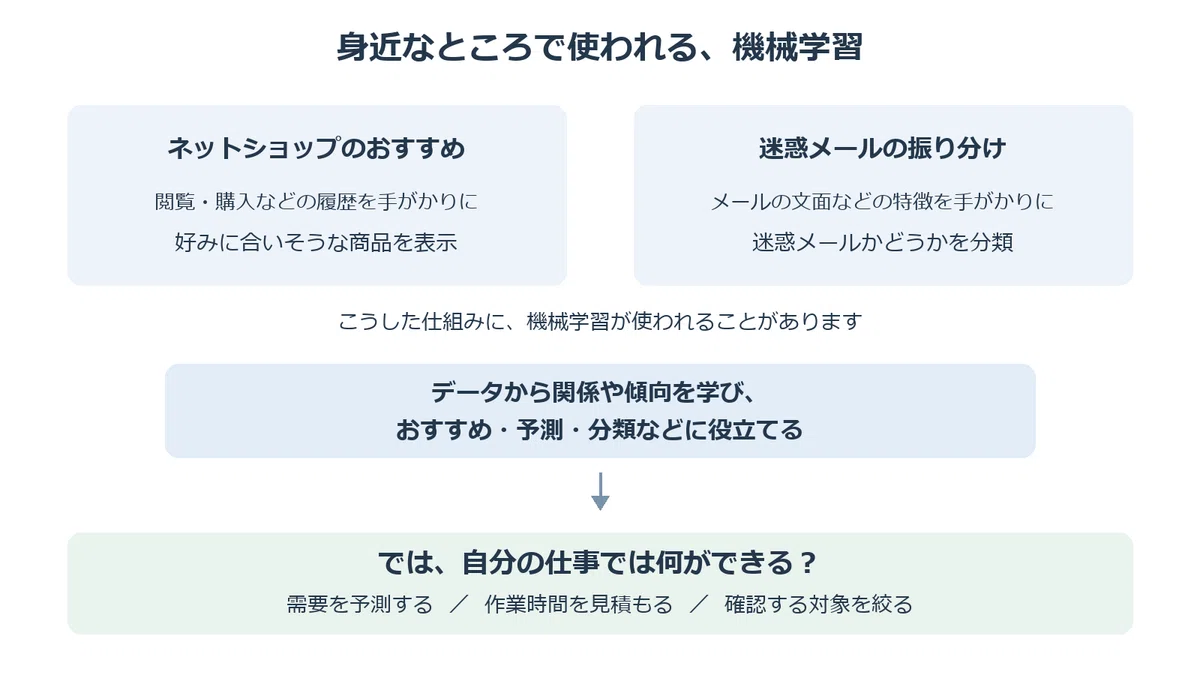
In an online shop, products similar to your preferences are displayed.
Emails are automatically sorted into spam.
Machine learning is sometimes used for mechanisms like these.
So, if you apply this to your own work, what kind of things can you do?
“I hear the word AI, but I don’t really understand what it can be used for.”
When I first started learning, I couldn’t quite connect the mechanisms with their actual uses.
In this article, I will organize what can be done with machine learning and what you should think about before using it, starting with familiar examples.
Machine learning is a mechanism that learns trends from data
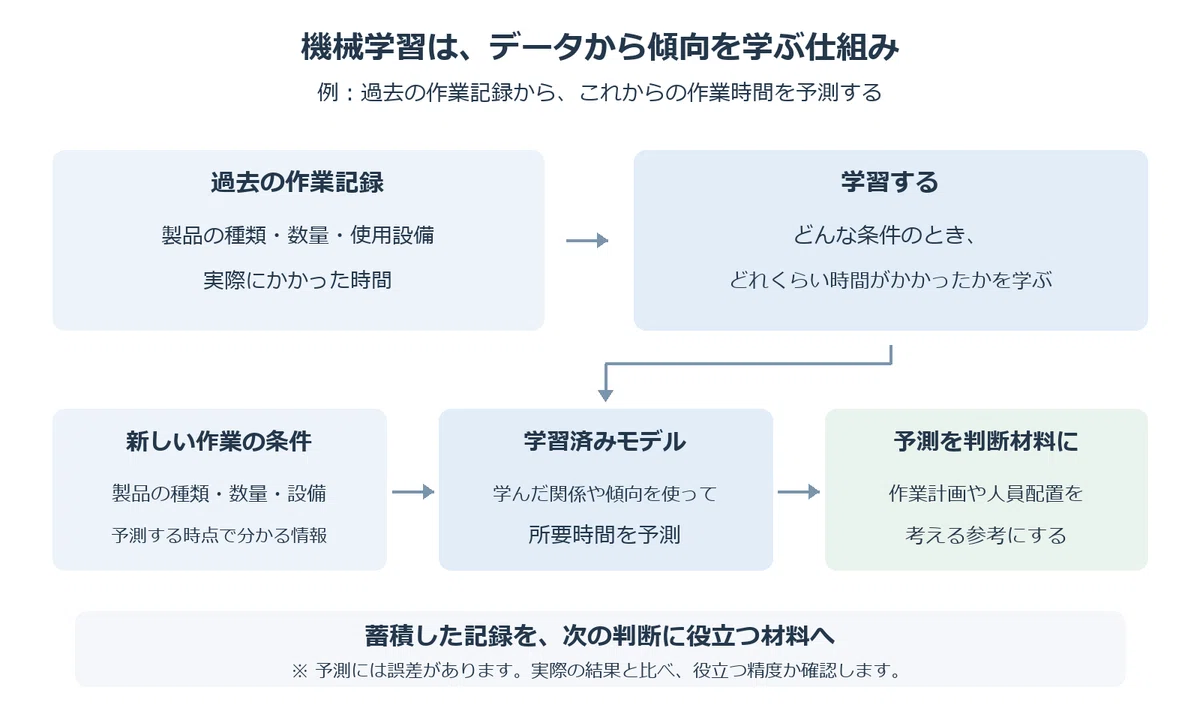
Machine learning is a technology that learns relationships and trends from data and performs predictions or classifications on new data.
For example, let’s consider a situation where you estimate work time.
Suppose that past records contain the product type, quantity, equipment, and the actual time taken.
Using that information, you can learn “under what conditions how much time was taken” and predict the time required for future work.
Turn accumulated records into material that helps with the next decision.
When you think of it this way, doesn’t it feel a bit more familiar?
What can it do? 4 typical ways to use it
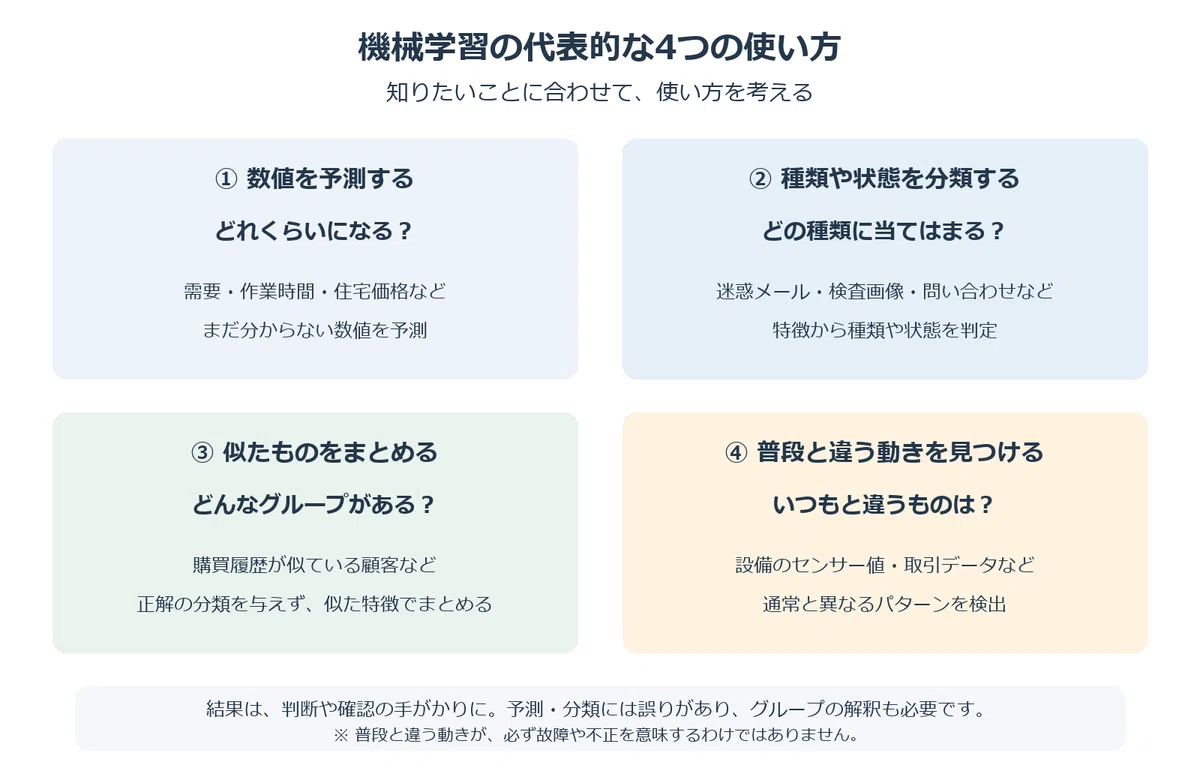
1. Predicting numerical values
Predict unknown numerical values from past data.
For example,
-
Predicting future demand from sales history
-
Estimating required time from product or work conditions
-
Predicting prices from housing characteristics
You can use predictions to help plan inventory, staffing, and work schedules.
However, predictions have margins of error. You need to check how much they might deviate and determine the range in which they can be used for business.
② Classifying types and states
Based on data characteristics, it determines which category something falls into.
For example,
-
Classifying emails into normal emails and spam
-
Classifying products as good or defective from inspection images
-
Sorting inquiry texts by content
It can be used to support checking and sorting tasks that involve large volumes of items.
Since it can sometimes misclassify, it is also important to decide where to keep human verification in the process.
③ Grouping things with similar characteristics
There is also a method of grouping similar data without preparing correct classifications in advance.
For example, it can be used to group customers with similar purchase histories and investigate what characteristics each group has.
You might discover differences you hadn’t noticed yourself or find a starting point for further investigation.
However, you need to look at the content to interpret what the divided groups mean.
④ Finding unusual behavior
This is a way to find patterns that differ from normal data and narrow down what needs to be checked.
For example,
By finding candidates for anomalies, it helps prioritize what people need to check.
However, something being unusual is not the same as it being a failure or fraud. Verification after detection is necessary.
What are the benefits of using it at work?
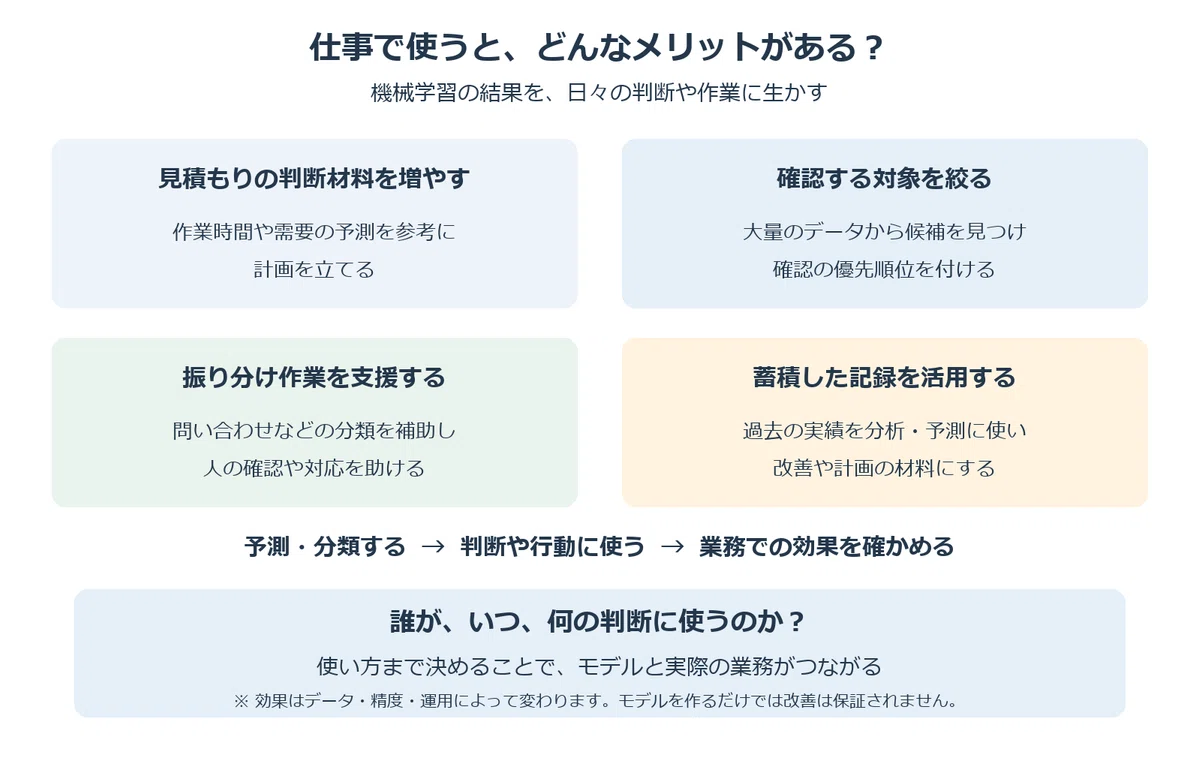
By using machine learning, you can expect support such as the following:
-
Adding data-driven decision-making materials to estimates that were previously based only on experience
-
Narrowing down targets to prioritize for checking from large amounts of data
-
Automating part of repetitive classification tasks
-
Utilizing accumulated records for planning and improvement
However, these effects do not occur just by building a model.
For example, even if you predict demand, if you do not use the results to make purchasing decisions, it will not lead to inventory improvement.
Who will use the prediction or classification results, when, and for what decisions?
By thinking through to that point, machine learning connects with actual business operations.
It is not the case that everything should be done with machine learning
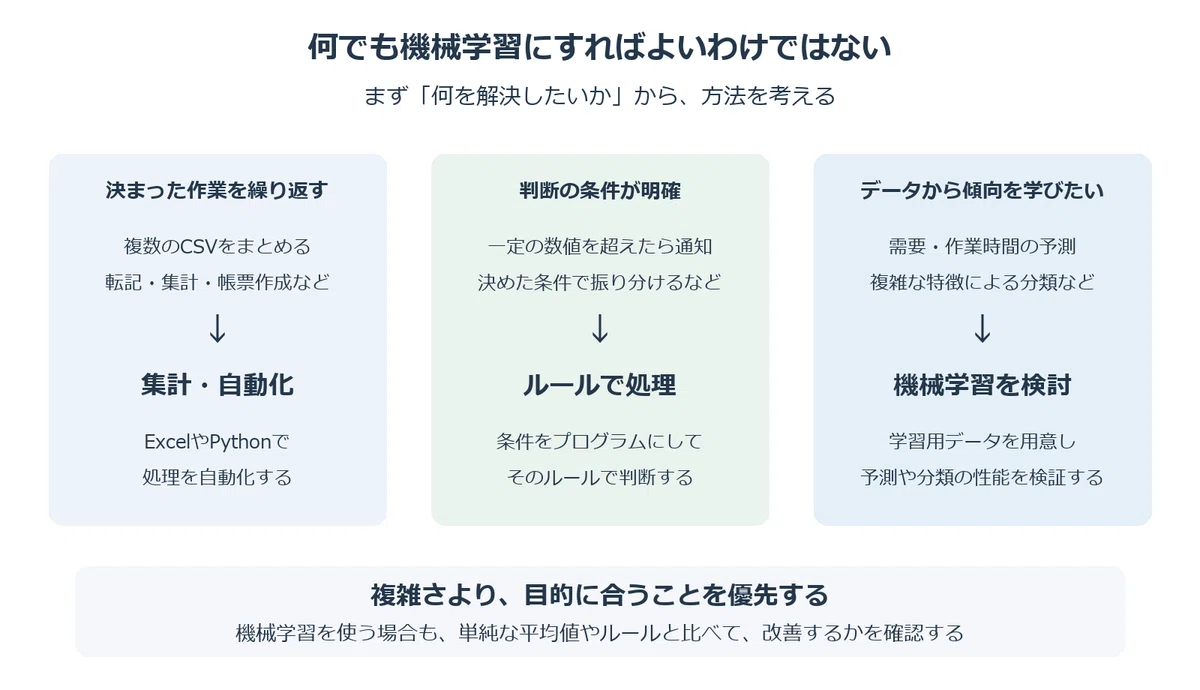
Among work problems, there are some that can be solved with simpler methods.
For example, if the task is to aggregate monthly CSV files, automation using Excel or Python might be more suitable.
If there is a clear condition such as “notify me if this value is exceeded,” it can be processed with established rules.
Before considering whether machine learning is necessary,
-
can it be solved just by aggregating data?
-
can it be judged by clear rules?
-
can a sufficient estimate be made with a simple average or similar?
It is also important to check.
I believe it is more important to choose a method that suits your purpose than to create a complex system.
Can it be used immediately if there is data?
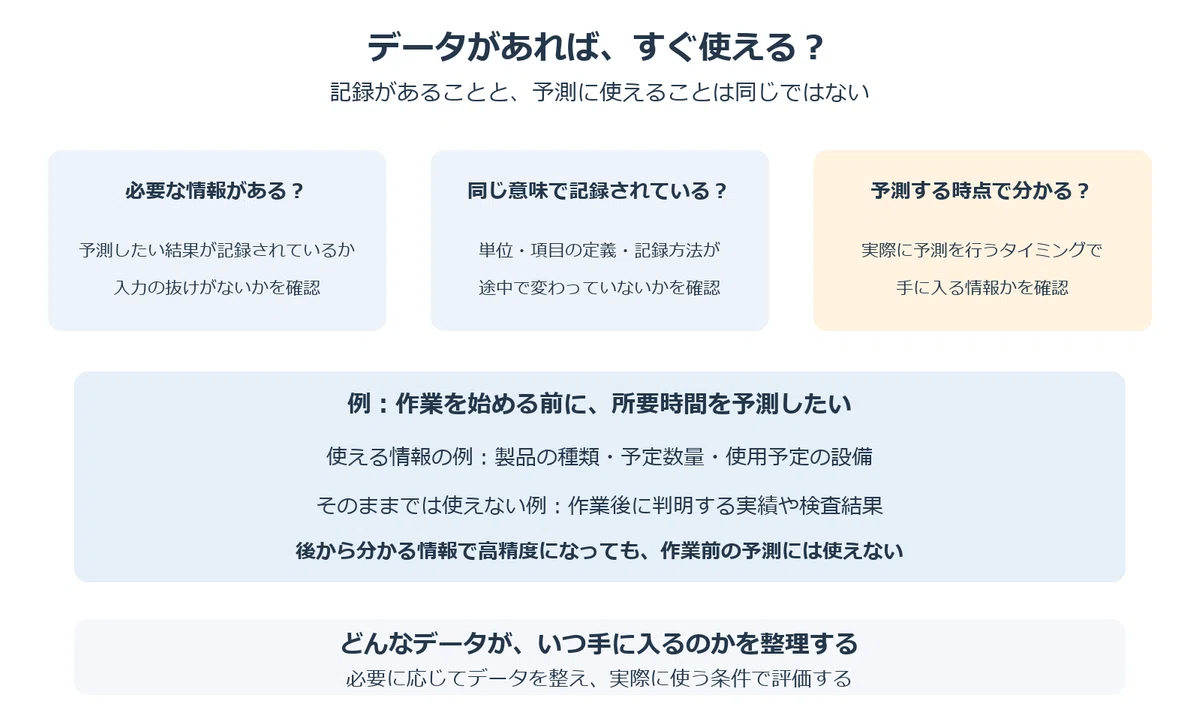
This is also a point I felt was important after actually learning it.
Even if data remains, it does not necessarily mean it can be used for prediction as is.
It is also possible that inputs are missing, recording methods have changed midway, or the results you want to predict have not been recorded.
Also, you need to make sure that you do not use information that is unknown at the time of prediction during the learning phase.
For example, if you want to predict the time required before starting a task, but you use “information that only becomes known after the task is finished” for the input, you cannot use it in the field as is.
What kind of data is available and when?
This is just as important as the type of model.
How to verify it after it is created?
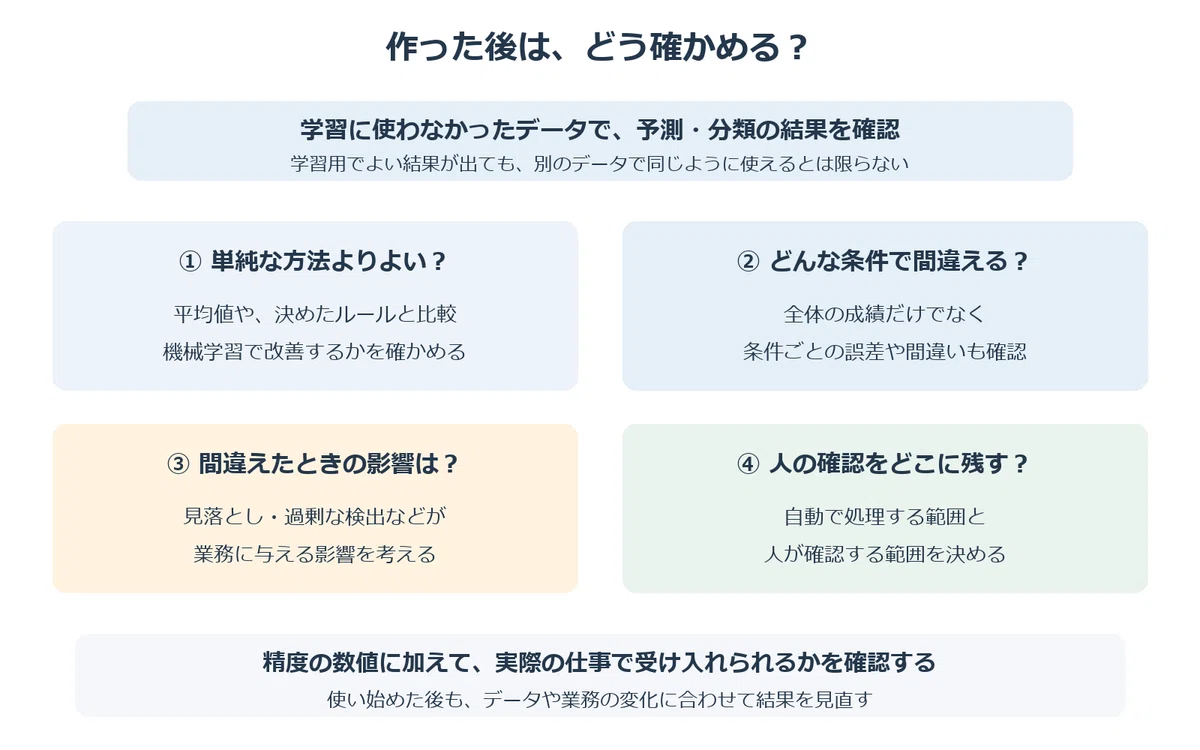
Even if you get good results with the data used for learning, it does not necessarily mean it can be used in the same way with other data.
Therefore, you should prepare data that is not used for learning and verify the results of predictions and classifications.
For example, the following points are what you want to confirm.
-
Is it an improvement compared to simple methods?
-
Under what conditions is it prone to errors?
-
What impact does it have on business when it makes a mistake?
-
Where should the parts that humans check be left?
In addition to whether the accuracy numerical value is high, you need to consider whether those errors and mistakes can be accepted in actual work.
I learned from housing price prediction
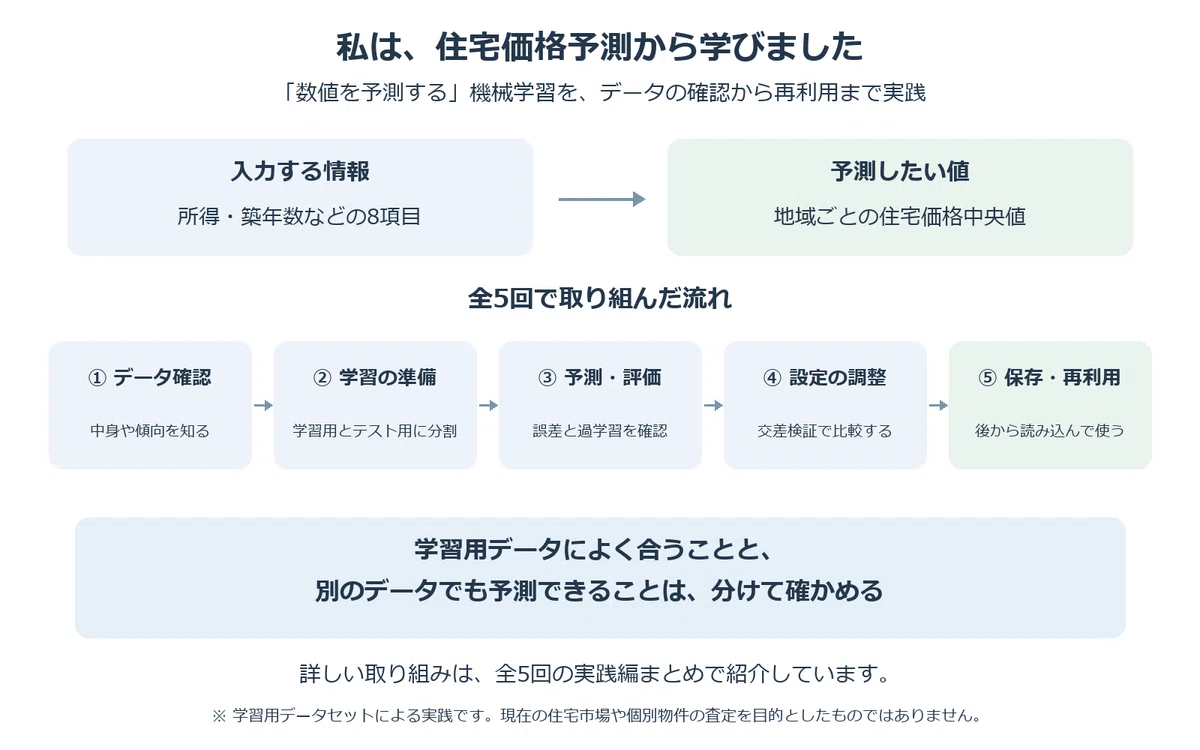
This time, I used housing price data to practice everything from data verification to prediction, evaluation, adjustment of settings, and model saving.
I mainly worked on machine learning for “predicting numerical values.”
By actually running it, I gradually began to see the difference between fitting training data well and being able to make predictions on other data.
The flow of the practice is introduced in a summary article covering all five sessions.
For those who want to learn from the terminology, such as mechanisms and evaluation metrics, I have also written a basics section.
First, look at what you are struggling with and the records you have
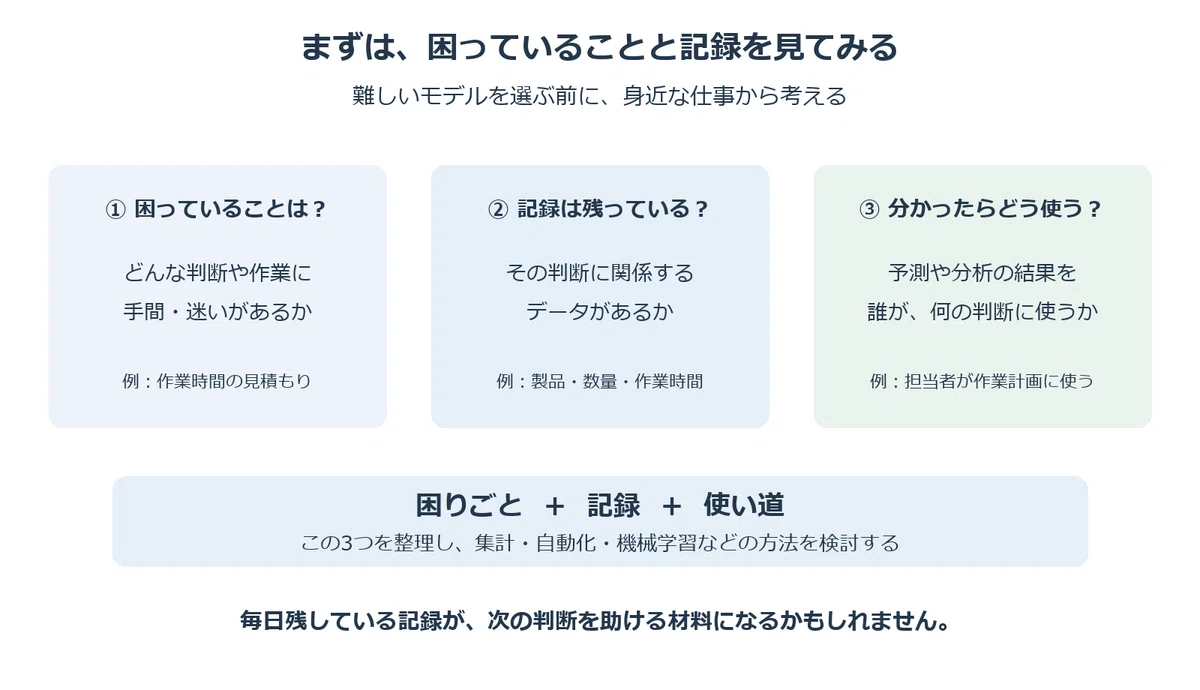
If you are thinking about connecting machine learning to your work, I don’t think you need to choose a difficult model from the start.
“What kind of decisions are you struggling with?”
“Are there records related to those decisions?”
“If you could predict it, how would you want to use it?”
Start by thinking about those things.
Within the records you keep every day, there might be material that can help with your next decision.
















Leave a comment