
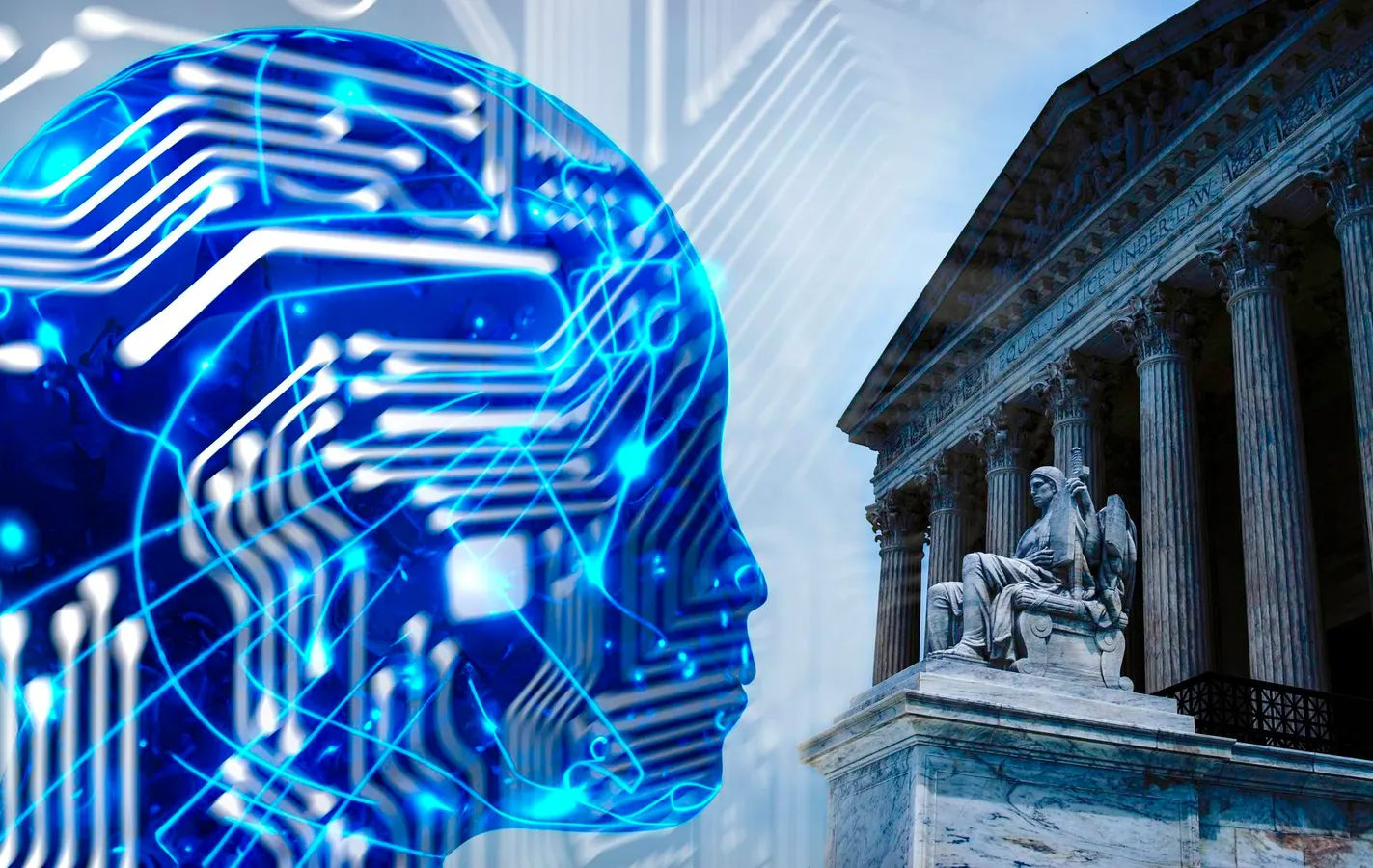

A digital head/brain stares at the United States States Court as it mulls the legality of artificial intelligence in our lives
getty
The Supreme Court made a little-noticed ruling in March 2026 about how AI-generated content is treated under U.S. Copyright Law. In short: Works created exclusively by artificial intelligence do not meet the requirements to receive copyright protection. This ruling was upheld when the Supreme Court decided not to take up a case related to whether an artificially intelligent being can be considered the “author” of the work it produces. With no author, there is no copyright protection. But what does this mean? A new set of liabilities will fall directly on the shoulders of those who use these tools (i.e., businesses) and not simply on the companies who build them.
If you are creating social media posts, email campaigns, course materials, video scripts or blog content with the help of artificial intelligence (AI) tools, you are likely operating within new territory legally most owners haven’t realized this yet.
The ruling has a dual impact. The first part of the ruling is that all content generated by an AI tool will be uncopyrightable to you as long as there was no meaningful human creative input. That means anyone could copy it, reuse it or create something off of it, and you would not have any legal recourse.
The second part of the ruling has major implications for businesses. It states that if that AI-generated content infringes on someone’s copyright due to either the training data of the AI or the method of creation of the AI-generated output, Intellectual Property lawyers from large law firms are now warning that the business utilizing the tool could be liable for that infringement. This includes liability against both the developer/platform of the tool and the user.
You are no longer just a user. You are the responsible party.
What The Supreme Court Actually Said
The Court issued no far-reaching or precedent-setting decision. It denied certiorari in Thaler v. Perlmutter and other AI-related authorship issues as such the lower courts’ decisions will remain in place. Those decisions affirmatively support the U.S. Copyright Office’s position that human authorship is required for copyright eligibility. Therefore works created exclusively using artificial intelligence are not protected under copyright law.
Morgan Lewis stated in its March 2026 report that the Court’s decision not to hear the case leaves companies with the responsibility to document the level of human creativity involved when an AI-assisted work is created in order for it to be eligible for copyright protections. This point is important since the issue at hand is not about the use of artificial intelligence, but rather what human decisions were made by which individual to create the final product.
What can be considered “human” creative input in documentation? The choice of selection, the arrangement (order) and the editorial decision-making process. If you determined the content organization or created the direction/angle for the piece, then you also made revisions to the product, then your contributions are possibly eligible for protection. If you merely entered a request, sent it out into the world, and did not make significant changes to the product produced from that request, then they probably were not.
The distinction matters more than most business owners realize.
The Liability Has Moved To You
Holland & Knight’s review of the decision on downstream risk illustrates how the use of these tools could become tangible. As a result of possible greater legal protection afforded to AI platforms due to their status as infrastructure providers, copyright owners are looking outside of the platform itself and instead targeting those who are using the tools. This includes the businesses that utilize them.
This trend has begun to emerge in reported cases, according to Norton Rose Fulbright’s 2026 AI Litigation Update. For example, the Bartz v. Anthropic case was settled, providing an industry benchmark of potential liability for the business (and its users) if they lose a copyright claim.
The escalations continued into May 2026 when another class-action was filed by Scott Turow, Hachette, MacMillan, McGraw-Hill, Elsevier and Cengage against Meta. In its complaint, Meta alleges it used copyrighted books and other materials to train Llama using pirated sites. According to Meta, it intends to defend itself against the suit further, Meta believes that the training of AI may be protected as “fair use”. However, this is not theory, it is actual litigation that will impact the companies generating large amounts of AI-generated content.
This is a systemic exposure for the small business owner who uses AI to produce content at high-volume. This includes coaches, consultants, course developers/authors, content marketers etc., and their exposure exists when they rely on AI-generated material without reviewing, documenting or establishing policies.
AI Content Practices: Copyright and Liability Risk Guide
Source: Institute Of Business AI
Three Things Your Business Needs To Do Now
The “human in the loop” framework is no longer just a quality argument. It is also a legal one. Here is what that looks like operationally:
Document your creative contribution. For each piece of AI-assisted content created for your company, create a log of all human decision-making involved in its creation. This includes the strategies used when developing the prompts, the editorial choices you have made, what has been changed from previous versions and why it was changed. Keeping as simple of a documentation process as possible (i.e., a document or even voice memo) prior to making final edits on your content will provide a paper trail.
Review your AI tool’s terms of service. The majority of all AI Platforms have Indemnity Language as part of their agreements. A lot of those agreements contain limitations on how much the provider agrees to indemnify. According to founders legal, this language has been varied among providers and there are currently a number of cases testing it. It is better to read them first than when you are forced to later.
Audit your highest-volume AI content first.Not all types of AI-assisted content are created equally in terms of the risks involved. A human edit is going to be more necessary for a summary of an article or book as opposed to a short social media post. The same applies to course materials that follow well-recognized formats (i.e. frameworks), marketing copy that follows industry templates and longer form content developed using research generated by an AI.
What This Means For Your Employees Too
Currently about 68% of smaller companies claim to be using some sort of artificial intelligence (AI) tools in their day-to-day operations. Most of these workers generate content. Content includes emails, reports, client presentations, sales notes and marketing drafts. A lot of this content goes through AI systems before anyone looks at the content.
According to an analysis by Complete AI Training, the essential issue here is how many important decisions did the human make when creating the final product? Whether you ask which employee created the prompt, which tool generated the output or if the output was reviewed after it was delivered to customers, the company has responsibility for the final product.
A business needn’t have overly complicated policies. The key is to develop policies that clearly address three questions: What content types will require human editing prior to publication? Who will review the final output? How will that review process be documented? These three answers provide the necessary operational records for claims of AI copyright liability should they arise.
Thus this is an area where the business liability for employee use of AI as a possible copyright infringing entity is more of a management problem (i.e. “Do we know what our employees are doing with AI”) then it is a strictly legal one (“Can I sue my employee”). By creating an AI policy that formally defines how to use AI employers will shift employees’ AI use from covert activity to normal workflow process.
The Business Case For Getting Ahead Of This
March 2026 is merely a starting point. In anticipation of future decisions regarding AI and copyrights by the EU’s Court of Justice, there are several international cases pending which can potentially alter how the use of international training data is regulated. Similarly, in the United States, we expect our laws and policies to change over time as many more courts begin addressing AI authorship copyright law and related litigation issues including training data disputes and alleged infringements.”
“The companies building their documentation processes today will not be scrambling for months after an AI copyright case generates panic driven regulatory compliance pressures. The liability has moved. Have you updated your process? While it may seem like the most effective method for small businesses to protect their AI-generated content is to cease usage of AI tools, it’s actually the opposite. The best course of action for protecting your AI-generated work is not to limit its use but to treat AI generated work as unfinished content.













Leave a comment