
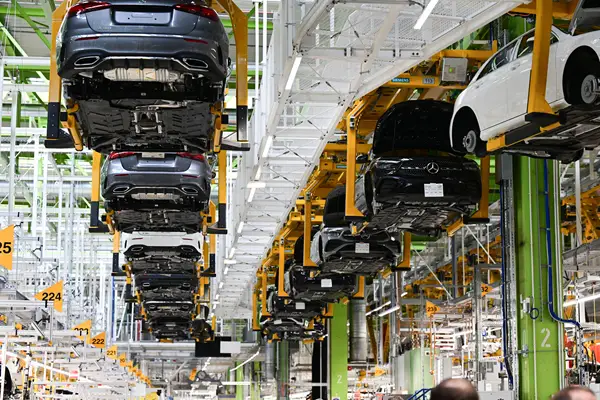
UK vehicle production fell -7.5% in the first half of 2026, with factories turning out 385,979 cars and commercial vehicles, according to the latest figures published today by the Society of Motor Manufacturers and Traders (SMMT).
Despite a challenging start to the year, however, output stabilised in the second quarter, dipping by just 128 units (-0.1%) year on year as exports strengthened and car production returned to marginal growth.
Overall production for export reached 294,222 units in the first six months, down -5.6% on the same period last year, while output for the domestic market fell more sharply, down -13.2% to 91,757 units. In the second quarter, however, exports increased, rising by 5,075 units (+3.9%).
June performance was particularly strong as car exports rose for the third consecutive month, up 4.5%, and commercial vehicle exports surged by 54.3%, albeit from a weak base. Overall output in June continued to steady, following a rise in May, easing by just -1.2% to 68,200 units.
In the year to date, exports represent 76.2% of all vehicles built, underlining the importance of free and fair trade with global markets. The EU remained by far the sector’s biggest customer – and supplier – taking 58.3% of car shipments, up 3.4% year on year to 166,801 units. The US was second, with 45,162 units accounting for 15.8% of exports, although volumes fell by -4.6%. China, the third biggest market, took 12,323 units, down -44.7% on H1 2025.
Model changes at several manufacturers continue to affect volumes, particularly electrified cars. Although these vehicles accounted for around four in 10 cars built in the first half, output was -8.6% behind last year. Reflecting the ongoing product transitions, trade and investment uncertainty, the latest independent production outlook anticipates total UK car and light vehicle output will be broadly flat this year, at 740,000 units, before returning to growth in 2027.
The potential to surpass one million units, which would require output to grow by some 40%, still exists – but only if further new model investment can be secured by making the UK more globally competitive for manufacturing.
With major investment decisions being made now, and a new government in place, SMMT is urging rapid implementation of the Modern Industrial Strategy. In particular, given energy price volatility, the UK’s uncompetitive industrial electricity prices, even after the introduction of the British Industrial Competitiveness Scheme (BICS), must be addressed.
ZEV Mandate reform is also vital. Manufacturers are investing billions in zero emission technologies, but regulation remains ahead of demand, making the cost of selling in the UK untenable and undermining any case for local manufacturing investment. Fair EU trade is equally critical, with ‘Made in Europe’ and Rules of Origin issues arising under the TCA threatening cross-Channel trade and supply chains. Left unresolved, they threaten an €80 billion-a-year trading relationship as well as Europe and the UK’s wider automotive competitiveness.
Mike Hawes, SMMT Chief Executive, said, “Global vehicle production remains under intense pressure, and the UK is no exception. Global market weakness, trade pressures and uncompetitive costs are taking their toll. But decline is not inevitable.
Urgent action on energy costs, reform of market regulation and improved trading arrangements with our global partners would ensure the sector can return to growth. And given that growth would be across every region in the UK, there is every reason for the new government to get behind the sector.”
At stake is an industry built on decades of investment, with automotive manufacturing alone turning over more than £85 billion, adding £18 billion in GVA and employing 188,000 people. Across the wider sector, including retail and service, maintenance and repair, automotive is worth nearly £400 billion, contributes more than £75 billion in GVA and supports 830,000 jobs in every region of the country. It also underpins Britain’s global trading strength, accounting for 10% of all UK goods exports, worth almost £40 billion, and £111 billion in total automotive trade, while SMMT analysis identifies a further £4.6 billion domestic sourcing opportunity by 2030.















Leave a comment