
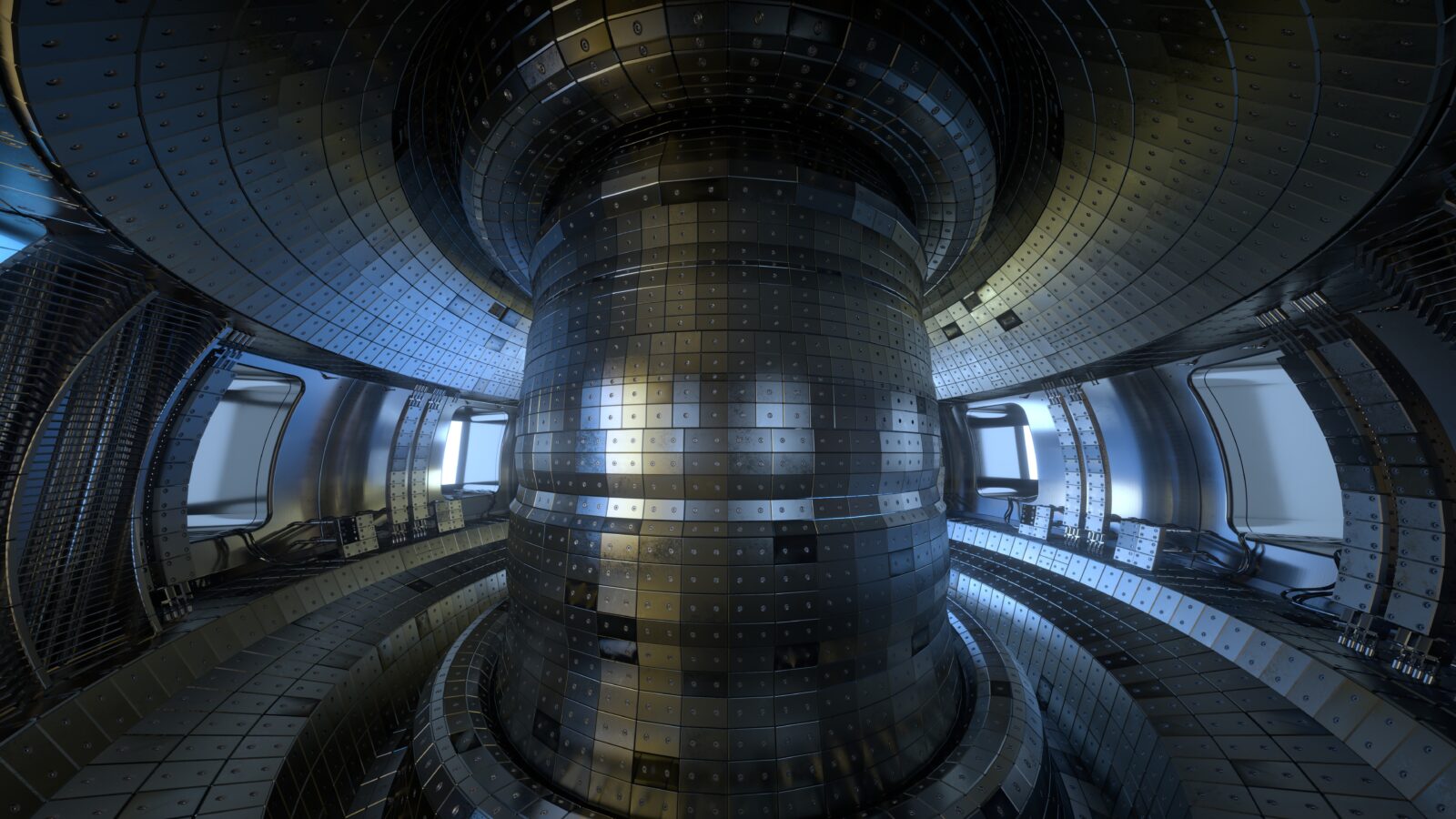

Image credit: Adobe Stock
The agreements were penned at this week’s (14 September) Global Fusion Summit.
Nuclear fusion replicates the process that powers the sun, whereby lightweight hydrogen atoms are forced together using extreme heat and pressure to combine and create helium. Doing so releases huge amounts of energy, which is why fusion has been spotlighted as a promising source of abundant, carbon-free energy.
But because it demands such a large energy input, the technology has not yet been harnessed and deployed at scale.
The agreements
The first agreement launches a new partnership between the UK Atomic Energy Authority and Princeton Plasma Physics Laboratory, enabling the institutions to share their expertise in artificial intelligence (AI), computing and nuclear fusion in order to help accelerate commercialisation of the technology.
The second is a Joint Statement committing to closer collaboration on fusion regulation, which should help to support the sector and attract critical investment.
Energy Minister Michael Shanks said: “Fusion has the potential to provide virtually limitless clean energy while supporting more than 10,000 jobs across the UK by 2030, attracting investment and creating major opportunities for British businesses.
“By strengthening our partnership with the US, we’re accelerating the race to commercial fusion, turning cutting-edge research into economic growth and cementing Britain’s position as a world leader in fusion energy.”
In addition, through the FURESHMA (Fusion Reactor Shielding Materials) programme, the University of Birmingham and the Electric Power Research Institute (EPRI) have confirmed a new £2.63m collaboration, funded by the UKRI Engineering and Physical Sciences Research Council and Element Six. The agreement will see the institutions share knowledge to help take fusion technologies from the lab to real-world applications.
The partnership announcements follow publication of the Government’s UK Fusion Investment Prospectus, which breaks down potential investment and commercial opportunities for fusion, a market that’s estimated to be worth £3trn-12trn globally.
Advancing a nuclear ‘golden age’
The new agreements build on the landmark Atlantic Partnership for Advanced Nuclear Energy, another UK-US deal established last September that aims to reduce the time it takes for companies to build new nuclear power stations in both countries.
Under the deal, the US and UK can fast-track reactor design checks for those reactors already rigorously checked in one country to avoid duplication of work.
Several major commercial deals were confirmed under the agreement.
These include a deal between X-Energy and Centrica to build up to 12 advanced modular reactors in Hartlepool. This would generate enough power for 1.5 million homes, and create up to 2,500 jobs. The project, the companies noted, could be worth £40bn in economic value, with £12bn of value within the North East of England alone.
Another was a £11bn project between Holtec, EDF and Tritax creating advanced data centres powered by small modular reactors in Nottinghamshire, and a project between Last Energy and DP World, backed by £80m in private investment, to establish one of the world’s first micro modular nuclear power plants.
In his previous role as Energy Secretary, Ed Miliband highlighted the Government’s goal of creating a “golden age of nuclear”.
He stated: “We’re kickstarting a golden age of nuclear in this country, joining forces with the US to turbocharge new nuclear developments and secure the technologies of the future.
“Nuclear will power our homes with clean, homegrown energy and the private sector is building it in Britain, delivering growth and well-paid, skilled jobs for working people.”
















Leave a comment