
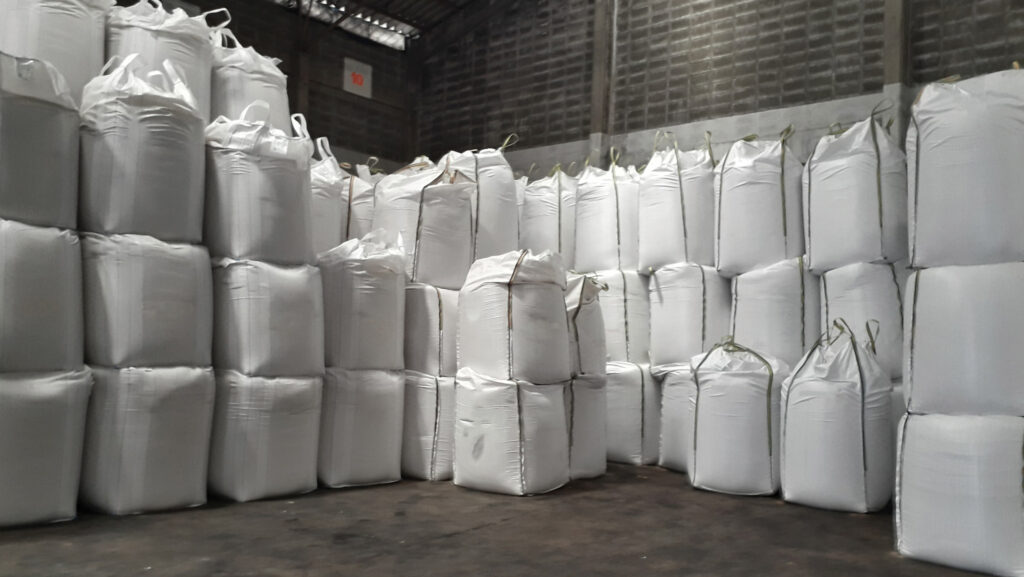
UK fertiliser merchants have been hastily stocking up on supplies and securing additional storage facilities close to ports in order to reduce the risks of future global supply chain disruption.
The UK remains heavily reliant on imported fertiliser, and farm businesses have already faced higher input costs this spring due to the Middle East conflict.
Imported ammonium nitrate is still trading at about 20% above pre-conflict levels, with prices collected by AHDB putting it at £485/t in mid-June.
See also: Fuel and fertiliser prices drop on possible US-Iran deal
The Strait of Hormuz, a major global shipping route which roughly one-third of global fertiliser shipments pass through, has been closed for much of the year due to the conflict.
This has resulted in merchants looking at alternative suppliers and acquiring additional warehouse capacity to stockpile fertiliser in order to avoid further shortages.
The Port of Liverpool is experiencing a surge in demand and has reported a 200% increase in interest from fertiliser importers.
Fertiliser products have traditionally been imported on the East Coast, via ports such as Sunderland and Great Yarmouth.
However, there has been a shift in demand with deep sea terminals in the North West providing access for larger vessels.
Phil Hall, port director at Peel Ports Group, said: “Customers are looking closely at how they can strengthen resilience across their supply chains.
“For many, that means reviewing vessel choice, storage capacity and alternative ports to ensure they can continue to move product efficiently despite ongoing uncertainty in global markets.”
Volatile markets
Traders at major agronomy and grain-trading group Frontier Agriculture say fertiliser markets remain highly volatile, with some easing of geopolitical tensions, but supply risks and structural tightness keeping the floor firm.
Origin Enterprises, parent company of fertiliser specialist Origin Soil Nutrition, reported strong revenue growth in its latest trading update for the nine months ended 30 April 2026.
The firm said this was primarily price led with average fertiliser prices up by 12% for the year to date, due to tight supplies, global volatility, and higher production and import costs.
Origin’s chief executive, Sean Coyle, said: “Farmers continue to manage input spend carefully, where crop input inflation, particularly in fertiliser, has outpaced grain pricing, reflecting market dynamics following the Middle East conflict and the introduction of the Cbam (Carbon Border Adjustment Mechanism).
“We continue to monitor geopolitical developments and mitigate any associated impact through disciplined procurement, flexible supply channels and local market access.”















Leave a comment