

A run of large cash premiums for UK-listed companies is fuelling an argument that the London market remains structurally underpriced and that a shrinking pool of listed businesses is making the problem worse.
The large cash premiums being offered for UK-listed companies, such as Tuesday’s bid for support services group Mitie, suggest UK equities remain underpriced despite major indices trading close to record highs, according to investment commentators.
What’s more, there are worries that each deal shrinks the UK market further, making the valuation gap harder to close.
Mitie shareholders will receive up to 221.6 pence a share in cash, valuing the company at approximately £3.1bn if the final dividend is declared and paid in full. The deal is expected to complete in the first quarter of 2027, subject to shareholder and regulatory approval.
Russ Mould, investment director at AJ Bell, noted that the Mitie deal is the eighth-highest UK takeover bid of 2026 and the 11th transaction this year valued at more than £1bn.
He put the 45% premium to Mitie’s undisturbed share price above the year-to-date average of 43% across 36 live or completed UK deals and said the combined value of this year’s live and completed bids could reach £69.3bn, equivalent to 2.4% of the combined market capitalisation of the FTSE All Share and AIM All Share.
Proposed UK takeovers in 2026 so far
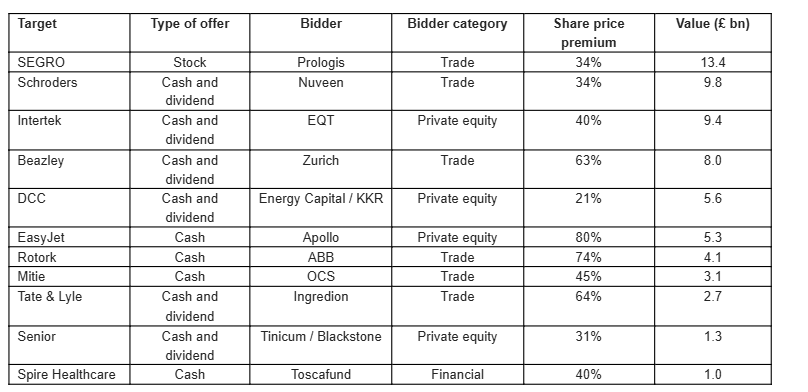
Source: AJ Bell, company accounts
Aberdeen Investments, using Deutsche Numis data, said the number of potential and confirmed UK takeover approaches this year sits at 27, with a combined value of more than $70bn. Nine approaches have been announced in the past month alone.
Each deal reduces the number of companies available to investors. The number of companies in the FTSE All Share has fallen 11% over five years, with almost 300 fewer constituents across the FTSE All Share and FTSE AIM All Share combined compared with five years ago, Aberdeen said.
Clive Beagles, senior fund manager of the JOHCM UK Equity Income fund, said the effect compounds over time. UK-listed companies once accounted for 10-15% of global stock market value; that share has fallen to roughly 3%, leaving the entire UK equity market smaller than the two largest US-listed companies.
“While acquisitions deliver short-term premiums, they reinforce a longer-term cycle of decline,” Beagles said. “At the current rate of M&A (the number of companies leaving the market relative to the number of companies joining the market), the UK market will be materially smaller in 10 years’ time.”
The businesses being acquired are not simply the cheapest or weakest, commentators noted. Rebecca Maclean, investment director for developed market equities at Aberdeen Investments, said: “Public markets may have fallen out of love with dependable compounders, but strategic acquirers continue to recognise the value of businesses with durable competitive advantages, that generate strong cashflows, visible earnings and returns comfortably above their cost of capital.
“Importantly, this is not just a search for cheap assets. Companies such as Rotork and Intertek illustrate the type of quality businesses that continue to appeal to acquirers.”
Garry White, chief investment commentator at Raymond James, said Mitie’s approach follows a run of takeover activity affecting energy firm DCC, oil and gas services company Rotork and property giant SEGRO within the space of roughly six weeks.
DCC had received an improved bid from a consortium led by KKR and Energy Capital Partners, following a series of proposals dating back to late April 2026, while Rotork had received a recommended takeover approach from ABB. SEGRO remains the subject of an ongoing approach from Prologis, which made a “best and final” offer of £14bn on Wednesday.
Mould said the size of the premiums being offered suggests acquirers still expect a return that compensates for the risk involved, even with the FTSE 100, FTSE 250 and FTSE All Share all trading close to record highs.
“Valuation is, after all, the ultimate arbiter of investment return, whether you own one share in a company or all of them,” he said.
Maclean said the broader macroeconomic backdrop may be turning more supportive for UK equities, pointing to an upward revision to second-quarter UK GDP and the Bank of England holding off further rate rises.
She also raised the question of whether the government should scrap stamp duty on share dealing, arguing this could help draw domestic capital back into UK-listed companies and slow the pace at which the market is shrinking.
“While the UK has some great stories to tell, sooner or later we are going to run out of them,” she added.
JOHCM’s Beagles expects to see incremental policy measures from the new government to lift domestic equity ownership, such as linking pension tax relief to minimum allocations to UK assets.
White finished: “Investors will be asking whether this wave of takeover activity reflects a belief among overseas buyers and private equity firms that UK-listed companies are undervalued.
“Attention will also likely turn to whether the autumn Budget under new prime minister Andy Burnham might include measures designed to enhance the attractiveness of London’s equity market and stem the flow of companies leaving the exchange.”














Leave a comment