

Image: Canva Studio/Pexels
The third in a series of extracts from Global Government Forum’s new study on future-proofing digital capability examines how a level of digital capability is now needed by all civil servants, not just technical staff, and how governments are working to achieve this
Governments are moving from treating digital as a technical silo to ensuring that the whole workforce is confident in using digital tools and approaches, according to a new study from Global Government Forum (GGF). This means delivering relevant training at scale and making sure theory translates to practice.
The Future-proofing government digital capability study, led by Kevin Cunnington, executive advisor at GGF and former director general of the UK Government Digital Service, explores how government organisations can ensure they have the right capability in place to deliver on their digital visions.
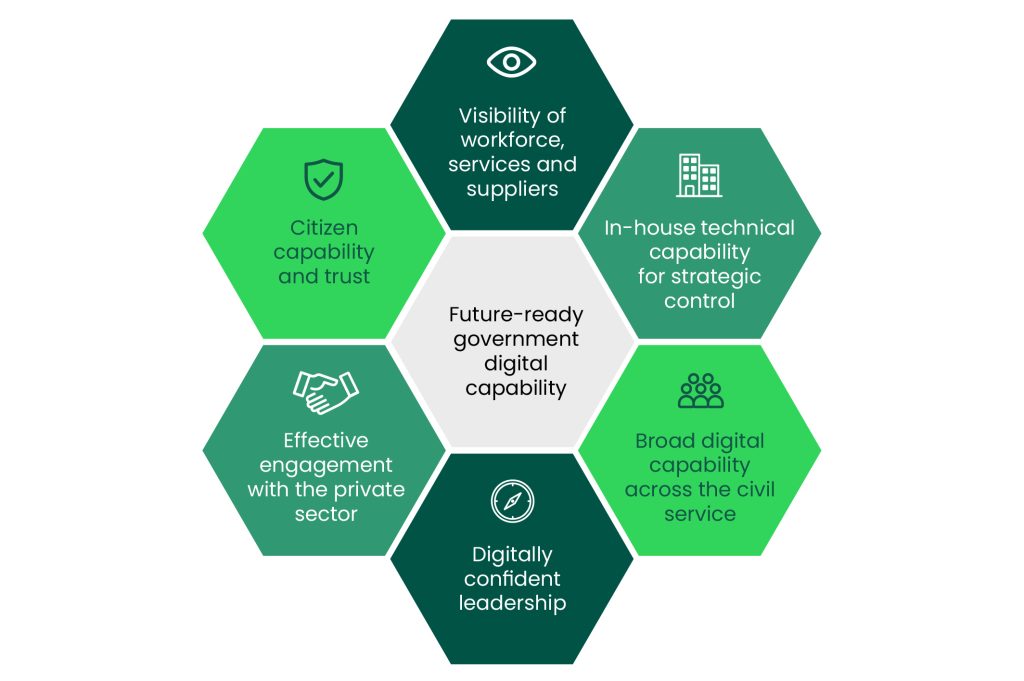
Based on interviews and a roundtable with over 20 digital leaders from around the world, including the UK, the US, Canada, Singapore, Australia and New Zealand, the report identifies six common foundations that underpin digital capability across governments, and how to make sure these foundations are resilient in a fast-changing environment.
Cunnington writes in the foreword: “The ability to meet today’s expectations and capitalise on tomorrow’s opportunities depends on capability – the right people, skills and partners to deliver. Governments need a clear understanding of their digital service priorities; strong in-house technical capability to retain control; a workforce that is confident in using digital tools and approaches; and a strategic approach to engaging and shaping the supplier ecosystem. They also need to ensure citizens are well-equipped to adopt digital services.”
Download the report: Future-proofing government digital capability: Six foundations for success
Broad digital capability across the civil service
This extract explores the second pillar: broad digital capability across the civil service.
Across governments, there is clear agreement that digital services and transformation cannot be delivered by technical specialists alone. While efforts to build dedicated technical capability continue, all administrations now recognise that digital capability must extend across the entire civil service because success also depends on changing processes, ways of working and culture. In a pre-roundtable survey, respondents agreed that core digital training for all civil servants was important or essential.
This includes those not traditionally seen as part of the digital workforce – policy officials, HR professionals, commercial teams, operational staff, and others whose decisions shape how services are designed, funded and delivered.
As one interviewee put it: “Everyone in the public service needs digital capability.”
Another emphasised that this is not about turning all staff into specialists, but about ensuring a minimum level of fluency: “It doesn’t mean that you are an AI expert, but it means that if you don’t actually understand how to leverage these tools, how to prompt them and how to leverage them to transform the way that you’re doing business, you’re going to be passed by.”
Turning strategy into delivery: Find out more about Global Government Forum’s training and advisory services
Scaling capability across the workforce
In response, many governments have introduced structured programmes to raise baseline digital literacy across large sections of the civil service.
These approaches vary in scale but typically include introductory training for the wider workforce and more specialised learning for those directly involved in digital delivery.
Several governments have established central academies or training institutions to support this effort.
The UK, for example, recently announced plans to establish a new National School of Government and Public Services within the Cabinet Office, focused on skills in technology, AI and strategic thinking. This will be accompanied by a cross-government learning offer intended to “give civil servants at every level the tools and knowledge to work in a modern digital government”.
Singapore has announced the creation of an Institute of Digital Government training academy, aiming to equip more than 150,000 public officers with digital, data and AI skills. Countries such as Canada and Australia have also drawn on central learning institutions, including digital academies and public service academies, with an increasing emphasis on digital capability.
In some systems, capability development is managed within agencies rather than delivered through a single central academy.
Across these approaches, a common lesson emerges: capability-building is not a one-off exercise. As one interviewee noted: “We have to constantly be rethinking.”
The challenge of scale and prioritisation
While the direction of travel is clear, implementation presents significant challenges.
The most immediate is scale. Governments are attempting to reach thousands – in some cases hundreds of thousands – of staff across diverse roles and organisations. As one interviewee put it: “How do you train thousands of people in a few years? And who do you prioritise?”
This raises practical questions about sequencing, targeting and delivery models. Some governments have introduced mandatory training in areas such as cybersecurity, data protection, and AI awareness. Others rely more on voluntary uptake, supported by incentives and encouragement.
There are also questions about delivery methods. Online learning platforms allow governments to reach large numbers of staff efficiently but interviewees consistently emphasised that information alone is insufficient to drive meaningful change. As one official explained: “If there aren’t conversations around the training, it’s not as effective. Otherwise, it’s just information. It’s meaningless.”
As a result, many governments are moving towards blended approaches that combine online modules with in-person workshops, discussion-based sessions, and applied project work.
One interviewee described an approach that focused on placing small teams of digitally literate leaders inside departments rather than attempting to train the whole civil service immediately: “You need at least a small team of champions,” they said. The logic behind this approach is that visible delivery results can generate internal demand for digital change more effectively than pushing out large-scale training programmes.
Read more: Why governments must ‘grab the nettle’ on digital capability
From theory to practice
Interviewees also described a shift in how capability is developed.
Traditional models often assume that learning should begin with theory before moving to application. However, experience with emerging technologies – particularly widely available AI tools – suggests that a more practical, exploratory approach may be more effective.
As one interviewee explained: “What we’ve learned through looking at how LLMs [large language models] are readily available and adopted by civil servants is actually the inverse of that is what works best, allowing people to play and explore and try things, rather than feeling like you’ve got to explain the underpinning ecosystem.”
With this in mind, some governments are focusing on enabling small teams to explore and demonstrate new ways of working.
This thinking also helps with prioritisation. As one interviewee noted, the most meaningful learning often comes not from structured programmes but from direct exposure to delivery challenges: “It’s not the masterclasses we’ve run or the workshops we’ve put them on; it’s actually when they’ve got something in their core accountabilities that relates to digital or AI.”
This has implications for how capability-building is designed. Rather than treating training as a separate activity, it needs to be integrated into real work, with opportunities for staff to apply new skills in context.
Vibe coding: Lowering the barrier to building
Interviewees also pointed to the rapid emergence of new AI-enabled ways of working that are reshaping how digital capability is distributed across the civil service.
Examples include using AI tools to tag government websites, generate internal documents such as memos, analyse financial data to detect patterns, support translation and transcription, and enable citizen interaction at scale via chatbots and voice solutions.
Tools that allow users to generate software prototypes or automate tasks through natural language – known as ‘vibe coding’ – are also making it possible for non-specialists to contribute directly to digital delivery. In some cases, non-technical staff are already using these tools to develop simple applications or prototypes, significantly reducing the time between identifying a need and testing a solution.
This is beginning to blur the boundary between specialist and non-specialist roles. As building tools and services becomes easier, greater emphasis is placed on judgement and prioritisation. As one leader put it, the key capability is increasingly “knowing what services are actually needed”, rather than simply how to build them.
Bringing in external expertise
Some governments report seeing “real value” in bringing in private sector expertise not to deliver work directly, but to work alongside civil servants through mentoring and coaching on “real-world work that agencies are grappling with”.
This kind of hands-on support can help accelerate capability development while ensuring that learning is grounded in practical delivery.
Vendor-provided training was also raised as an untapped resource for upskilling at scale. While this training would not form the whole learning solution, it could be “incredibly helpful” given the pace of change and help government organisations maximise the value of their investment in technology.
Building the foundations for future-ready capability
- Digital as a baseline capability for all roles. As digital becomes integral to service delivery, a minimum level of digital and AI fluency will be expected across the entire civil service.
- Capability embedded in everyday work. Training alone will be insufficient. Governments will need to focus learning on core responsibilities, ensuring capability is built through real delivery.
- Continuous, adaptive learning models. As technologies evolve rapidly, capability-building will need to move from one-off training interventions to ongoing, flexible learning systems.
- Targeted and scalable approaches. Governments will need to prioritise key roles and teams who are essential to digital projects and work outwards. They can use champions and demonstrator projects to drive wider adoption rather than attempting to train entire workforces at once.
- From skills to behaviours. The long-term challenge is not just increasing knowledge, but changing how civil servants think, collaborate and deliver services in a digital environment.
GGF will now take the collaborative opportunities identified in this report forward – if you’d like to be involved, get in touch by emailing [email protected] so we can structure the work to be as useful as possible.

Participants in the study were as follows (job titles reflect those at the time of interview/roundtable participation):
- Dr Subho Banerjee, deputy commissioner, head of the Australian Public Service Academy and capability, Australian Public Service Commission
- Gregory Barbaccia, federal chief information officer, Office of Management and Budget, United States
- Thomas Beautyman, deputy director of government digital capability, Department of Science, Innovation and Technology, United Kingdom
- Dominic Chan, assistant chief executive, product, and chief information officer, GovTech Singapore
- Marie-Chantal Girard, president, Public Service Commission, Canada
- Shafiqa Dawood, chief digital and technology officer, Department for Education, United Kingdom
- Wolfgang Ebner, federal chief digital officer, Austria
- Richard Gevers, head of service design and delivery, Digital Services Unit, South Africa
- Luukas Ilves, former chief information officer and undersecretary for digital transformation, Government of Estonia, and advisor to the deputy prime minister and minister of digital transformation, Ukraine
- Valeriya Ionan, advisor to the deputy prime minister of Ukraine on innovation, digitalisation and global partnership and former deputy minister of digital transformation, Ukraine
- Birna Íris Jónsdóttir, CEO, Digital Iceland, Iceland
- Paul James, government chief digital officer, New Zealand
- Romina Kostani, deputy general director of the National Agency of Information Society, Albania
- Chris Leck, group chief technology officer, Public Sector Science & Technology Policy & Plans Office, Prime Minister’s Office, Singapore
- Barry Lowry, government chief information officer, Ireland
- Lauri Luht, government chief information officer, Estonia
- Dominic Rochon, government chief information officer, Canada
- Haseley Straughn, digital development policy coordinator, Ministry of Industry, Innovation, Science and Technology, Barbados
- Jaanus Vant, AI and data strategy coordinator, Ministry of Economic Affairs and Communications and Ministry of Justice, Estonia
- Paul Wagner, chief executive officer, Canadian Digital Service, Canada
- Vicky Wang, senior director, digital workforce transformation, Smart Nation, Singapore
- Claire Wraith, head of strategic workforce and transformation, Government Digital Service, United Kingdom
















Leave a comment