
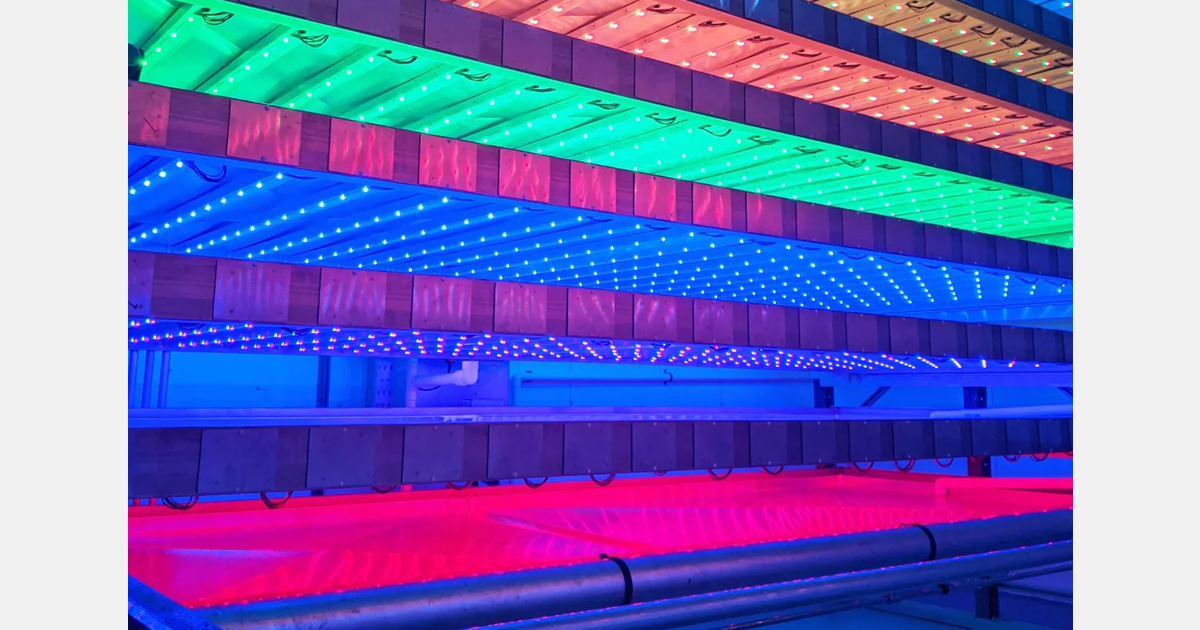
UK Urban AgriTech (UKUAT) will host a webinar titled “CEA & Energy: Growing Greener Infrastructure” on September 30, bringing together speakers from Intelligent Growth Solutions, the University of Sheffield, the University of Glasgow, Farm Urban and Urban Chain. The session extends work UKUAT has been developing through the InnovateUK-funded V-FAST project, which pairs vertical farms with renewable energy generation and storage.
“This is a topic we have been pursuing for some time, both generally and more specifically through projects like the InnovateUK-funded V-FAST project,” says Mark Horler, Founder and Chair of UKUAT. “There is clear recognition across the sector that CEA is inextricably linked to energy. It is also clear that energy and food sectors have similar goals around decarbonisation.”
 © IGS
© IGS
A meeting in Glasgow set the format
Mark traces the specific shape of the webinar to a conversation at an unrelated industry event. “When we happened to meet Urban Chain at the All Energy event in Glasgow, we spotted an opportunity to advance the conversation around what that looks like in practice,” he says.
Jacob Nickles, Director of Food System Integrations at UKUAT and CEA Project Lead at the University of Sheffield, sets the environmental and economic case alongside the technical one. “When we look at the environmental effects, land and water-use efficiency, CO2-equivalent emissions and so on, and the economic feasibility of CEA, we need to discuss opportunities for improvement and collaboration,” he says.
“Most pertinently, energy production, especially renewables, can be varied. CEA can adjust production to align with peaks and troughs in both consumption and production. This, in turn, can benefit the energy sector and related infrastructural challenges, such as storage and demand management.”
Vertical farming’s largest line item
“Energy use does indeed represent one of the largest costs for CEA, especially for vertical farming, where it is frequently the highest operational cost,” Mark says. “At the same time, energy source is the largest component of environmental impact assessment for CEA businesses, so it is a crucial factor in their sustainability. We must consider both energy use efficiency and the source of this energy.”
“Some very interesting research is taking place, for example at the University of Glasgow, a participant in this webinar, around how coordinating renewable energy availability with energy expenditure enables PACE horticulture facilities to be an asset to the evolving smart energy grid, whilst maintaining crop yield and quality.”
 © IGS
© IGS
Storage projects already underway
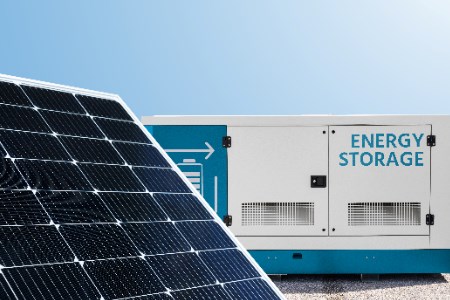
“We have demonstrated through the V-FAST project that integration of renewables and vertical farming, alongside appropriate energy storage technologies, could offer significant cost savings for growers, whilst also offering benefits to renewable energy suppliers and developers,” Mark says.
“Meanwhile, others are also doing work in similar areas, for example, the Resource Innovation Institute ‘Farm Park’ model. This is clearly an idea whose time has come, but for it to be adopted and implemented at scale, there will need to be a significant amount of R&D and de-risking.”
A push for policy attention
“The crucial point is that the combination of food and energy should be seen as critical green infrastructure,” Mark says. “Food and energy availability and affordability are key questions for national resilience.”
“We hope to increase policy awareness of CEA with a view to leveraging support mechanisms such as the UK BIC Scheme, whilst highlighting the opportunity afforded by coupling CEA and energy infrastructure,” Jacob says.
Decoupling food production from land
“There are several elements to consider here,” Jacob says. “CEA, alongside other bioeconomy innovations of this kind, offers the opportunity to decouple productivity from land use, so alleviating the current, perceived competition between other more extensive land uses, protecting food production from unstable climatic conditions, reducing inputs, reducing water, nutrient and pesticide application, and maximising food productivity and security by integrating within other circular economy resource loops.”
“While we deal with the complex interaction of reducing our impact on the environment and fielding varied input costs and availability, CEA can be deployed to increase the productivity of crops not readily available in the UK, or implement rapid development of resilient cultivars and seedlings for field use.”
“The technologies are ready. What we need is coherent policy and incentives which can unlock blended finance sufficient to achieve this goal at scale and as part of a wider integrated set of food system resilience initiatives,” Mark says.
The webinar takes place on September 30 at 12:00 (GMT+1) and is free to attend. Full details and registration are available here.
For more information:
UK Urban AgriTech Mark Horler, Founder and Chair
Jacob Nickles, Director of Food System Integrations
[email protected]
www.ukuat.org












Leave a comment