
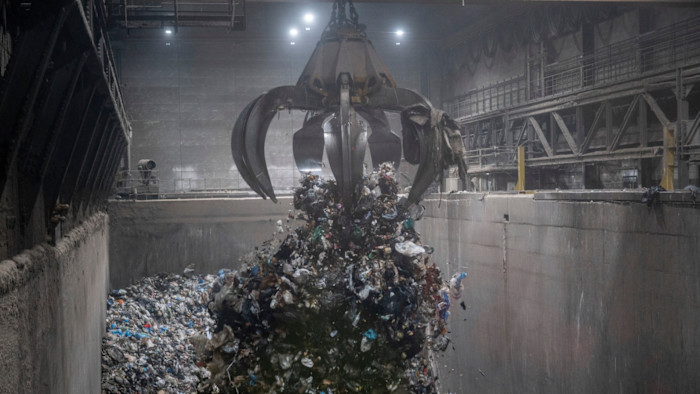
Every week barges loaded with yellow containers collect black-bag rubbish from sites along the river Thames and deliver it to a plant that converts non-recyclable household waste into electricity.
Cory Group, which has run the facility in Belvedere, south-east London since 2012, will this summer open a £900mn plant next door. The largest single “energy-from-waste” site in Europe, it will be able to burn 1.5mn tonnes of refuse and turn it into 150MW of low-carbon partially renewable electricity, powering 400,000 homes.
“We’re driven by economic growth, consumerism and the rising population,” said Dougie Sutherland, Cory Group chief executive. “It’s a good business to be in.”
Expansion is not limited to the capital: the Belvedere site is one of 65 energy-from-waste (EFW) facilities across the UK, with 10 more under construction, according to the Environmental Services Association, a trade body.
It is not welcomed by all. Critics say EFW plants reduce the incentive to recycle waste, emit large amounts of carbon dioxide and that the pollutants they release into the air pose a health risk.

Sir Sadiq Khan, London’s Labour mayor, initially opposed Cory’s expansion but dropped the case after deciding it was too expensive. Greenpeace said the air pollution from EFWs tended to “disproportionately affect poor communities”.
In 2024 the UK government announced a crackdown on new furnaces in England, saying it would only “back projects if they meet strict local and environmental conditions”. But the amount of waste that is incinerated, with or without energy recovery, has increased.
About 50.2 per cent of waste collected by local authorities in England was burned in 2023-24, the latest full year for which official data is available, while the recycling rate was relatively unchanged at 44 per cent. The government’s target is to halve waste sent to incineration or landfill by 2042.
Decisions on EFW plants are taken by local authorities but some have been approved since Labour won power in 2024. They include a new facility in Teesside in north-east England, which was given the green light last year.
Shlomo Dowen, national co-ordinator of the United Kingdom Without Incineration Network, a campaign group, said ministers should be closing down EFW facilities rather than allowing new ones to be built, pointing to the low rates of recycling in local authorities with the most plants.
“Most of this waste should be recycled . . . The energy-from-waste companies are not paying for the damage they do to the environment or to air quality,” he said.

In Teesside’s case, waste management company Viridor is the preferred bidder. It already operates 12 plants and is building a new facility in Tilbury, Essex.
Tim Rotheray, Viridor’s chief sustainability officer, said the EFW model was “vastly preferable” to landfill, which produces more greenhouse gases and “leachate” — a toxic liquid created by rain pouring into landfill sites.
“Even if the government achieves these stretching recycling rates, they are still estimating that there are 19mn tonnes that will be processed at energy-from-waste plants,” he said. “And if you don’t do it that way there is no alternative to landfill, which is worse on every measure.”
Cory is keen to point to the Belvedere site’s environmental credentials: it says it operates the largest number of vessels on the Thames, avoiding roads by taking the waste on barges to its furnaces.
The plant’s heat separates the metals and ash, which are taken by boat to Tilbury, where they are repurposed for road and civil engineering projects. The remainder is converted into electricity and heat, which can be pumped back into the grid.


Electricity generated from waste contributes a small but growing share of Britain’s power supplies, accounting for about 10,040 gigawatt-hours or 3.6 per cent of total net UK power generation in a year, according to the ESA.
“We’re not digging up Mother Earth’s minerals and we are not cutting down trees and the energy is already there, so it would be wasted anyway,” said Sutherland.
Recycling is also difficult, especially plastic. Most plastic rubbish is soiled and composed of different layers, making it too complex for the usual recycling method of chopping material into bits before it is remoulded.

The UK generates about 2.26mn tonnes of plastic packaging a year, with about half collected for recycling.
Domestic reprocessing capacity has improved but about half of plastic packaging is still sent abroad to countries such as Turkey, Malaysia and Indonesia, where investigations by Greenpeace have documented UK waste being illegally dumped or burned instead of reprocessed.
The plastic waste that is not collected for recycling is either incinerated for energy — the most common route — or sent to landfill.
“If you want to increase recycling, you really need to talk to the producers,” said Sutherland.

The business of converting waste into energy is profitable. Underlying earnings at Cory Group rose 4.9 per cent to £85.2mn in the year to December 2024, when it paid dividends of £32.7mn to the consortium of infrastructure investors that own it.
Nearly all EFW plants are operated privately, though many are on long-term private finance initiative contracts. Over the next decade they are due to be handed back to councils, which have a statutory duty to deal with waste.
There are problems. Exploding nitrous oxide, or laughing gas, canisters have shut down some furnaces, while lithium-ion batteries in e-cigarettes have caused a surge in fires at the sites. But there is little sign they are denting private-sector appetite.
“Investors like the business,” said Sutherland. “People just keep producing rubbish and it’s got to go somewhere.”
















Leave a comment