Home
Artificial intelligence
Market to Reach $659.7 Billion by 2030, Fueled by Demolition Robots, Labor Shortage, and Cost Reduction in Robotic Technology
Market to Reach $659.7 Billion by 2030, Fueled by Demolition Robots, Labor Shortage, and Cost Reduction in Robotic Technology
November 30, 20255 Mins read200
Share
Company Logo
The construction robots market is set to transform the industry by enhancing efficiency and safety, addressing labor shortages, and meeting urbanization demands. Key opportunities lie in advancing AI, machine learning, and robotics, driven by complex architectural needs and sustainable practices, promising faster and precise construction.
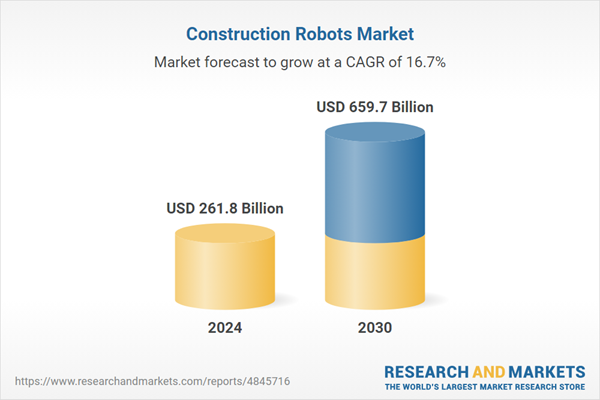
The global market for Construction Robots was valued at US$261.8 Billion in 2024 and is projected to reach US$659.7 Billion by 2030, growing at a CAGR of 16.7% from 2024 to 2030. This comprehensive report provides an in-depth analysis of market trends, drivers, and forecasts, helping you make informed business decisions.
Construction robots represent a revolutionary shift in the building and infrastructure sector, enhancing both the efficiency and safety of construction projects. These automated systems and robotic devices are specifically designed to assist, augment, or automate various construction operations such as bricklaying, painting, loading, and assembly tasks.
Their integration into construction sites addresses several industry challenges, including labor shortages and the increasing demand for faster construction processes. Robots are equipped with various technologies such as GPS, LIDAR (Light Detection and Ranging), and advanced imaging systems, enabling precise and efficient task execution that often surpasses human capabilities in terms of speed and accuracy. This technological infusion not only speeds up the construction process but also improves the overall quality of the build, reducing waste and increasing structural integrity.
What Are the Main Drivers Behind the Rapid Expansion of the Construction Robot Market?
The growth in the construction robot market is driven by several factors. Foremost, the increasing complexity of architectural designs and the growing emphasis on sustainable and precise construction are compelling the industry to adopt advanced technological solutions like robots. Additionally, as urbanization continues to rise, the demand for housing and infrastructure projects accelerates, necessitating the need for faster construction methods that robots ideally provide. The shift towards green building practices also fuels the adoption of robots, as they offer more precise control over material usage, significantly reducing waste.
Furthermore, economic factors such as the reduction in long-term costs associated with robotic integration play a crucial role. Although the initial investment in construction robots can be substantial, the return on investment through increased productivity and reduced labor costs is a significant market driver. Lastly, consumer behavior and expectations towards innovative construction methods continue to push the boundaries of traditional construction practices, promoting the adoption of robotics in this sector. Together, these elements are catalyzing the rapid development and deployment of construction robots across the globe.
What Technological Advances Are Propelling Construction Robots?
The technological backbone of construction robots involves a synergy of artificial intelligence (AI), machine learning, and robotics engineering. This integration allows robots to perform complex tasks such as autonomous navigation around the construction site, adapting to new tasks through machine learning algorithms, and executing tasks with precision.
Innovations such as 3D printing robots that can print entire structures from digital designs are becoming increasingly common. These robots can work continuously, reducing the time required to build and minimizing human errors. Additionally, the advent of drones for surveying provides a bird’s-eye view, enabling better site management and project planning. These technological advancements are crucial for catering to customized construction needs and for adapting to the ever-evolving design complexities in modern architecture.
How Is the Adoption of Construction Robots Impacting the Labor Market and Safety Standards?
While the introduction of robots into construction promises enhanced efficiency, it also presents significant implications for the labor market and onsite safety standards. Robots are taking over repetitive and physically strenuous tasks, which reduces the incidence of work-related injuries and allows human workers to focus on more complex aspects of construction that require critical thinking and problem-solving skills.
This shift is leading to a demand for a new skill set among construction workers, including robotic maintenance and supervision, thereby transforming the nature of construction jobs. Furthermore, robots contribute to significantly higher safety standards. Their use minimizes human exposure to hazardous environments and tasks, such as working at great heights or handling heavy materials, which traditionally pose high risks of accidents.
Report Features:
Comprehensive Market Data: Independent analysis of annual sales and market forecasts in US$ Million from 2024 to 2030.
In-Depth Regional Analysis: Detailed insights into key markets, including the U.S., China, Japan, Canada, Europe, Asia-Pacific, Latin America, Middle East, and Africa.
Company Profiles: Coverage of players such as Advanced Construction Robotics, Inc., Alpine Sales & Rental Corp., Apis Cor, Autonomous Solutions, Inc. (ASI), Beijing Borui Intelligent Control Technology Co. Ltd. and more.
Complimentary Updates: Receive free report updates for one year to keep you informed of the latest market developments.
Key Insights:
Market Growth: Understand the significant growth trajectory of the Traditional Robots segment, which is expected to reach US$352.2 Billion by 2030 with a CAGR of 15.4%. The Robotic Arms segment is also set to grow at 17% CAGR over the analysis period.
Regional Analysis: Gain insights into the U.S. market, valued at $72.8 Billion in 2024, and China, forecasted to grow at an impressive 15.9% CAGR to reach $100.9 Billion by 2030. Discover growth trends in other key regions, including Japan, Canada, Germany, and the Asia-Pacific.
Geographic Regions/Countries: World; United States; Canada; Japan; China; Europe (France; Germany; Italy; United Kingdom; and Rest of Europe); Asia-Pacific; Rest of World.
Key Attributes:
Report Attribute
Details
No. of Pages
187
Forecast Period
2024 – 2030
Estimated Market Value (USD) in 2024
$261.8 Billion
Forecasted Market Value (USD) by 2030
$659.7 Billion
Compound Annual Growth Rate
16.7%
Regions Covered
Global
Key Topics Covered:
MARKET OVERVIEW
Trade Shocks, Uncertainty, and the Structural Rewiring of the Global Economy
Global Economic Update
Construction Robots: Market Overview & Outlook
Construction Robots – Global Key Competitors Percentage Market Share in 2025 (E)
Competitive Market Presence – Strong/Active/Niche/Trivial for Players Worldwide in 2025 (E)
Global Economic Update
MARKET TRENDS & DRIVERS
Demolition Robots Seek Opportunities
Labor Shortage in Construction Industry Drives Adoption of Automation and Robotics
Technological Advancements in AI Propel Use of Robotics for Complex Constructions
Increasing Focus on Safety Enhances Market Penetration of Construction Robots
Cost Reduction in Robotic Technology Generates Demand in the Construction Sector
Enhanced Precision and Efficiency through Robotics Strengthens Business Case for Automation
Integration of IoT with Construction Robots Expands Addressable Market Opportunities
Aging Infrastructure Necessitates Advanced Robotics for Maintenance and Repair
Surge in Mega-Projects Sets the Stage for Large-Scale Adoption of Robotics
Robotics as a Solution to Rising Construction Costs Spurs Market Growth
Advancements in 3D Printing and Robotics Combine to Propel New Construction Techniques
Collaborative Robots (Cobots) Becoming Crucial for Human-Robot Worksite Collaboration
Enhanced Data Collection by Robots Drives Efficiency in Project Management
Rising Urbanization and Smart City Projects Generate Demand for Construction Robots
Growth in Modular and Offsite Construction Supports Use of Robotics
FOCUS ON SELECT PLAYERS:Some of the 28 companies featured in this Construction Robots market report
Advanced Construction Robotics, Inc.
Alpine Sales & Rental Corp.
Apis Cor
Autonomous Solutions, Inc. (ASI)
Beijing Borui Intelligent Control Technology Co. Ltd.
Brokk, Inc.
Conjet AB
Construction Robotics
Cybe Construction BV
Cyberdyne, Inc.
Ekso Bionics
Fastbrick Robotics Ltd.
Fujita Corporation
Giant Hydraulic Tech Co., Ltd.
Husqvarna AB
Komatsu Ltd.
MX3D B.V.
nLink AS
TopTec Spezialmaschinen GmbH
Ying Chuang Building Tech (Shanghai) Co., Ltd. (Winsun)
About ResearchAndMarkets.com ResearchAndMarkets.com is the world’s leading source for international market research reports and market data. We provide you with the latest data on international and regional markets, key industries, the top companies, new products and the latest trends.
Attachment
CONTACT: CONTACT: ResearchAndMarkets.com Laura Wood,Senior Press Manager press@researchandmarkets.com For E.S.T Office Hours Call 1-917-300-0470 For U.S./ CAN Toll Free Call 1-800-526-8630 For GMT Office Hours Call +353-1-416-8900

















Leave a comment