

The biotechnology instruments market is growing due to personalized medicine, genomics, and molecular diagnostics. Opportunities lie in integrated multi-omics platforms and automation. Challenges include high costs. North America leads the market, with key players like Thermo Fisher and Danaher dominating.
Biotechnology Instruments Market

Dublin, April 21, 2026 (GLOBE NEWSWIRE) — The “Biotechnology Instruments Market Size, Industry Dynamics, Opportunity Analysis and Forecast 2026-2035” report has been added to ResearchAndMarkets.com’s offering.
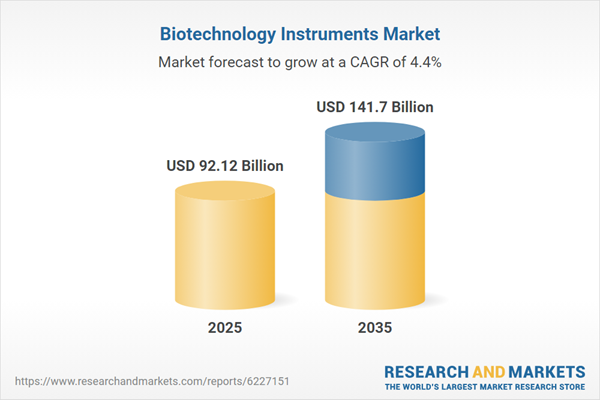
The biotechnology instruments market is experiencing consistent expansion as biotechnology becomes increasingly central to healthcare delivery, pharmaceutical innovation, and biological research. In 2025, the market is valued at US$ 92.12 billion and is projected to grow to US$ 141.70 billion by 2035. This growth corresponds to a CAGR of 4.4% during the 2026-2035 forecast period, highlighting steady long-term demand for advanced instrumentation.
Growth is driven by the rising adoption of personalized medicine, which relies heavily on genomics, molecular diagnostics, and precision analysis. The increasing prevalence of chronic diseases has further intensified the need for improved diagnostic accuracy and therapeutic development, prompting sustained investment in biotechnology research tools. These factors collectively reinforce the critical importance of biotechnology instruments across both research and commercial applications.
Noteworthy Market Developments
The biotechnology instruments market exhibits a high degree of consolidation, with major industry players such as Thermo Fisher Scientific and Danaher Corporation holding significant market share through extensive product portfolios and global operational reach. Their dominance is reinforced by strong research and development capabilities and integrated service offerings that address a broad spectrum of life sciences applications.
At the same time, the market remains dynamic due to innovation from specialized players targeting niche applications. In December 2025, Bio-Techne Corporation expanded the launch and initiated shipments of its next-generation LeoT System powered by Simple Western Technology, enhancing protein analysis capabilities. During the same period, Oxford Instruments released Imaris 11, advancing 3D/4D microscopy image visualization and analysis. Additionally, in October 2025, CN Bio introduced the PhysioMimix Core platform, further strengthening organ-on-a-chip solutions for drug discovery and development.
Core Growth Drivers
Innovation in sequencing throughput is a central driver reshaping the biotechnology instruments market. Advances in sequencing technologies have significantly improved speed, accuracy, and data depth, enabling more efficient analysis of genetic material. These developments are accelerating progress across genomics, molecular diagnostics, and personalized medicine, expanding the role of biotechnology instruments in both academic research and commercial drug development.
Emerging Opportunity Trends
Demand is increasingly shifting toward integrated multi-omics platforms and automated workflows that minimize manual intervention. These systems combine genomics, proteomics, metabolomics, and transcriptomics into unified analytical frameworks, enabling comprehensive biological insights. Automation within these platforms enhances efficiency, reduces error rates, and improves reproducibility, aligning with the operational requirements of modern high-throughput research environments.
Barriers to Optimization
High capital costs and elevated asset valuations present notable challenges for market growth. Rising interest rates have increased borrowing costs, making it more expensive for organizations to finance new equipment acquisitions. Smaller biotechnology firms, in particular, are adopting more cautious investment strategies, delaying or scaling back purchases of advanced instruments due to budgetary constraints.
Detailed Market Segmentation
By product, analytical instruments dominate the biotechnology instruments market, accounting for 65.3% of total revenue. This leadership reflects their essential role in molecular characterization and biological analysis. By end use, pharmaceutical and biotechnology companies represent the largest revenue-generating segment, contributing more than 55% of market demand due to their substantial investment in research, development, and manufacturing activities.
















Leave a comment