
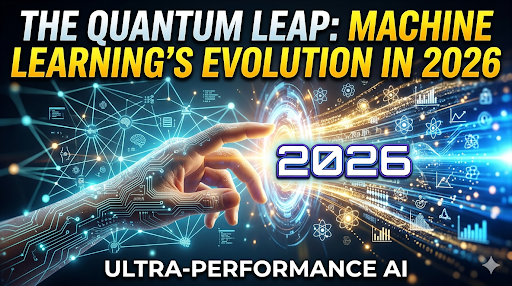
 Image courtesy by QUE.com
As we navigate through 2026, the landscape of technology is no longer just shifting; it is being fundamentally restructured. At the heart of this transformation lies Machine Learning (ML), which has evolved from a tool of predictive analytics into the very fabric of global operational intelligence. We are witnessing the dawn of the ‘Autonomous Intelligence Era,’ where ML systems no longer merely assist human decision-making but anticipate needs and execute complex strategies with minimal oversight.
The Shift from Predictive to Prescriptive Intelligence
For years, the industry focused on predictive ML—predicting a stock price, a weather pattern, or consumer behavior. However, 2026 marks the definitive pivot toward prescriptive intelligence. Modern ML architectures are now capable of not only predicting an outcome but prescribing the exact series of actions required to achieve the optimal result. This is particularly evident in high-frequency trading and real-time supply chain logistics, where the delta between a prediction and an action has collapsed to nearly zero.
The integration of Neuromorphic Computing has further accelerated this trend. By mimicking the human brain’s neural structure, these new ML models operate with a fraction of the energy requirement of traditional GPU clusters, allowing sophisticated intelligence to reside on edge devices. We are seeing ‘Intelligence at the Edge’ move from a buzzword to a biological necessity for the IoT ecosystem.
The Synergy of ML and Quantum Processing
Perhaps the most disruptive development of the last eighteen months is the convergence of Quantum Computing and Machine Learning. Quantum ML (QML) has solved the vanishing gradient problem that plagued deep learning for decades. By utilizing quantum superposition and entanglement, QML models can explore vast parameter spaces simultaneously, finding global minima in optimization problems that would take classical computers millennia to solve.
In the pharmaceutical sector, this has led to the Zero-Trial era for certain molecular simulations. ML models powered by quantum backends can now predict protein folding and drug interactions with 99.9% accuracy, reducing the drug discovery pipeline from ten years to ten weeks. This is not just an incremental improvement; it is a paradigm shift in how we approach human health and longevity.
Ethical Algorithmic Governance: The New Social Contract
With great power comes the urgent need for rigorous governance. The Black Box era of ML is ending. In 2026, the industry has moved toward Explainable AI (XAI). Regulatory frameworks now mandate that any ML system affecting human rights, finance, or health must be able to produce a human-readable trace of its reasoning process. We are moving away from blindly trusting the ‘probability’ and moving toward verifiable logic.
The rise of Federated Learning has also addressed the critical tension between data utility and individual privacy. By training models on decentralized data across millions of devices without the data ever leaving the source, we have created a system of ‘Collective Intelligence’ that respects the sanctity of the individual’s digital footprint. This balance of power is essential for the continued trust in automated systems.
The Future of Work: From Prompting to Orchestrating
The role of the human professional has shifted. The Prompt Engineer of 2024 has become the Intelligence Orchestrator of 2026. The value no longer lies in knowing how to ask a question, but in knowing how to architect a workflow of interconnected ML agents. Experts are now designing Agentic Mesh networks where specialized models—one for research, one for synthesis, one for execution—collaborate autonomously to solve multi-variable problems.
This shift requires a new set of skills: systemic thinking, ethical auditing, and strategic curation. As ML handles the how of execution, the human element is more focused than ever on the ‘why’ of intent. The synergy between human creativity and machine precision has reached a state of equilibrium, fostering a new era of hyper-productivity.
In conclusion, Machine Learning in 2026 is no longer a separate field of study—it is the operating system of the modern world. From the Quantum-enhanced laboratories of Big Pharma to the edge-computing nodes of our smart cities, ML is the engine driving an unprecedented acceleration of human capability. As we look forward, the goal is not to replace the human mind, but to expand it, creating a symbiotic relationship where intelligence is limited only by our imagination.
Website: https://QUE.COM Intelligence | Sponsored by https://MAJ.COM Automate Your Business. Multiple Your Revenue.
Articles published by QUE.COM Intelligence via Yehey.com website.
Source link













Leave a comment