
ITV News Reporter Sam Holder explains what the real-world effects of the PHP security scare could be, while ITV Political Editor Robert Peston gives his analysis of a government warning to stockpile on essentials
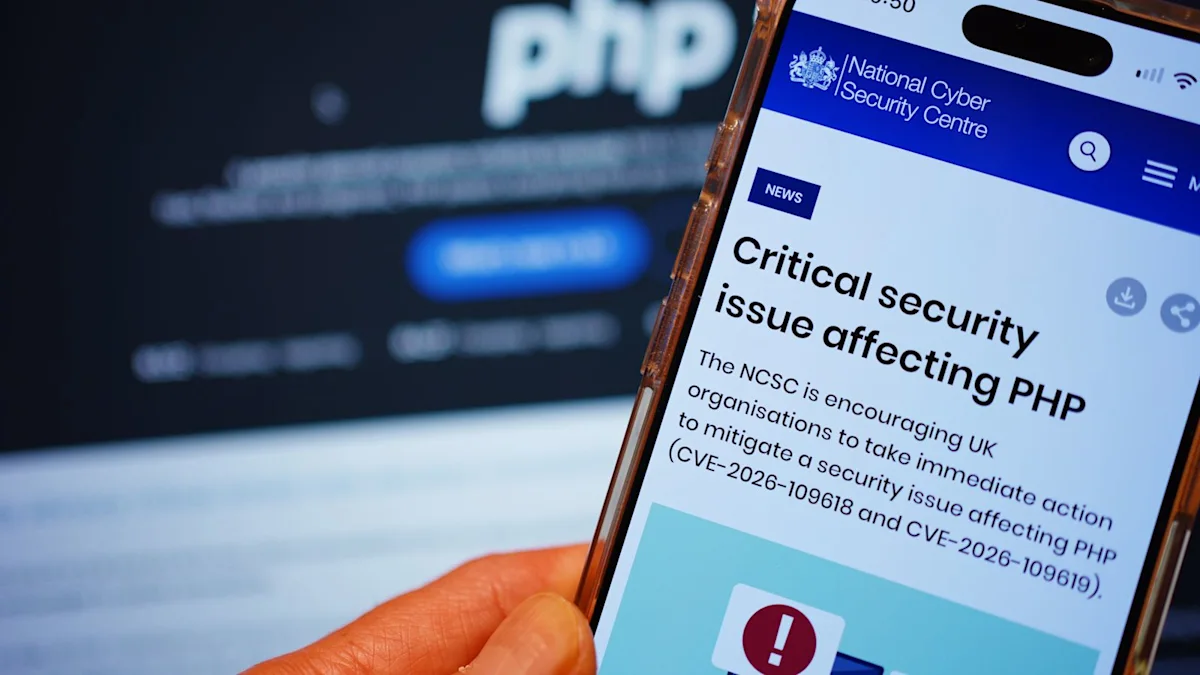
The National Cyber Security Centre has warned more than 50,000 UK organisations they are vulnerable after a researcher using AI discovered a “critical security issue” in a globally-used programming language.
Speaking to ITV News, CTO Ollie Whitehouse said the critical security flaw in the programming language PHP – used by the majority of websites – posed an “extremely serious risk”.
“We do not know yet, but what could possibly happen is a range of organisations which hold either sensitive data or provide critical functions could be compromised, which is why we have issued the level of severity warning,” Whitehouse said.
“We’ve issued over 50,000 warnings to organisations in the United Kingdom. So it kind of gives you a sense that this is a very prevalent vulnerability and there is going to be quite a lot of data available behind those websites. That’s why the owners need to take action.”
‘The time to act is now’: The NCSC’s Ollie Whitehouse explains why organisations must respond to the PHP security alert
Earlier on Thursday a minister said more than 30 government services are offline and four are partially unavailable while work is being carried out to address the potential risk.
Downing Street said no large UK public-facing critical services have been affected, but some “limited” government websites have gone dark while issues are resolved.
National Cyber Security Centre (NCSC) experts are working with OpenAI, whose technology was used to discover the vulnerabilities, and partners around the globe to address potential problems, a No 10 spokeswoman said.
Tech minister Baroness Lloyd of Effra told the House of Lords: “The information I have is that 32 government services are unavailable and four are partially unavailable.”
She said that “has largely resulted from precautionary measures taken to protect systems while security updates and mitigations are applied”.
Subscribe for free to our weekly newsletter for exclusive and original coverage from ITV News. Direct to your inbox every Friday morning.
The Downing Street spokeswoman told reporters: “Work has already taken place across government to identify and fix potential exposures to our systems, and our experts are continuing to work closely with both OpenAI and international partners on this issue.
“No large public-facing critical services are being affected by the exercise, but some limited services may temporarily be offline while security work is carried out. But this does not mean they were hacked, and work continues to resolve any issues.”
The spokeswoman said it was not “standard practice” to provide a list of government services that were affected.
It came after cybersecurity chiefs warned UK organisations on Wednesday that a “critical security issue” had been discovered in PHP, which is used by almost 70% of websites according cybersecurity firm Cloudflare.
Lady Lloyd said the NCSC was briefed by OpenAI on the vulnerability “last week” and “the government acted proactively ahead of public disclosure”.
Organisations have been urged by the NCSC to update to a new, fixed version of the PHP software – or consider taking their websites offline if they cannot be upgraded immediately.
The No 10 spokeswoman said: “Organisations of all sizes should follow NCSC guidance to protect their system.”
Earlier, a minister said the security of next week’s Budget has not been compromised.
Scottish Secretary Douglas Alexander was asked whether the issues identified with PHP could result in major Budget leaks because the Office for Budget Responsibility (OBR) had to take down its website.
Mr Alexander told Times Radio on Thursday morning: “No, I’ve had no indication whatsoever that there’s any problem in terms of a breach of Budget security.
“Indeed John Healey, who I was with yesterday in Scotland, as I understand it initiated new security protocols reflecting his experience in the Ministry of Defence when he came to the Treasury as Chancellor in the summer.”
The PHP security issue identified could allow attackers to remotely control any web servers running PHP, which underpins popular platforms such as WordPress and Magento.
Many attempts at exploiting the vulnerability were spotted within hours of it being announced, according to Amazon and Cloudfare.
In an update published on the Amazon Web Services security blog, the company said its threat intelligence team found the flaw was “now being broadly exploited in the wild”.
Cloudfare chief executive Matthew Prince said on Thursday the firm spotted hundreds of thousands of hacking attempts within two hours of the announcement, with millions ongoing.
Barclays to cut 5,000 jobs this year as AI makes work more efficient
Chancellor says Budget’s cost of living support will be ‘targeted and temporary’
PHP developers had reportedly planned a security update on Thursday, but the release was brought forward after details of its work to address the vulnerabilities leaked online.
Alan Woodward, a visiting computer science professor at the Surrey Centre for Cyber Security (SCCS), said “the cat was let out of the bag rather earlier than it was supposed to have been”.
“There’s always a window between the flaw being publicly known about and it being patches so that the attackers can’t successfully get in,” Professor Woodward told BBC Radio 4’s Today programme.
“And what happened, unfortunately, the day before the patch was out, somebody let the cat out of the bag.
“There was an initial version of the patch that was released, and so it was very easy to compare the original with the patched version and see which bit of code you needed to go and exploit.”
The Wall Street Journal had reported that the flaw was discovered in August by Ryan Austin, a researcher at the cybersecurity company Calif, using an advanced AI model developed by OpenAI.
Professor Woodward explained the vulnerability had in fact already been identified by human researchers in 2024, but it was then believed exploiting this security flaw would be “too complicated”, and nothing was done.
“People have been scrambling away, saying, ‘Well, actually, yes, you can exploit it, and we now need to patch it’,” he said.
“And the patch came out yesterday afternoon – luckily, the PHP Foundation issued one, so that’s why everybody’s scrambling to make sure that that’s in place.”
Have you heard our podcast Talking Politics? Tom and Robert dig into the biggest issues dominating the political agenda in every episode…













Leave a comment