
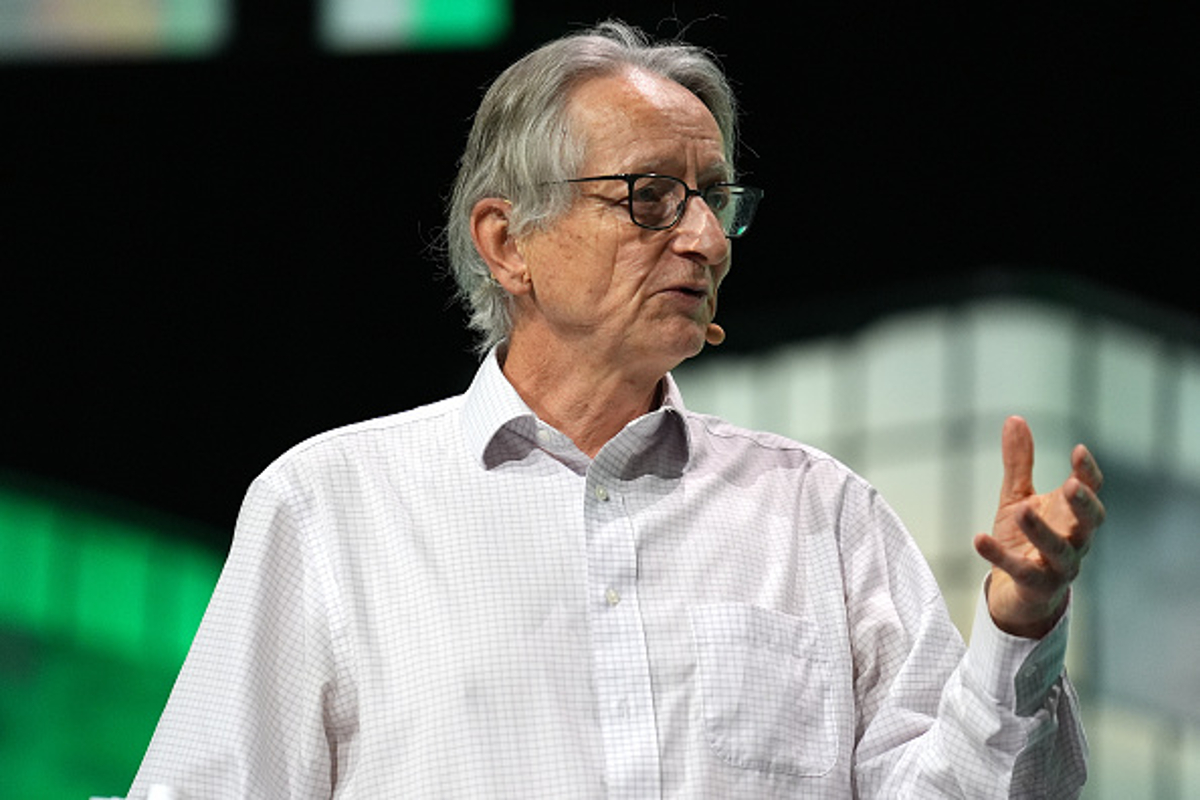

The ‘godfather of AI’ has warned the UK’s growing dependence on a handful of American tech giants is “very dangerous”, taking aim at Silicon Valley’s most powerful executives and questioning whether they can be trusted to control the technology.
Geoffrey Hinton, the Nobel Prize-winning scientist whose research helped lay the foundations for modern artificial intelligence, told City AM the concentration of AI development in the hands of a few American firms was particularly concerning given the people running them.
“I think it’s particularly dangerous because of the character of some of the people involved, like Altman, Musk and Zuckerberg. I wouldn’t buy a used car from any of them”.
The swipe at OpenAI boss Sam Altman, Tesla, SpaceX and xAi chief Elon Musk and Meta founder Mark Zuckerberg comes as their companies pour billions into increasingly powerful systems, while governments struggle to establish how they should be regulated.
Hinton also took aim at OpenAI boss Sam Altman over the company’s failed boardroom coup in 2023, which saw co-founder Ilya Sutskever help orchestrate the chief executive’s short-lived removal.
“Ilya has a strong moral compass. He’s a brilliant scientist. He’s not so strong on political manipulation. Sam is the exact opposite”, Hinton said.
He admitted he too would have fired Altman, although joked he would have waited until after a funding round to do so.
Hinton, who left Google in 2023 to speak more openly about AI safety, also dismissed the idea of a the idea of a “kill switch” that could cut countries off from AI systems they rely on.
“When AI is that smart, it’ll be very good at persuasion. So even if you have someone who’s meant to turn it off if it misbehaves, it’ll be able to persuade them not to”.
Two months ago, the UK government rejected calls from MPs and peers for an emergency AI shutdown mechanism, arguing that blocking access to models domestically would not prevent their development or misuse overseas.
Britain faces an uphill AI battle
Hinton was equally dismissive of Britain’s prospects of becoming a major force in the global AI race.
“The UK sort of tries to position itself as very important in AI. I don’t think it’s going to be”, he said when asked about Britain’s role in international AI governance.
The assessment is unlikely to please ministers, who have spent the past year trying to position Britain as a leading destination for AI investment while reducing its dependence on Big Tech.
The government has committed £500m to a Sovereign AI Fund, topped up with another £60m in last week’s Budget, to back domestic developers and strengthen the UK’s tech independence.
But the government’s own AI minister, Kanishka Narayan, warned that the country risked becoming a “high-value AI customer” rather than a developer of the tech shaping its economy.
The concern is that British businesses and public services could become increasingly reliant on AI models and infrastructure controlled by companies overseas, leaving them exposed to foreign policy decisions and commercial restrictions.
Meanwhile, UKAI has warned that without a coherent national strategy, Britain risks becoming a “vassal state” dependent on these firms.
Hinton’s verdict suggests the gap between the UK’s ambitions and the financial willpower of American AI behemoths may be harder to close than ministers would like.
Silicon Valley’s race for profits
The Nobel laureate also warned that competition between governments and the tech sector was pushing AI development forward far faster than efforts to make it safe.
“What’s happening at present is there’s just this competition between countries and between companies to make it smarter and smarter and smarter, in the hopes that you can replace lots of workers and get lots of money”, he said.
“That’s what’s driving it. And this is the future of humanity that’s on the line”.
Hinton, who won the 2024 Nobel Prize in Physics for his pioneering work on neural networks, said he had brought forward his own estimate of when AI could surpass human intelligence”.
“I used to say 10 to 20 years; now I say 10. It’s always getting closer”.
He added that researchers were devoting too little time and attention to making sure intelligent systems would act in humanity’s interests.
“We’re going to have to share the planet with something smarter than us. What would we like the other aspects of that being to be, other than its intelligence?
“And we’re hardly doing any work on that – it’s crazy”.
Hinton also called for developers to face legal liability when their AI systems cause harm.
“If people produce AI models that do bad things, somebody should be held to account”, he said.
Despite his concerns, he acknowledged AI’s potential to increase productivity and accelerate scientific breakthroughs, including the development of better batteries and new materials.
But he questioned who would ultimately benefit from the wealth it generates.
“Sam Altman and Elon Musk talk about radical abundance for all of us. They don’t talk about exactly how that wealth is going to be distributed”, he said.









Leave a comment