
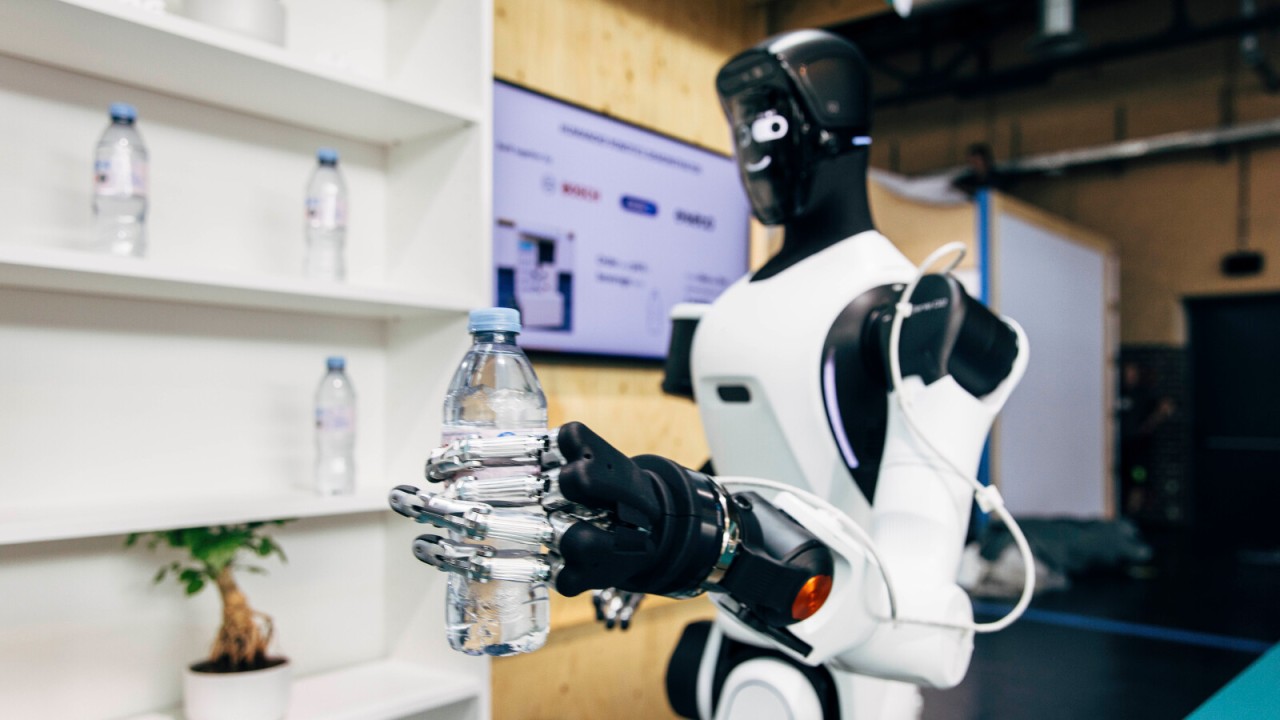
With its comprehensive expertise, the company is well positioned to participate in the growth of the robotics market. Bosch sees the potential to develop a business worth billions in this field. The company is putting its faith in synergy effects to achieve this. “We’re combining proven technologies from various business sectors with visionary innovations to drive forward the industrial scaling of robotics – all the way to humanoids,” Hartung said. “We also hope that committing to this course will strengthen Europe as a technology location.” Moreover, Bosch is making targeted use of automation to increase the competitiveness of its German plants compared to the rest of the world as well as to counteract the ever more acute shortage of skilled workers.
Robotics needs a delicate touch
“Bosch is moving the future – on wheels and with arms,” says Tanja Rueckert, member of the board of management of Robert Bosch GmbH. The company is deploying its cross-domain automation expertise – from the car to the factory to the home – as its decisive advantage in shaping this growth market. Bosch is positioning itself not as a manufacturer of humanoid robots, but as a leading supplier and partner for the “brain and nervous system” of modern automation and robotics. At the heart of these flexible solutions is Bosch’s open ctrlX AUTOMATION platform. “This makes robotics accessible, modular, and quick to integrate. We’re already enabling our customers to combine driverless transport systems with high-precision robot arms, for example, which can then take over tasks in existing processes in a stable and flexible manner,” Rueckert says. The Bosch Rexroth division is currently implementing several customer projects in this area.
Robots need a keen sense of touch so that they can interact safely and precisely with their environment, whether in the factory or in the home. A tiny but indispensable technology gives robots precisely this tactile sense: microelectromechanical systems, known as MEMS sensors. They are the key to enabling robots to handle objects with the necessary finesse and react sensitively to physical contact. For example, it’s these sensors that give a robot the ability to precisely adjust its grip to a robust water glass or a delicate stemmed glass. Bosch is the global market leader in this key technology field of MEMS sensors, which is central to the company’s Reutlingen semiconductor location. “Humans have 4 million touch sensors. If we were to build robots with just as many sensors, then 4 years’ worth of worldwide sensor production would barely be enough for 12,500 robots,” Hartung says. This figure illustrates the immense potential in the future of automation and robotics – and Bosch’s key role in that future. According to the Yole Group , a market research and strategy consultancy, the market for MEMS sensors – a market Bosch leads – is expected to grow to over 19.2 billion U.S. dollars by 2030 and achieve an average annual growth rate of 4 percent.
Bosch is working to further develop cognitive robots
To accelerate development in automation and robotics, Bosch is relying on a combination of targeted in-house innovation and an open ecosystem approach. To this end, the company founded Robert Bosch Robotics GmbH, a specialized unit that focuses on the development and commercialization of new robotics solutions. At the same time, Bosch is continuing to drive forward industrial scaling through strategic partnerships. For example, the company is working together with the German Start-up Neura Robotics to further develop cognitive robots. Thanks to its deep manufacturing expertise, Bosch also acts as a key partner for leading robotics startups from around the world including Humanoid from the U.K., and other U.S. and Chinese partners, and is bringing their prototypes to production scale. Bosch has pooled its activities in China in particular in the Bosch Robotics Center China (BROC), which was established at the beginning of the year and is driving forward the development of physical AI and the commercialization of robotics solutions.
In addition to the robots’ “intelligence,” Bosch’s strength lies in the crucial components that give robots their physical performance. Bosch Rexroth has a comprehensive portfolio of key components for modern robotics and factory automation. These include high-precision electric motors and powerful servo drives that ensure dynamic and precise movements, as well as CtrlX AUTOMATION for smart, flexible control of robots for a range of environments and requirements. Bosch also offers complex assemblies and subsystems that give robots the power, speed, and precision they need, meaning these components serve as the technological backbone for various automation tasks. Moreover, Bosch can provide support with factory equipment for robotics manufacturing, for example with Rexroth conveyor systems.
Unique treasure trove of data from over 230 plants worldwide
Artificial intelligence (AI) is the engine that gives automation and robotics new capabilities. “The combination of cutting-edge electronics and mechanics with AI puts significant technological breakthroughs in automation and robotics within reach,” Rueckert says. “For example, it enables robots to perceive their environment, understand processes, and learn from experience.” Bosch has embedded this key technology firmly in its strategy and uses it on two levels. First, the company is bringing AI models from the cloud directly into its physical products to enable automated operation. Second, Bosch already makes extensive use of AI in its own manufacturing, for example in the optimization of production processes, in predictive maintenance, and in optical fault detection. The foundation for these learning AI systems is a treasure trove of data from over 230 Bosch plants worldwide that is unique in the industry. “Our decisive competitive advantage is not the machinery alone, but the data from our global manufacturing network,” Rueckert says. “This treasure trove of data is the raw material from which we’re developing the intelligent automation solutions of the future.” In addition, to translate human expertise into machine-readable data, Bosch uses special data suits that record complex movement sequences as a basis for training. The company is specifically contributing this expertise to its partnership with Neura Robotics in order to accelerate the development of cognitive robots.
On the topic of AI, the Bosch Tech Compass, a survey of more than 11,000 people in 7 countries worldwide, shows that the majority of people see AI as the most influential and most positive technology in the years ahead. A key finding is that enthusiasm for AI is growing worldwide, with 70 percent of respondents seeing it as crucial for the future.
Press photos and infocharts are available on the Bosch Media Service at www.bosch-press.com.
















Leave a comment