
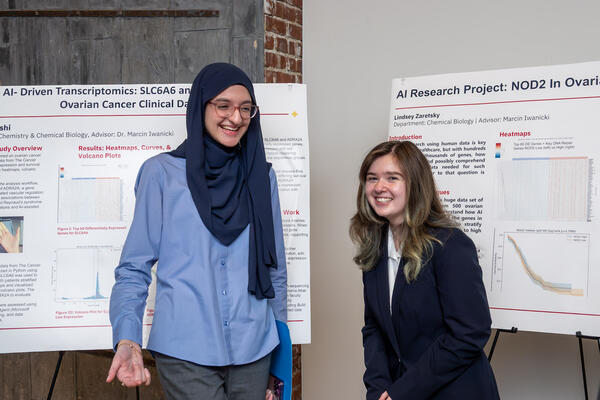
Kamna Mamidyala entered college unsure how artificial intelligence would intersect with her plans to pursue a career in medicine.
The incoming second-year biology major at Stevens Institute of Technology said she initially viewed AI as something separate from patient care and clinical work. But through her university’s newly launched Artificial Intelligence in Biology and Chemistry (AiBC) Community, she gained firsthand exposure to how the technology can support scientific research, analyze large datasets and accelerate discoveries in the life sciences.
“My understanding was, in a hospital setting, at least, that no AI is going to be able to do the work as well as a human can,” Mamidyala said. “But with the [AiBC Community], I was able to see that AI can be used as a tool to help humans do more efficient work.”
Mamidyala is one of a growing number of students participating in the AiBC Community, a collaboration among Stevens Institute of Technology, Hudson County Community College and Saint Peter’s University. The program shows first-year STEM students how artificial intelligence is transforming scientific work across northern New Jersey’s biotechnology, health care and educational technology sectors.
Marcin Iwanicki, a teaching associate professor at Stevens and director of the program, said the initiative reflects a broader shift in science education to emphasize critical thinking and professional judgment alongside technical AI skills. He noted that advances in AI have transformed his own research process.
“I’m a cancer biologist by training, and my undergraduate education is also biology, and the evolving AI technologies broke a lot of barriers as far as access to data and analysis,” Iwanicki said. “I always relied on computational biologists to analyze the data, and that was sort of a collaboration. Now I can do this myself because of AI.”
Those advances, he said, are also changing what can be taught in introductory science courses.
“This is something that we really have to put into our curricula,” he said. “At the freshman level, we can bring real data into the classroom and have students analyze it in minutes. That allows us to build lessons around scientific data exploration in ways that weren’t possible before.”

Students connect with industry professionals and explore real-world applications of AI to help envision themselves as future scientists.
Stevens Institute of Technology
The AiBC Community: As part of the program, incoming second-year students spend four weeks in a summer research program analyzing real cancer RNA-sequencing datasets and using AI and machine learning tools to support drug development and scientific research.
The program also connects students with industry leaders through workshops and corporate partnerships. During the inaugural workshop last month, professionals from Pfizer, Merck and Bristol Myers Squibb served as panelists and advisers, discussing how AI is reshaping the biotechnology industry.
Iwanicki said one of the program’s primary goals is to help students develop a scientific identity early in their college careers. Many students leave STEM fields because they struggle to see where they fit, he said. By exposing students to real-world applications of AI and professionals working in the field, the program aims to help them envision themselves as future scientists.
Patricia Muisener, a teaching professor at Stevens, said interactions with industry professionals help students understand how AI is being used in careers they hope to pursue while encouraging them to think differently about their own futures.
“We’re finding our students say that they’re feeling more confident about their choices and their reasons for adopting a career [path] because it changes after they’ve been with the career role models,” Muisener said. “We do feel that they are connecting their science identity and getting more of an identity by hearing from and connecting with others.”

Students said the program’s workshops changed how they view AI’s role in scientific research and careers.
Stevens Institute of Technology
AI shapes career views: After the recent summer program and career workshop, Muisener said post-session surveys showed that more than 60 percent of participating students reported choosing career paths based on enjoyment and passion, compared to about 43 percent in pre-session responses. Many cited interactions with career role models as influential.
Phoenix Campbell, an exercise science major at Saint Peter’s University, said those conversations expanded his understanding of possible career trajectories after college.
“Hearing those specific pathways you can take was really interesting,” Campbell said. “Once you finish your undergraduate degree, whether it’s biology or exercise science, there are the popular pathways people tend to hear about. But by meeting professionals in the field, it was good exposure for us to realize there’s more than just the popular pathways.”
Campbell also said the program shifted how he thinks about artificial intelligence in scientific work.
“Honestly, before the [program], I thought using AI was a little bit of a lazy route,” Campbell said. “This program is really highlighting how AI, when used correctly, can be used for good. It frees up more time for humans to use their brains for analysis, while the more tedious tasks, like running the numbers, can be done by AI.”
Javier Ramdhani, a biotechnology major at Hudson County Community College, said he shared similar skepticism at first.
“Originally, I believed AI was full-on taboo, where if teachers saw you use AI for anything, it was an automatic zero,” Ramdhani said. “It can be used as a lazy way out, but with the right mindset it can also be an effective tool in whatever field it’s in, and this program is validating that.”

Many students cited the program’s career role models as influential in shaping their career interests and aspirations.
Stevens Institute of Technology
Building AI literacy: Muisener said that as part of the program, students often focus on developing discernment in evaluating AI-generated results and scientific outputs.
“One of the big skills that a lot of the students wanted was really being able to have that foundational knowledge to judge what is correct and what is not correct,” Muisener said. “Also being able to analyze the results that you get from AI and making sure that they make sense before you move forward with them.”
Iwanicki emphasized that AI is lowering barriers to computational science and expanding who can engage in data-heavy scientific work.
“Those tools allow people who never had a computing degree or experience to actually work with the computer and get their task done,” Iwanicki said.
“The AiBC program that we are running here is a great example of that, because none of us are computer scientists but we are doing heavy computational work,” he added. “We still do have computer scientists to oversee some of those outputs, and that’s part of the program as well, but the program is really democratizing access to computational science.”
Get more content like this directly to your inbox. Subscribe here.









Leave a comment