
Editor’s note: All opinions, columns and letters reflect the views of the individual writer and not necessarily those of the IDS or its staffers.
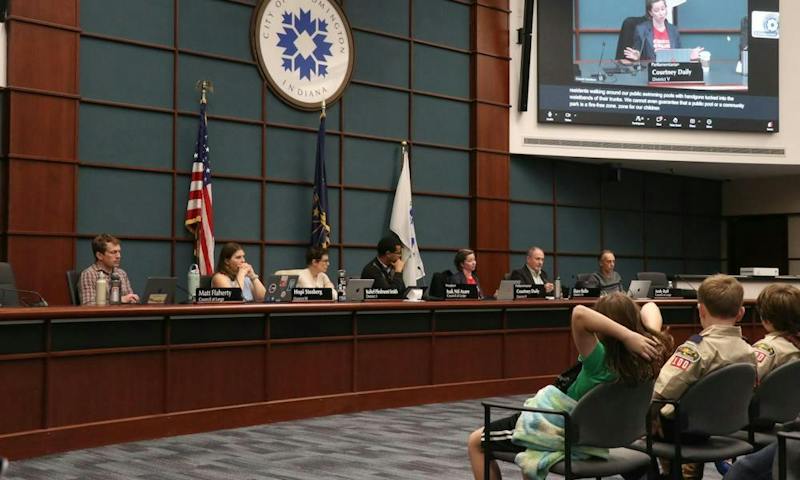
On Nov. 4, the Bloomington City Council unanimously passed Ordinance 2026-29, which will ban superintelligent AI within city limits if signed by Mayor Kerry Thompson.
In the Bloomington City Council meeting on Nov. 4 councilmember Dave Rollo described artificial superintelligence as having three tenets: capabilities of agency, generality and intelligence. The defining aspect of AI superintelligence is that humans are no longer in control. ASI is the iteration of artificial intelligence that follows artificial general intelligence, which is commonly understood as AI that has matched human-level intelligence, though that metric is difficult to define. In general, AGI and ASI can be used interchangeably because their full scope and definitions are still being established.
So, the city council has banned something that doesn’t exist and might never. Preposterous? Perhaps. Overly apocalyptic? Maybe. I think careful is a more apt description. Such a ban will help Bloomington, other cities and eventually the nation build a regulatory framework to counter dangerous AI advancement.
Whether AI achieves general or even superintelligence or not, it is developing rapidly, amid outcry from university experts but also Silicon Valley leaders . The response intensified after the OpenAI Hugging Face incident in July, when OpenAI models left the sandbox they were being trained in and infiltrated Hugging Face, a smaller AI company that held the answer to a prompt. In the incident’s aftermath, many AI developers, including former OpenAI and Anthropic Researcher Jacob Coxon spoke out about curbing AI use before it becomes a threat to humanity. Superintelligence is being framed less as a far-out possibility and more as a future probability.
Some federal and state lawmakers have noted the risks. Rep. Greg Caser, D-TX and Sen. Bernie Sanders, I-VT introduced H.R. 10538 in September, which would enforce a nation-wide ban on Artificial Superintelligence like Bloomington’s Ordinance 2026-29, but the bill lacks widespread support. On Monday, California sued OpenAI over the Hugging Face incident, citing the risk posed to the public, but courts are still deciding how to handle such cases.
Ordinance 2026-29 has the possibility to bring about the same change at a more grassroots level. In a memo accompanying the original resolution, Councilmember Rollo said the ban is intended to inspire other cities to pass similar legislation in the absence of state and federal regulations. If numerous other cities pass similar bans, they can create a more powerful safety net that can be leveraged by this local-level coalition to establish nation-wide limits on AI’s reach.
At the very least, this ordinance gives Bloomington citizens a reference point on AI governance that allows them to ask questions of their city council representatives and have conversations about AI’s threats. By cementing AI superintelligence as a public issue, even if fully superintelligent AI never develops, Bloomington has given cities a starting point for navigating the complicated fallouts from current AI advancements. Any action is valuable at a time when there is no action from state and federal legislators, which is why this ordinance matters.
Passing it is better than the alternative: doing nothing. By passing preventative measures, cities, states and — eventually — the country can develop a course of action on AI instead of dealing with the fallout later. Take, for example, how governments are retroactively trying to limit social media for kids, who have already been experiencing social and mental harm from the apps for years. With the issue of AI advancement, widespread change must begin from the bottom up.
We should be careful not to be too drastic or speculative in predicting AI advancements, which are currently based on assumptions rather than certainty. Currently, however, the technological future holds so many unknowns, with some bleak predictions. Therefore, local responses like Ordinance 2026-29 bring more voices into the conversation aside from Silicon Valley executives, creating solutions that protect not only tech companies but everyday people. Also, city council ordinances can always be amended as AI’s future becomes a clearer picture.
If we wait to act and continue allowing AI companies to self-regulate, we will look back and wonder why we waited so long to see AI advancement as a threat to the common good. Bloomington may be helpless in effectively enforcing Ordinance 2026-29 on its own, but its very existence serves as common ground for citizens and cities to eventually put limits on AI to protect humanity.
Rebekah Arnold is a freshman studying Global Media.
Just like Google’s motto used to say: “Don’t be evil.”













Leave a comment