
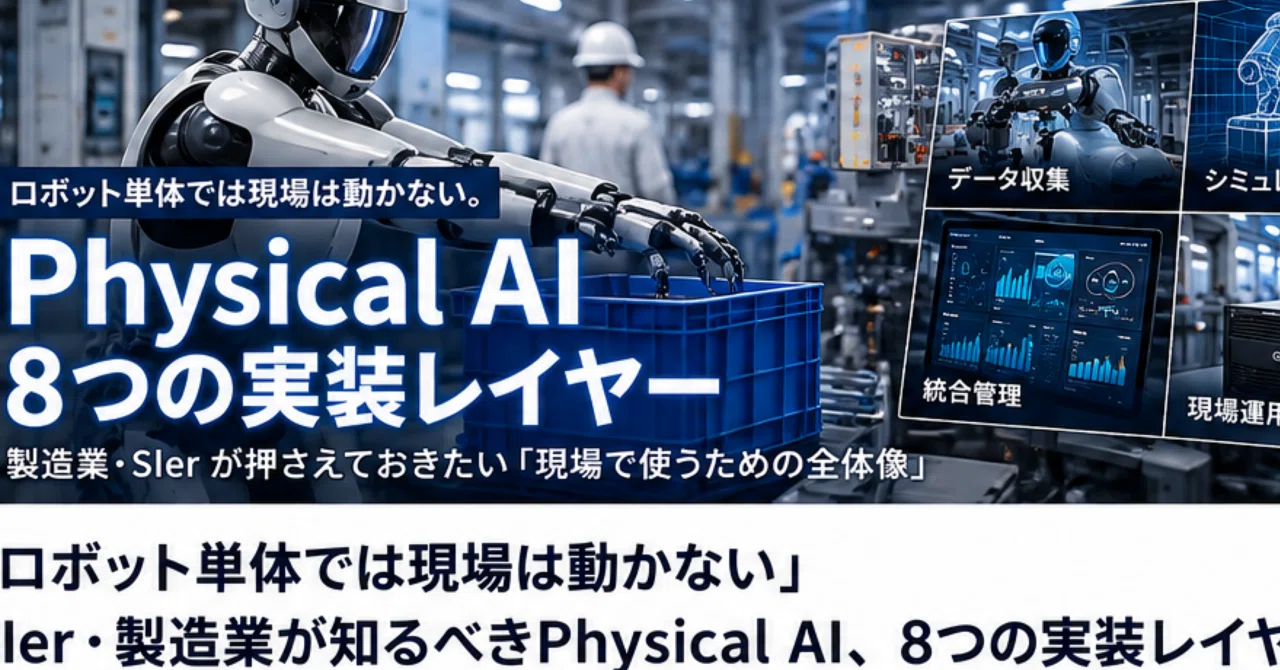
Recently, there is hardly a day that goes by without seeing news about humanoids or Physical AI.
Whether it’s Boston Dynamics’ Atlas, Figure, Agility Robotics’ Digit, or humanoids from Chinese manufacturers, what inevitably stands out is the “robot itself.”
However, as someone following the news from the perspective of sales in the manufacturing industry, I have started to see things a bit differently.
Perhaps the competition in Physical AI isn’t decided solely by “which robot is the most amazing.”
To use them in an actual factory, simply introducing a robot is not enough.
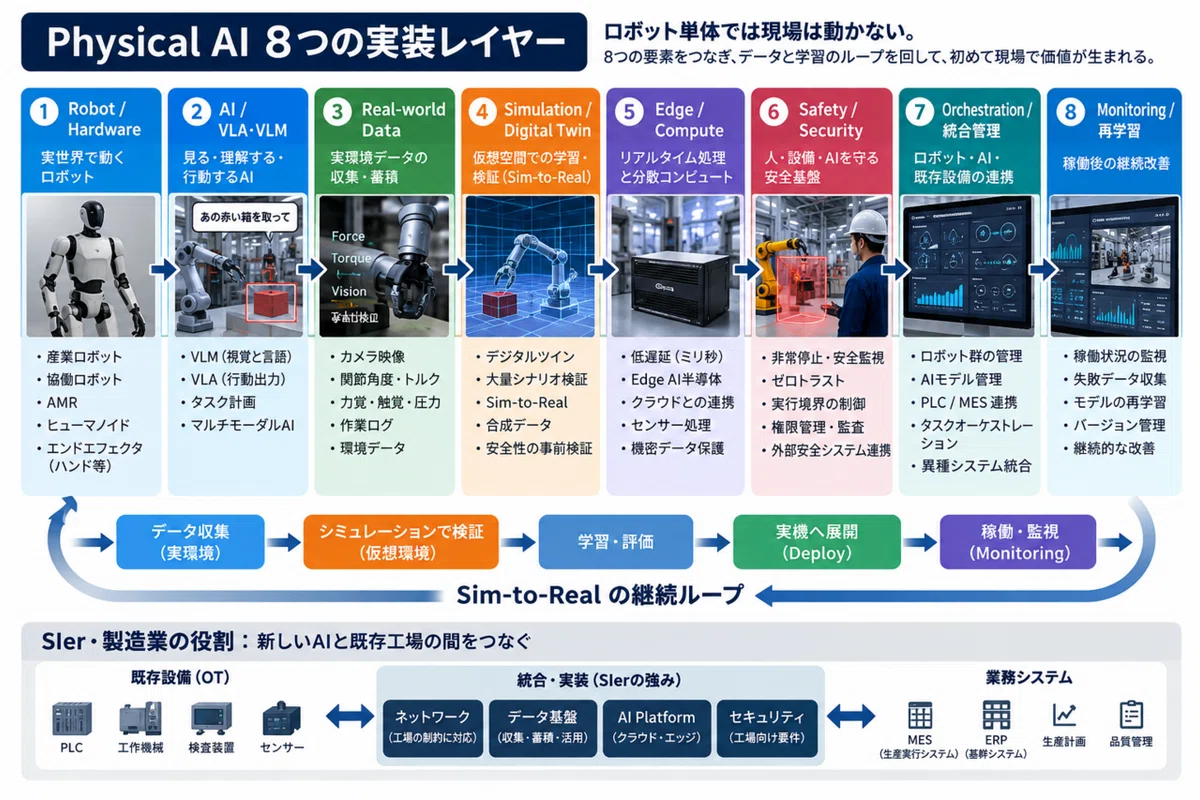
You need to teach the AI tasks, collect data from the real environment, verify it through simulation, and deploy it to the field. Then, while operating it safely, you must use failure data to make improvements.
In other words, I believe it is easier to think of Physical AI as a “system” that combines
Robot × AI × Data × Simulation × Edge × Safety × Operation
I think it is easier to understand if we think of it as a “system” that combines these elements.
By looking across the moves announced this week by Hitachi × FANUC, Hitachi × Agile Robots, Agility Robotics, Boston Dynamics, NVIDIA, and others, that structure has become quite clear.
In this article, from the perspective of sales and planning rather than an engineer, I will organize the elements likely needed to use Physical AI in actual companies and manufacturing sites into eight layers.
⸻
① Robot / Hardware
The entry point is the robot that moves in the real world.
The form changes depending on the application, such as industrial robots, collaborative robots, AMRs, and humanoids.
What was interesting here recently is Boston Dynamics’ Atlas.
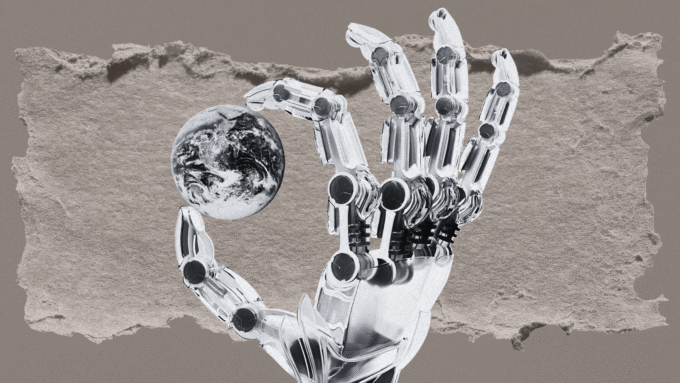
The company unveiled a new hand for Atlas.
The feature is that it has four fingers instead of the five fingers humans have.
“Wouldn’t five fingers be better if it’s doing human work?”
one might think, but increasing the number of fingers also increases the number of motors, weight, power consumption, and points of failure.
What Boston Dynamics is aiming for is not to replicate the human hand exactly, but a hand that can execute the tasks required on-site while ensuring durability.
I find this way of thinking interesting.
As Physical AI moves from research to practical application, the question becomes not “how much does it resemble a human,” but how stably it can perform work.
⸻
② AI / VLA・VLM
The “brain” of the robot is the AI.
In recent AI robotics, technologies that often appear are
VLM (Vision Language Model)
VLA (Vision Language Action Model)
Roughly speaking,
See → Understand → Interpret instructions → Act
This is the idea of connecting the flow with AI.
For example,
“Pick up that red box”
a human gives an instruction.
The robot recognizes the surroundings with a camera, understands which one is the “red box,” moves to it, and grabs it appropriately.
AI models are used to realize such flexible work.
This week, Hitachi announced the joint development of the “brain” for AI robotics with Agile Robots.
They will combine Hitachi’s Physical AI technology, which learns the movements of skilled workers in a short period, with Agile Robots’ general-purpose AI and robotics technology.
What becomes clear from this is that it is not a world where everything is completed by the robot manufacturer alone.
Apart from the hardware, the AI model itself has become a major area of competition.
⸻
③ Real-world Data
When thinking about Physical AI, I am personally paying particular attention to real-world data.
In the case of generative AI, there is a massive amount of text and images on the internet.
On the other hand, that is not all that is needed for robots.
“How to hold this part”
“From which angle to grab it”
“How much force to apply”
“How to recover when it fails”
Data from when the body is actually moved is required.
There is also data unique to Physical AI, such as joint angles, torque, pressure, and force/tactile sensing, in addition to camera footage.
Therefore, the loop of
Move the robot
→ Collect real-environment data
→ Train the AI
→ Improve the robot
→ Collect data again
is effective.
This week’s Hitachi × FANUC announcement was also symbolic.
It is a concept to introduce Physical AI using Hitachi’s factory as “Customer Zero” and continuously learn from data obtained from the actual manufacturing site.
In Physical AI, I see that not just the model itself, but **“whether you can continuously collect high-quality real-environment data”** will become the competitive edge.
⸻
④ Simulation / Digital Twin
However, it is not realistic to perform all learning on actual machines.
Moving a robot thousands or tens of thousands of times takes time, and there is also a risk of damaging equipment or the robot.
That is where Simulation and Digital Twin come into play.
By reproducing robots and factories in a virtual space, you can
・Learn movements
・Try a massive number of conditions
・Create failure cases
・Verify safety
A commonly used concept here is Sim-to-Real.
Deploy what was learned and verified in the simulation to the real world, and return the data obtained there back to learning.
Simulation
→ Learning
→ Real machine deployment
→ Real-environment data
→ Re-learning
In Physical AI, how fast you can run this “loop between virtual and reality” becomes one of the key points.
⸻
⑤ Edge / Compute
In Physical AI, it is not always possible to process everything in the cloud.
Robots move in the real world.
For example, if a large communication delay occurs between the robot recognizing an obstacle and stopping, it directly affects safety and work quality.
In factories, there are further constraints such as:
・Low latency
・Handling network failures
・Environments where confidential data cannot be taken outside
・Large amounts of camera/sensor data
Therefore, how to use Cloud + Edge is a key point in Physical AI.
In the Hitachi × FANUC initiative, verification combining Edge AI semiconductors and robots is also planned.
AI infrastructure, which seemed cloud-centric in generative AI, will expand to the edge side of the factory in Physical AI.
I think this change is something IT companies cannot overlook.
⸻
⑥ Safety / Security
What makes Physical AI significantly different from general generative AI is safety.
The type of risk is different between ChatGPT giving an incorrect answer and a robot making an incorrect movement in the real world.
This week, Agility Robotics and FORT Robotics announced that they will jointly strengthen the safety foundation for the next-generation Digit.
What is characteristic is that safety is not completed only within the robot.
It is designed to include emergency stops and the factory’s safety system.
NVIDIA also announced the “Open Agent Safety Platform,” showing the idea of setting execution boundaries outside the AI agent.
Although the targets are different, these two share a common way of thinking.
Do not leave safety to the AI alone.
Outside the AI, have:
・Access control
・Monitoring
・Stop mechanisms
・Network control
・Auditing
As Physical AI moves from PoC to production use, the weight of this safety/security layer should increase.
⸻
⑦ Orchestration / Integrated Management
This is an area that is particularly interesting for SIers.
What exists in an actual factory is not just the latest humanoid.
Industrial robots, collaborative robots, AMRs, cameras, PLCs, equipment, and MES.
Manufacturers, communication methods, and generations are all different.
You must connect the latest AI or Physical AI platform to that.
For example,
Which robot is operating?
Which AI model is installed?
What is the model version?
Is there an abnormality?
What information should be acquired from the PLC?
How to link the MES production plan with the robot’s task?
It is necessary to connect such heterogeneous systems.
When Physical AI becomes widespread, it will become necessary to think about
Robot Fleet Management
+ AI Model Management
+ Factory System Integration
all together.
⸻
⑧ Monitoring / Re-learning
The last is after introduction.
Physical AI is not
complete once the model is made.
In manufacturing sites,
Parts change.
Equipment changes.
Lighting changes.
Workers change.
Processes change.
These things happen normally.
Therefore, a cycle of
Deploy
↓
Monitoring
↓
Failure data collection
↓
Re-learning
↓
Evaluation
↓
Re-deploy
is required.
It might be closer to think of it as introducing a mechanism to continuously nurture the robot, rather than just introducing a robot.
⸻
Connecting the 8 makes a “Physical AI Platform”
Organizing what we have so far,
① Robot / Hardware
② AI / VLA・VLM
③ Real-world Data
④ Simulation / Digital Twin
⑤ Edge / Compute
⑥ Safety / Security
⑦ Orchestration / Integrated Management
⑧ Monitoring / Re-learning
However, what is really important is not having all eight technologies.
It is being able to connect these eight and run the loop.
Collect real-environment data
↓
Process data
↓
Learn with simulation + real data
↓
Evaluate model
↓
Deploy to robot
↓
Monitoring on-site
↓
Collect failure data
↓
Re-learning
I think the competitiveness of Physical AI will be reflected not only in the performance of the robot itself, but also in how fast and stably this improvement cycle can be run.
⸻
SIer’s business opportunity lies in “connecting the gaps”
“Isn’t Physical AI a business for robot manufacturers?”
At first, I thought so too.
But the more I researched, the more I felt that the area SIers can take on is quite broad.
For example, suppose you introduce a new robot to a factory.
Even if only the robot is the latest, there is equipment on-site that has been operating for years, or in some cases, decades.
Acquire data from the PLC.
Receive production plans from the MES.
Collect camera and sensor data.
Send robot data to the data platform.
Distribute AI models to the edge.
Monitor for abnormalities.
Apply security policies.
And connect these without breaking the existing factory network.
It is not flashy, but I believe this “work of connecting the new AI and the existing factory” is the difficult part when introducing Physical AI into production.
Data platform, cloud/edge, network, security, AI platform, OT linkage.
The areas that SIers have built up so far will lead directly to the implementation foundation for Physical AI.
The role of SIers in the Physical AI era might be
“not selling robots, but creating a mechanism for robots to keep moving on-site.”
⸻
And finally, what is questioned is ROI
Even if it can be realized technically, there is another barrier for companies to introduce it.
It is the question, “Is it worth the investment?”
In the initial stage, Physical AI requires investment not only in the robot itself but also in data collection, simulation, AI development, edge environments, and safety measures.
Looking at just one process, I think there are cases where it feels expensive.
However, if the foundation for data, learning, deployment, and monitoring can be shared, it will not be necessary to create everything from scratch when expanding to the second or third process.
Therefore, when looking at the ROI of Physical AI, I think it is necessary to look not only at
“how many people can be reduced by one robot”
but also at
“how many processes and factories can the AI, data, and operation foundation created once be expanded to.”
I think this will become a very major point of discussion when thinking about corporate Physical AI investment in the future.
⸻
Things to watch from now on from a sales/planning perspective
When looking at Physical AI news,
it is interesting to change your perspective a little instead of ending with “this humanoid is amazing.”
Where is the real-environment data being collected from?
What kind of simulation environment do they have?
What kind of AI model are they using?
How do they deploy to the robot?
How is safety guaranteed?
How is it connected to existing equipment?
How is the data after operation returned to re-learning?
Looking at this, I feel you can see whether the company is simply “making an amazing robot” or
whether they are trying to create the Physical AI ecosystem itself.
Physical AI has only just begun.
That is precisely why,
rather than predicting “which robot will win,” understanding “what mechanism is needed to win” is more interesting for a sales/planning role right now.
⸻
Reference Information
・Hitachi “Hitachi and Agile Robots agree to strategic co-creation partnership”
https://www.hitachi.com/ja-jp/press/articles/2026/09/0929/
・FANUC “Hitachi and FANUC form strategic partnership toward commercialization of Physical AI”
https://www.fanuc.co.jp/ja/profile/pr/newsrelease/2026/news20260930.html
・Boston Dynamics “Robot Hands for Modern AI and Real Work”
・Agility Robotics “Agility and FORT Robotics Announce Strategic Partnership to Advance Humanoid Robot Safety”
https://www.agilityrobotics.com/content/agility-and-fort-robotics-announce-strategic-partnership-to-advance-humanoid-robot-safety
・NVIDIA “Open Agent Safety Platform”
https://nvidianews.nvidia.com/news/open-agent-safety-platform












Leave a comment