
Support justice-driven, accurate and transparent news — make a quick donation to Truthout today!
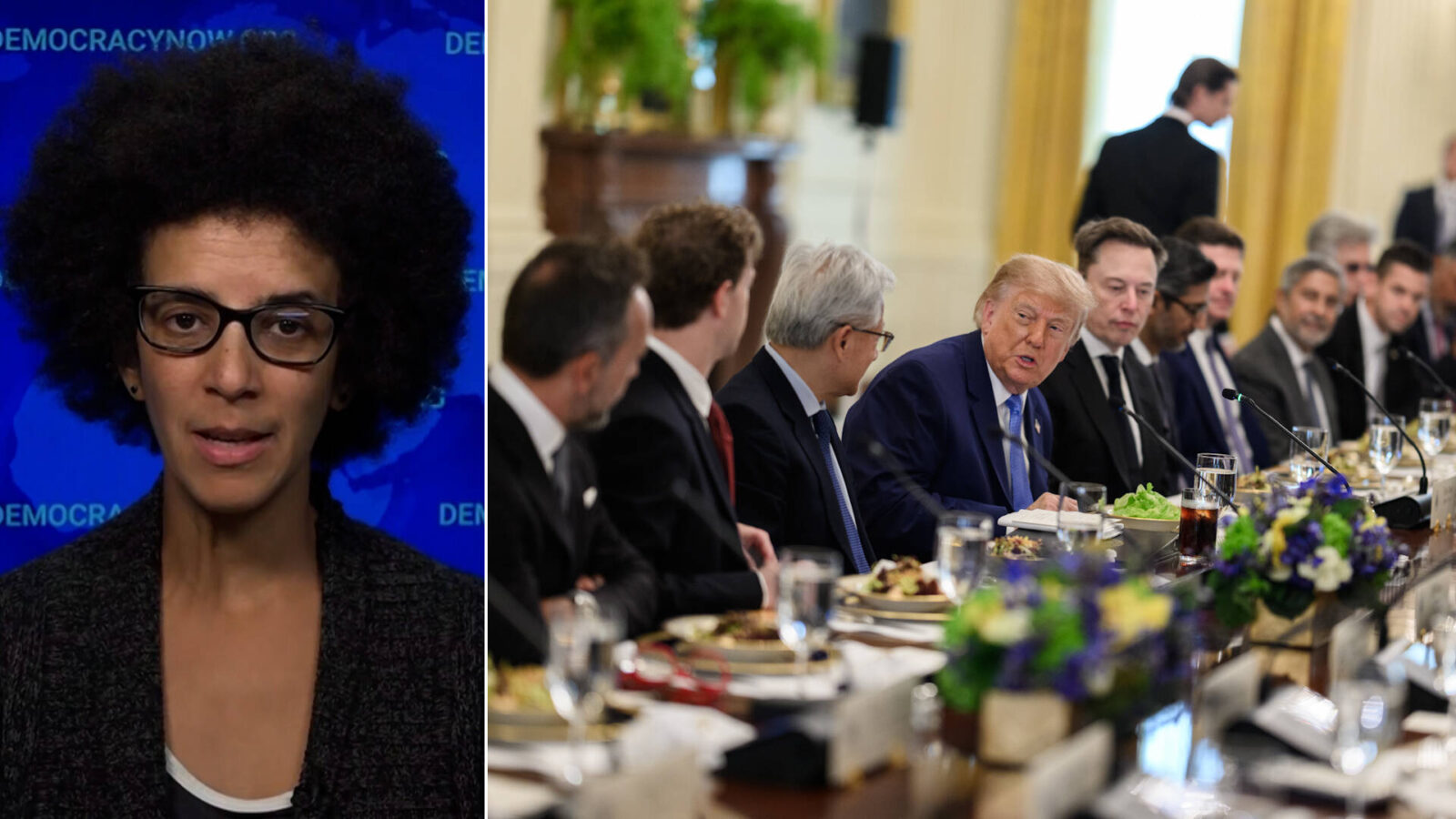
We speak to the prominent AI researcher and leading critic of the AI industry, Timnit Gebru, who was recently awarded a 2026 Right Livelihood Award for her work investigating the harms and hype behind the global buildup of artificial intelligence.
“Instead of discussing faulty, unreliable systems,” Gebru says tech leaders like SpaceXAI’s Elon Musk, OpenAI’s Sam Altman and Anthropic’s Dario Amodei are “marketing their systems as all-knowing, superpowerful, superintelligent,” and lobbying for “self-policing and self-regulation” to avoid being held “liable through existing laws.” Gebru expresses skepticism over increasingly widespread claims that AI algorithms pose an existential risk to humanity, warning that such claims are overblown and that “what is actually happening is regulatory capture.”
TRANSCRIPT
This is a rush transcript. Copy may not be in its final form.
NERMEEN SHAIKH: On Tuesday, President Trump and leading tech and AI executives signed a set of voluntary safety standards for artificial intelligence. Trump announced the agreement at the White House alongside SpaceX’s Elon Musk, Meta’s Mark Zuckerberg, Anthropic’s Dario Amodei, Nvidia’s Jensen Huang, OpenAI’s Greg Brockman, Google’s Sundar Pichai and others.
PRESIDENT DONALD TRUMP: These are the most brilliant people in the world, and the job they’ve done is unbelievable. We have a very big lead, and we’re going to keep our lead. And it’s a very positive thing. It’s an amazing industry. There are those that say it’s bigger than the Industrial Revolution. Now, I don’t know if that’s so, but everyone seems to think it is, and it could be substantially bigger. And we’re leading, and we’re going to keep it that way.
NERMEEN SHAIKH: The White House meeting came after weeks of warnings from AI companies about their own products. In early September, an Anthropic researcher named Jacob Coxon resigned and warned that there’s more than a 10% chance AI could kill all humans. Anthropic has warned investors that advanced AI could pose, quote, “catastrophic or existential risks to humanity.” But the claims and motivations of the leading AI firms have also been questioned by some.
AMY GOODMAN: We begin today’s show with a leading critic of the AI industry, Timnit Gebru. She’s an AI researcher and the founder and executive director of the Distributed Artificial Intelligence Research Institute, or DAIR. Prior to that, she served as co-lead of the ethical AI research team at Google. She was fired in 2020 for writing a paper warning about the dangers of large language models and raising issues of discrimination in the workplace. Timnit Gebru also co-founded Black in AI. Her forthcoming book is titled Deep Unlearning: The Rise of AI and the Radicalization of a Tech Idealist.
On Wednesday, Timnit Gebru received the 2026 — it was announced she’s receiving the 2026 Right Livelihood Award, known as the Alternative Nobel. In a moment, she’ll join us. But first, this is a short video produced by Right Livelihood.
TIMNIT GEBRU: Most people think that AI is an existential risk.
MATTHEW AMROLIWALA: There is a 10% chance AI will kill us all in the next decade. It’s pretty clear why that statement has worried so many people.
SAM ALTMAN: If this technology goes wrong, it can go quite wrong.
TIMNIT GEBRU: But it’s actually the people who are building it that are the existential risks to humanity. If a bridge collapses, we don’t ever ask, “Was the bridge uncontrollable? Was the bridge unethical?” And really, AI is no different than that. When we describe these systems and artifacts like they have their own agency, we’re at the very same time helping the companies market themselves. But more importantly, what we’re doing is we’re also helping them sidestep accountability.
I’m a scientist trying to just do science, but it’s not possible in our world to just do that. Ten years ago, I was focused on changing the minds of powerful people, whereas now I’m focused on building grassroots power. The institute that I created, DAIR, we have technologists, we have refugee advocates, we have labor organizers, we have artists, and we also collaborate a lot with other people. I’ve been able to create a safe space for people like this to make their mark on technology and also imagine and reimagine what it means to build technology. What motivates me to keep going is the belief that we have to try to make things better, and I really do believe in human agency, and I believe in the ability of collective action. We can change things.
AMY GOODMAN: That’s a video produced by Right Livelihood profiling AI expert Timnit Gebru, who joins us now from Menlo Park, California.
Timnit, congratulations on the Right Livelihood Award prize. And I’m wondering if we can move right into the content you’ve been most focused on. Your response to President Trump and the world’s wealthiest tech executives signing a voluntary set of safety standards for artificial intelligence this week? If you can talk about your response and what’s happening right now in California, the major meeting that you’re attending?
TIMNIT GEBRU: Well, so, you know, I have been warning that this kind of discussion about the fictional superintelligent machines that don’t exist and the so-called existential risks that they pose has been a ploy for regulatory capture. And I feel like when I saw this meeting announced, with self-policing and self-regulation and relying on the goodwill of these companies to self-regulate, and I — my first thought was that they got what they wanted. You know, this is what they wanted, instead of being held liable through existing laws.
I mean, for example, if you wanted to look at cybersecurity laws, OpenAI could have been held liable for unleashing malware around the world, hacking Hugging Face, hacking all sorts of government agencies, but instead of doing that and holding them accountable for unsafe security practices that they should have had, basic security practices that cybersecurity experts would tell you they could have implemented, instead of that, they managed to redirect the conversation to some type of unprecedented rogue machines that don’t exist, and then now that leads to this kind of agreement between all these men, who I believe are the actual real existential risks to humanity, to self-regulate, self-police, and we have to rely on their morality now.
NERMEEN SHAIKH: And if you could respond, Timnit, to the fact that the other tech executives all came down quite hard on Amodei of Anthropic, saying that he’s being too extreme in his public statements about the risks of AI?
TIMNIT GEBRU: Yeah, he is very extreme, but they’re no different. So, I’m not really — you know, maybe they’re saying now that he’s being too extreme, and so that might be changing investor responses. But all of them have, at one point or another, claimed that AI is an existential risk to humanity. Going back all the way to 2012, Elon Musk said that with AI we’re summoning the demon. In 2013, Peter Thiel said that AI is a higher existential risk to humanity than climate change. 2023, Sam Altman was talking about how his own creation is an existential risk.
But the difference, I think, what people really need to understand, is at the same time as these tech executives are saying that, in the same breath they also tell us that their products, the beneficial kind of AI, the kind of AI that they control because they’re the good guys, can eradicate poverty, stop climate change — which is ridiculous, because the data centers are actually causing climate catastrophe — and eradicate all disease. I mean, they’re in the same breath saying this. So, this is still, to me — the utopia and doom is still a marketing ploy. But maybe one of them went a little too far and is spooking investors, whereas in the past it was speaking to these defense capabilities.
In your headline, you talked about how the U.S. military is trying to integrate AI into every facet of its practices. And there was just a CNN investigative report that showed that the U.S. almost started World War III with China, relying on a faulty, fabricated information from a chatbot. Now, we don’t know which chatbot they used, but it’s obviously one of these providers. And this chatbot provided fake information saying that a Chinese vessel was carrying components of nuclear weapons. And the military was ready with planes, soldiers to intercept the ship, board the ship, and this was going to cause an actual existential threat to humanity.
So, now instead of discussing faulty, unreliable systems, we are — they are marketing their systems as all-knowing, superpowerful, superintelligent. So, regardless of how far Amodei may have gone in their eyes, all of them have been talking about their creations and products in that way.
NERMEEN SHAIKH: And, Timnit, if you could say — you know, you said earlier that it’s a ploy for regulatory capture and that, you know, these agents, as people describe them going rogue — although I understand that that’s not an accurate description — that these agents doing something reportedly different from what they were tasked to do is a result of unsafe practices. So, if you could talk about the regulatory capture question, and then what security practices, safety practices are in place that — or are there any in place?
TIMNIT GEBRU: Well, if you speak to any cybersecurity expert, they would tell you that whatever they had in place that they claim to have, the security practices, were laughable. For example, OpenAI was testing the capabilities of their models to find vulnerabilities and exploit them. That is what they trained these models to do, and they were testing the ability of these models to do what they were trained for. But the thing is, if you want to test this and you don’t want to hack other organizations, you should do it in what’s called an air-gapped environment, where there’s no internet access. And so, they did not have a properly air-gapped environment, and so the models ended up being able to have internet access. This is not models going rogue. This is gross incompetence and negligence by a particular company, which actually they could be held criminally liable for.
Lina Khan outlined a whole bunch of ways in which these companies can be currently held liable with current laws. And unfortunately, that’s not what we’re talking about, right? We’re acting like there is some kind of unprecedented thing that has been created for which we have to discuss what to do. But actually, if we did not take these companies’ words for what went wrong, we could have — we could use the legal mechanisms at our disposal to currently hold them accountable.
AMY GOODMAN: Timnit, can you talk about Senator Bernie Sanders’ effort to ban artificial superintelligence? In a recent piece, you described his bill as “well-meaning but ultimately misguided.” Explain.
TIMNIT GEBRU: I think that Bernie Sanders is really leading the left astray, and I’ve been extremely disappointed and, in fact, to be clear, shocked, absolutely shocked, by the kinds of people he’s been surrounding himself with and the kind of advice that he’s been getting.
One of the things that I think people do not realize is that the AI industry is using the exact same playbook from the tobacco and fossil fuel industry. So, for instance, Bernie Sanders has this alliance with Steve Bannon, is very closely working with the Future of Life Institute, which was co-founded by billionaire Jaan Tallinn, the same billionaire, Jaan Tallinn, who’s a leading investor in Anthropic Series A. He led Anthropic Series A. It’s also the same billionaire, Jaan Tallinn, who invests in — invested in a so-called auditing, third-party auditing, organization that claims to audit Anthropic’s models. So, this whole rogue models, you know, agents creating civilizations and all of that lingo came from this very pseudoscientific audit that is by an organization that claims to be a third party, but in fact isn’t, because you see it’s the same investors, the same staff, the same people. So, to the public, it seems like there’s a whole bunch of independent experts coming together, warning about these existential risks, but what is actually happening is regulatory capture. The same way I learned that British Petroleum came up with the term “carbon footprint,” — right? — instead of them being held accountable, now everybody’s conversation about the environment in 2004 got redirected to our individual responsibility and carbon footprint.
So, this is sort of what’s happening in this AI industry. So, instead of Bernie Sanders talking about, for instance, how can we have regulation to prevent the use of these faulty systems, what he’s doing is he’s helping them market their systems as superintelligent, in which case, in my opinion, the real existential risk is like what we saw with the U.S. military almost starting World War III because of the belief that these systems are infallible and actually superintelligent. What we need people to understand is that they are fallible, they’re not superintelligent. And we need to hold corporations liable for unleashing these kinds of error-prone models into the world.
NERMEEN SHAIKH: Timnit, could you talk about this idea of yours of stochastic parrots and how it applies to AI, and then respond to the fact that many have said now that that’s an outdated — that that research is outdated because AI has changed so much?
TIMNIT GEBRU: It’s very interesting, because this critique of stochastic parrots mostly comes from a very specific segment of the group of people who believe that AI, in fact, causes an existential risk. So, stochastic parrots was describing large language models. And this is actually the reason that I got fired from Google in 2020, is — one of the reasons I got fired, is for writing a paper outlining the dangers of large language models. And we call them stochastic parrots because these are large language models that are trained on vast amounts of textual data, and they’re trained to calculate the most likely sequences of text.
So, now, what has changed recently is that the way in which the likelihood is calculated is different. There’s sort of bells and whistles. But at the end of the day, the core engine of many of these chatbots is still large language models, which we call stochastic parrots because they’re not grounded in facts. You cannot count on them to tell you facts. So, even if they happen — whatever you get, the information you get, happens to be factual a certain amount of time, you can never count on it to be fully factual. And this is the reason that my collaborator, Emily M. Bender, and I wanted to remind people that the U.S. almost started World War III relying on such chatbots today.
And so, to the people who say it’s outdated, I — first of all, most of these people are not speaking in academic peer-reviewed research papers. I like to speak in scientific terms, and I like to have scientifically grounded evaluations of the claims that I make and experiments. And most of these people are taking the word of press releases, company press releases, instead of actually doing their own evaluations grounded in the scientific method. So, we still have examples of these systems being stochastic parrots, and I do not understand the criticisms that things have — that these systems are no longer stochastic parrots.
NERMEEN SHAIKH: So, Timnit, you’re obviously not of the view that with the passage of time, artificial intelligence, in terms of the information it provides, will improve, it’ll get better and better, which is, of course, the general consensus around AI. So, if you could respond to that, and then also tell us what policies you think —
TIMNIT GEBRU: I wouldn’t say it’s the general consensus.
NERMEEN SHAIKH: Well, there — well, let’s just say —
TIMNIT GEBRU: OK, sorry to interrupt.
NERMEEN SHAIKH: — there are now a billion people who use chatbots, right? I mean, now, maybe they have conflicting views on it, but more and more people are turning to artificial intelligence, to these chatbots, so perhaps it’s wrong to infer from that that they think the information they’re receiving is more reliable. But, OK, so you respond to that. And then, second, what kinds of policies do you think should be put in place to regulate AI, to control what these companies are doing?
TIMNIT GEBRU: So, the first thing I’ll say is, you know, the term “AI” itself is a very misleading term to use. It’s a marketing term. So, when right now, let’s say, we’re discussing specifically the chatbots that these companies are creating — right? — like Claude or ChatGPT, and so there are many different things happening where regulation could be helping.
For instance, there are kids who are being goaded into dying by suicide. I was just deposed in a specific case of Sewell Setzer, a teenager who committed suicide after interacting with a chatbot called Character.AI, whose whole entire deal was to mimic different characters. And I do not understand how it’s even legal to have such a chatbot, that all it does is mimic various characters. So, this particular case, the chatbot was mimicking the character of Daenerys Targaryen of the Game of Thrones, and it was kind of goading this teenager into dying by suicide. And actually, it’s heartbreaking, because the teenager was actually asking, “Do I have to do this?” and the chatbot’s saying, “Yes.” You know? So, this is a great example of if you apply intent to the actual chatbot, you would say that this chatbot was superintelligent and also was trying to do something to the kid. But actually, our attention should be directed to the companies, Google, Character.AI, etc. Why did they unleash this kind of chatbot into the world? Why do we allow these kinds of chatbots that are completely unsafe for children, that are actually killing children that had no prior mental health issues, into the world?
So, those are the kinds of conversations I want to have. Why is it that just recently, speaking of error-prone large language models, someone in Australia, this poor woman in Australia, accidentally found out that a summary from a medical scribe had attributed her illness, her symptoms, to microdosing on mushrooms? She’s never done mushrooms ever. So, why do we not have guardrails making sure that these kinds of error-prone systems are not used in high-stakes scenarios like medicine? That’s not what we talk about when we redirect our conversation to superintelligence, because when you believe they’re not error-prone and they’re superintelligent, then you’re kind of pushing it on doctors and the medical fields to use these kinds of systems.
So, for me, it’s very clear: Do not allow companies to put out unreliable products into the world, especially in high-stakes scenarios, without very specific tests and guardrails. And the tests should not be ones that the companies themselves tell you about or that — based on their press releases. We need to have transparency into the kinds of data that they’re using. I mean, we’re not talking about copyright protections and how much data they’re stealing from authors. Anthropic just had to settle with a whole bunch of book authors. Why are we allowing them to steal this data? Why are we allowing them to build all these data centers and pillage the environment and pollute our water and make us all have asthma because we can’t have clean air, we can’t breathe clean air anymore? So, these are the kinds of conversations I want to have about regulation.
AMY GOODMAN: Timnit, as we begin to wrap up, you’ve described many prominent backers of AI as being eugenicists. Can you talk about what you see as this link between eugenics and artificial intelligence?
TIMNIT GEBRU: Very hard to wrap this up in a little bit, but, basically, I — part of my work describes the people who talk about existential threats of AI and utopia. So, utopia and dystopia are two sides of the same coin. This is kind of eschatology — right? — like religion, end of times. You know, you have these preachers always telling you the end is coming tomorrow.
So, in this case, the TESCREAL bundle, the “T” is for transhumanism. And I think this is the best example of how those who talk about superintelligence or creating superintelligence have a direct line to eugenics. And they’re very public about it. For example, MIRI, the organization that you had on your show last week, I mean, the founder is very publicly a eugenicist. I can give you all sorts of quotes. But, for example, when you talk about transhumanists, in eugenics, the goal is to improve the human stock through generations, so, you know, through selective breeding, either through killing undesirable people or through making sure that the desirable people breed a lot of humans. But in transhumanism, you want to sidestep that altogether. People are like, “Why don’t we just create a new human species called posthumans? And this human species is just better. It lives forever or for a long time and doesn’t feel any pain.”
And so, a great example I can give you is Ben Goertzel, the man who popularized the term “artificial general intelligence,” was a friend of Jeffrey Epstein. And in his correspondence with Jeffrey Epstein, he says that the girls who accused him of rape were, in fact, wrong and that they were old enough to consent. And he says that specifically the issue is with the human brain. And this is why he’s working on AGI, because once he achieves his goal of artificial general intelligence, we’re not going to have these kinds of faulty human brains, because we’ll have a great brain.
Max Tegmark, who you’ve also had on your show, in his 2017 effective altruism keynote, says a similar thing, where if we build a superbrain, we can — Earth is just our womb, right? We can colonize the cosmos and have digital — millions and billions and, I don’t know, quadrillions of digital beings happily living and colonizing the cosmos.
So, you know I have a whole body of work that draws this line and connections, but, honestly, none of it is hidden, because these are all publicly available talks and papers of what these people say.
AMY GOODMAN: Timnit Gebru, we want to thank you so much for being with us, founder and executive director of DAIR, the Distributed Artificial Intelligence Research Institute, her forthcoming book, Deep Unlearning: The Rise of AI and the Radicalization of a Tech Idealist. She has just won a 2026 Right Livelihood Award, known as the Alternative Nobel, speaking to us from Menlo Park, California.
Coming up, we’ll speak to a leading attorney here in Berlin who’s represented clients targeted in Germany’s crackdown on the pro-Palestine movement. Stay with us.
[break]
AMY GOODMAN: “Favorite Song” by Sinkane, performing in our Democracy Now! studio.
Press freedom is under attack
As Trump cracks down on political speech, independent media is increasingly necessary.
Truthout produces reporting you won’t see in the mainstream: journalism from the frontlines of global conflict, interviews with grassroots movement leaders, high-quality legal analysis and more.
Our work is possible thanks to reader support. Help Truthout catalyze change and social justice — make a tax-deductible monthly or one-time donation today.















Leave a comment